
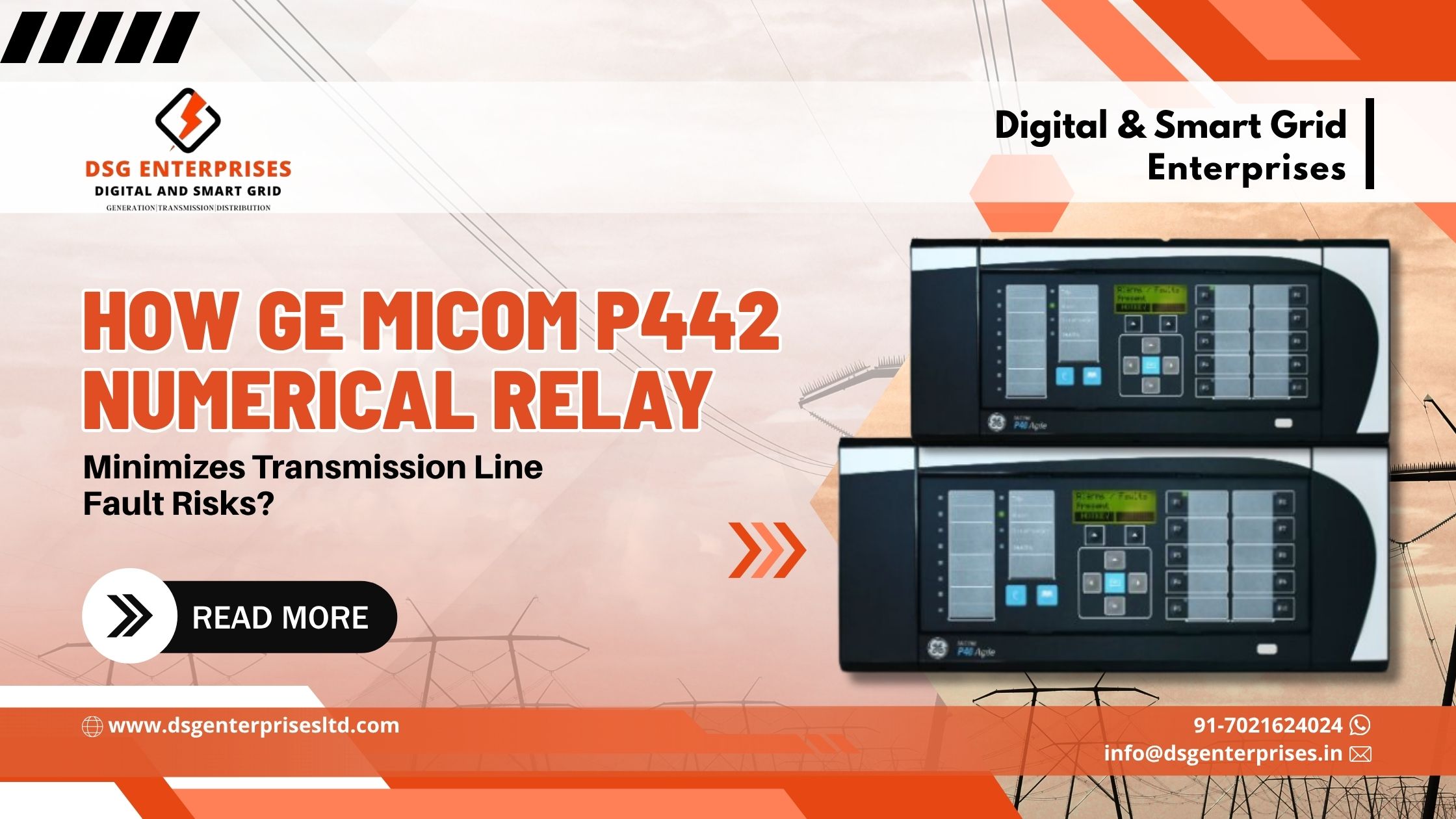
A single undetected transmission fault can black out an entire city in seconds. Utilities cannot afford slow, unreliable protection at critical substations. The GE MiCOM P442 Distance Protection Relay exists to stop faults before they cascade into major outages. This relay detects line faults within milliseconds and isolates the affected zone instantly. As a result, the GE P442 Numerical Relay protects transmission networks from cascading failures, equipment damage, and prolonged downtime.
Transmission lines carry power across long distances, often through harsh weather, heavy loading, and remote terrain. Consequently, fault risks such as short circuits, earth faults, and lightning strikes remain constant threats. The GE MiCOM P442 Distance Protection Relay addresses these risks with dependable, numerical protection logic built for modern grids. Furthermore, it fits easily into both legacy substations and new digital installations.
What Makes the GE P442 Numerical Relay Different?
Traditional electromechanical relays react slowly and require frequent manual calibration. In contrast, the GE P442 Numerical Relay uses digital algorithms to analyze voltage and current in real time. This shift from analog to digital logic changes how utilities plan protection schemes.
This numerical relay combines full-scheme, six-zone distance protection with aided directional earth fault detection. Therefore, it covers both phase faults and ground faults across the entire line length. As a result, engineers no longer need separate devices for each fault type.
- Six-zone distance protection for comprehensive line coverage;
- Dual distance algorithms that boost fault detection dependability;
- Aided directional earth fault protection for ground faults;
- Fast operating times between 0.85 and 1.3 cycles for Zone 1.
A numerical relay is a microprocessor-based device that measures electrical signals and issues trip commands digitally. This speed limits fault duration and protects costly transmission equipment. In short, faster detection means smaller, more manageable outages.
How Does the GE MiCOM P442 Distance Protection Relay Detect Faults?
The relay continuously monitors current and voltage signals from the line’s CT and VT connections. When a fault occurs, superimposed signal changes reveal the fault’s direction and distance instantly. This method works whether the fault sits close to the substation or far down the line.
Engineers rely on this direction-sensing method because it filters out normal load variations. Consequently, the GE MiCOM P442 Distance Protection Relay avoids nuisance tripping during heavy but healthy loading conditions. This reliability matters most during peak summer or winter demand periods.
- Compares predicted and measured voltage-current values continuously;
- Identifies faulted phases through superimposed current comparison;
- Uses directional elements to confirm fault location before tripping;
- Supports single-pole and three-pole tripping for flexible operation.
Why Do Utilities Choose This Relay for Transmission Lines?
Grid operators need protection that survives extreme conditions without failing. Many buyers search for reliable GE P442 Numerical Relay Suppliers because uptime depends on trustworthy hardware. A poor supplier choice can delay commissioning and increase long-term risk.
Utilities across India favor this relay for several practical reasons. It reduces maintenance visits, supports harsh environmental standards, and integrates smoothly into digital substations. Not only that, but it also simplifies spares holding across multiple sites.
- No internal batteries in newer models, which removes a common failure point;
- Advanced binary inputs built to withstand severe electrical surges;
- Compliance with strict cybersecurity standards, including role-based access control;
- Compatibility with IEC 61850-9-2 process bus architecture for digital substations.
Reliable hardware like this reduces long-term maintenance costs for transmission operators. Working with established GE P442 Numerical Relay Suppliers also ensures genuine parts and proper documentation. Comparing multiple GE P442 Numerical Relay Suppliers further helps buyers negotiate better lead times and pricing.
What Role Does Fault Location Play in Grid Reliability?
When a fault trips a line, crews need to find the damage quickly. The GE P442 Numerical Relay calculates the fault’s distance from the relay automatically. This saves valuable time during storm season or emergency repairs.
This built-in fault locator speeds up repair dispatch and restoration. As a result, utilities restore power faster and reduce revenue loss from prolonged outages. Meanwhile, dispatch teams can plan crew routes more efficiently.
- Pinpoints fault distance along the protected line;
- Records fault data for post-event analysis and reporting;
- Supports autoreclose functions to restore service after transient faults;
- Includes check synchronism features for safe breaker reclosing.
Faster fault location directly improves overall grid reliability and customer satisfaction. This feature alone therefore frequently justifies the investment for busy transmission corridors.
Before ordering, it helps to shortlist at least two GE P442 Numerical Relay Suppliers and compare their commissioning support. Understanding GE P442 Numerical Relay Cost at this stage also prevents budget surprises later in the project.
How Does Pricing Compare Across Numerical Relay Options?
Budget planning matters as much as technical performance for procurement teams. Many buyers research GE P442 Numerical Relay Cost before finalizing a substation protection scheme. However, price alone should never drive the final decision.
Pricing depends on configuration, communication modules, and order volume. However, the long service life and reduced maintenance needs often offset the initial investment. In contrast, compromising on quality can end up costing more down the line due to failures.
- Base relay cost varies by protection scheme and communication options;
- Bulk orders from verified suppliers often reduce per-unit pricing;
- Spare parts and calibration costs stay low due to standardized platforms;
- Total cost of ownership typically favors numerical relays over electromechanical types.
Comparing GE P442 Numerical Relay Cost against long-term savings helps buyers make informed decisions. As a result, many EPC contractors budget for this relay early in project planning. Overall, the GE P442 Numerical Relay delivers strong value across its full operating lifetime, from commissioning through decommissioning.
How Should Buyers Select a Trusted Supplier?
Choosing the right supplier affects delivery time, technical support, and pricing. As a distributor of protection relays and switchgear across India, we see this decision matter daily. Hence, we recommend a careful and well-documented selection process.
Buyers should verify authorization status, stock availability, and after-sales support before ordering. Furthermore, working with established GE P442 Numerical Relay Suppliers reduces the risk of counterfeit or mismatched components. When in doubt, ask for factory documentation and test certificates.
- Confirm the supplier holds authorized distribution status;
- Check for local technical support and commissioning assistance;
- Request documented GE P442 Numerical Relay Cost breakdowns before purchase;
- Verify warranty terms and spare parts availability.
The right supplier relationship protects your investment long after installation. Consequently, this step deserves as much attention as the technical specification itself.
What Installation and Maintenance Support Does the Relay Need?
Proper installation determines how well any protection relay performs over its service life. The GE MiCOM P442 Distance Protection Relay requires correct CT and VT wiring, accurate settings, and thorough commissioning tests. Skipping these steps can leave a line poorly protected.
Routine maintenance stays simple compared to older electromechanical designs. As a result, plant teams spend less time on calibration and more time on core operations. In addition, self-diagnostic features flag problems before they cause a missed trip.
- Secondary injection testing confirms CT and VT wiring accuracy;
- Scheduled functional tests verify trip logic remains correct over time;
- Firmware updates add new features without replacing hardware;
- Remote monitoring supports faster troubleshooting across multiple substations.
Consistent maintenance keeps the GE MiCOM P442 Distance Protection Relay performing reliably for decades. This lowers total ownership costs while keeping transmission lines safe.
Technicians generally find the GE P442 Numerical Relay straightforward to commission and test on site. Factoring routine maintenance into your GE P442 Numerical Relay Cost projections gives a more accurate long-term budget.
Conclusion
Transmission networks face constant fault risks from weather, equipment aging, and load stress. The GE MiCOM P442 Distance Protection Relay addresses these risks through fast distance protection paired with directional earth fault detection. Its digital design reduces nuisance tripping and speeds up fault location. It also lowers long-term maintenance demands for utilities and EPC contractors alike. Overall, it gives grid operators a dependable foundation for line security.
Procurement teams evaluating a GE P442 Numerical Relay should weigh technical performance alongside supplier reliability and total cost of ownership. Reach out to an authorized distributor today to discuss availability, pricing, and commissioning support for your next substation upgrade.
At Digital & Smart Grid Enterprises, we provide advanced transmission line protection solutions with the GE MiCOM P442 Numerical Relay, designed to minimize fault risks, improve system stability, and ensure reliable power transmission. With high-speed fault detection, accurate distance protection, and intelligent communication capabilities, the P442 Relay helps utilities and industries reduce outages and enhance network reliability. Click here to inquire about the latest GE Numerical Relays price or discuss your transmission line protection requirements. Contact us at +91 7021624024 or email info@dsgeneterprises.in. Protect your transmission network with proven relay technology and expert support. Connect with our specialists today.