
A single missed signal can turn a minor fault into a costly shutdown. Protection engineers know this risk well. That is why every contact in a relay panel matters.
Auxiliary relays rarely get the spotlight; however, protection schemes depend on them every second. The Hitachi RXMA Auxiliary Relay multiplies contacts, repeats signals, and keeps control circuits dependable. This guide explains its features, applications, and benefits in plain language. It also helps buyers choose a trusted Hitachi RXMA Relay Supplier.
What Is the Hitachi RXMA Auxiliary Relay?
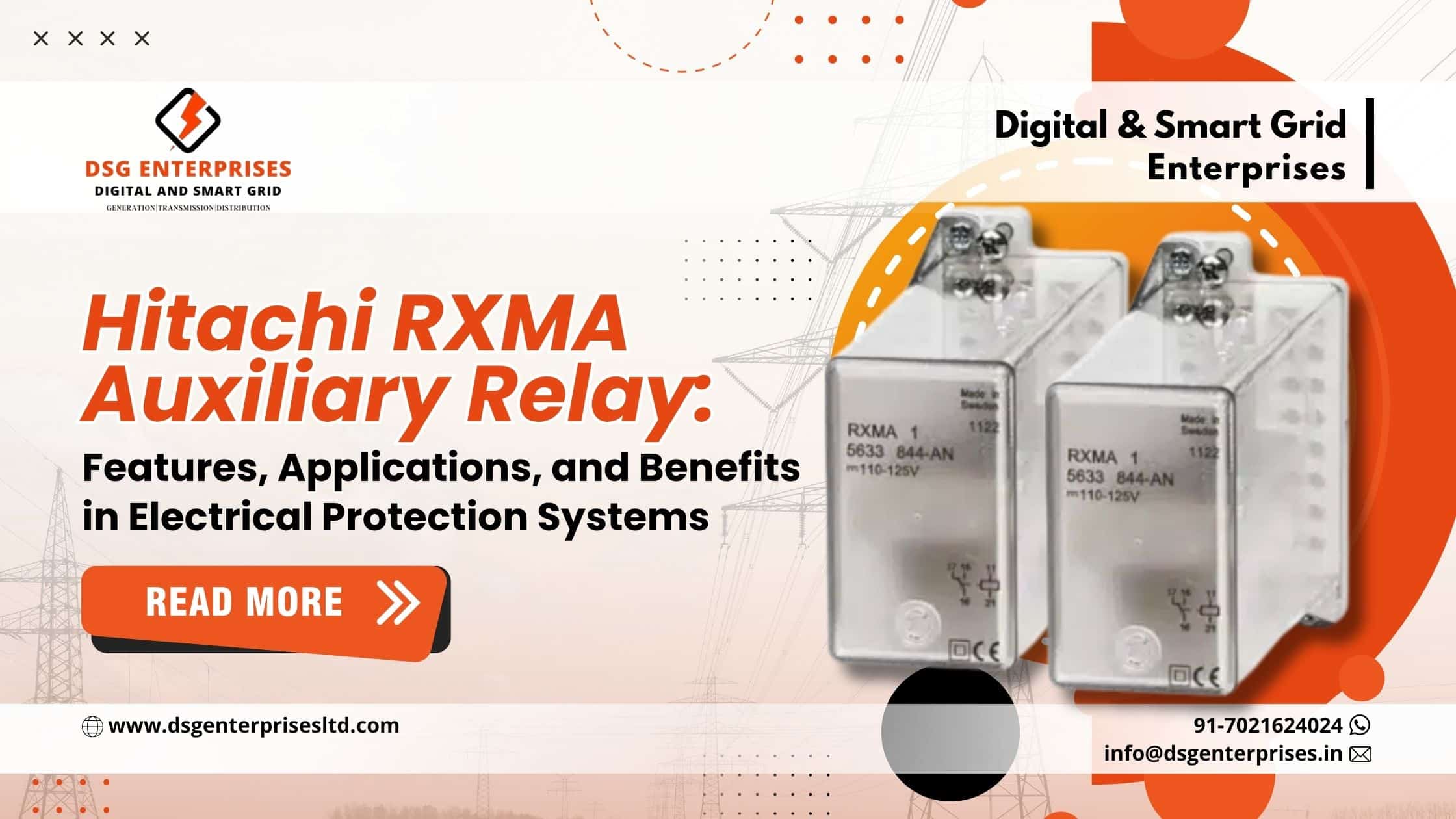
The RXMA series belongs to Hitachi’s range of auxiliary relays. Engineers use it wherever a protection or control circuit needs extra contacts. Furthermore, it fits a single COMBIFLEX modular relay seat, so panel builders save space.
In simple terms, an auxiliary relay works like a messenger. A protection relay detects a fault; the auxiliary relay then passes that command to many devices at once. As a result, one signal reaches several circuits reliably.
Think of a busy control room during a fault. Breakers must trip, alarms must sound, and interlocks must lock. One relay cannot carry all these jobs alone, so auxiliary relays share the work.
Modern numerical relays pack many functions, yet they offer a limited number of output contacts. Therefore, designers add auxiliary relays to extend that reach. This simple step keeps the main relay free for its core protection tasks. The Hitachi RXMA Auxiliary Relay comes in two versions.
- RXMA 1 offers up to 7 contacts for compact control and signaling duties
- RXMA 2 offers up to 15 contacts through a larger terminal plug-in plate
- Shared strengths: low power consumption, long mechanical life, and twin contacts
Key Features of the RXMA General Purpose Relay
Every feature of the RXMA General Purpose Relay targets one goal: dependable switching. The design stays simple, yet it performs well in demanding panels. Consequently, maintenance teams rarely need to touch it.
Bifurcated Twin Contacts
Each contact uses a bifurcated twin design. In other words, the contact splits into two touching points. If one point fails to connect, the other can still complete the circuit.
Why does this matter? Many auxiliary circuits carry small currents, and small currents need clean, firm contact. Therefore, signal reliability improves in dusty industrial plants.
Low Power Consumption
The relay draws very little power from the control supply. Notably, the RXMA 2 carries a burden below 2W. Lower burden means less heat inside the panel; moreover, it eases the load on the station battery. This saving matters when many relays share one supply.
Wide Operating Range and Long Life
The relay works across a wide operating range; this flexibility suits varied station supplies. In addition, its long mechanical life reduces replacement cycles. Meanwhile, the RXMA 1 supports DC operation and handles AC through RTXE diodes. As a result, one relay family suits many station designs.
Compact Modular Mounting
The RXMA 1 fits into a single COMBIFLEX modular relay seat. This standard seat lets designers arrange several relays in neat rows. Furthermore, technicians trace wiring faster during testing and maintenance.
Taken together, these features make the relay a safe default choice. Designers can specify it once and reuse the same approach across many panels. That consistency also simplifies spare-parts planning.
RXMA 1 vs RXMA 2: Choosing the Right Version
Both versions share the same core design; however, they serve different panel needs. Choosing correctly saves wiring effort and panel space. The RXMA General Purpose Relay family covers small and large contact requirements alike.
Start with a simple question: how many contacts does your scheme need? Count trip, alarm, interlock, and indication outputs. Then add a few spare contacts for future changes. Planning prevents costly rework.
When to Select RXMA 1
- Control equipment that needs a few extra contacts
- Contact multiplication inside compact panels
- General signaling and alarm duties
- Protective relay assemblies where space is tight
When to Select RXMA 2
- Tripping and blocking circuits that need many contacts
- Interlocking schemes across several bays
- Breaker-position repeat (mirror) relay duties
- Demanding installations that need many high-quality contacts
Some designers mix both versions in one panel. For instance, they use RXMA 1 for local alarms and RXMA 2 for trip repeat duties. This approach keeps wiring tidy and costs sensible.
Remember the supply too. The RXMA 1 works on DC and uses RTXE diodes for AC. Confirm this detail early to avoid redesign.
Applications in Electrical Protection Systems
Substations, power plants, and factories all rely on layered protection. The Hitachi RXMA Auxiliary Relay supports these layers by handling the many small jobs around a main relay. Each use below shows how a small contact protects a large asset.
- Tripping: the relay forwards a trip command from a protection relay to breaker circuits.
- Blocking: it holds back one function while another condition stays active
- Interlocking: it prevents unsafe switching sequences between breakers and isolators
- Signaling: it sends alarms and status information to annunciators and SCADA inputs
- Contact multiplication: it turns one input into many output contacts
- Breaker-position repeat: it mirrors the breaker’s open or closed state elsewhere
In Substations
Substation panels need many repeated signals. The relay repeats breaker positions for control boards and SCADA. As a result, operators see the true switchgear status.
In Power Plants
Generator and transformer schemes demand fast, clean tripping. The relay multiplies trip contacts so several breakers open together. Furthermore, it supports blocking logic that prevents unwanted operations.
In Industrial Plants
Factories run motors, feeders, and process lines around the clock. The relay passes alarms and interlock signals between panels. Therefore, a fault in one area does not surprise the next.
Imagine a feeder panel in an industrial plant. A numerical relay detects an overcurrent fault. Then the RXMA General Purpose Relay repeats the trip command to the breaker, the alarm window, and the interlock circuit.

Benefits for Engineers, Buyers, and Plant Managers
The right auxiliary relay lowers risk and cost across the whole project life. The Hitachi RXMA Auxiliary Relay delivers value to several groups. Let’s look at each one.
- Engineers: simple wiring, flexible contact counts, and an easy panel layout
- Maintenance teams: long mechanical life means fewer replacements and shorter shutdowns
- Procurement managers: one relay family meets many contact needs, which simplifies stocking
- Plant managers: reliable signaling reduces nuisance failures and unplanned downtime
- EPC contractors: the COMBIFLEX modular seat keeps panel assembly orderly
Moreover, low power consumption supports healthy battery sizing. Twin contacts also reduce the chance of a missed signal. Together, these traits protect both equipment and people.
Consider a real project timeline. Panel builders wire hundreds of contacts before commissioning begins. A relay that wires easily and tests cleanly keeps that schedule on track.
Cost also matters. A reliable relay cuts repeat site visits and emergency replacements. Over many years, those savings exceed the small purchase price.
Safety improves as well. Dependable interlocking and blocking prevent unsafe switching; consequently, field crews work with greater confidence. Finally, standardization helps, because one relay family simplifies training, drawings, and test procedures.
How to Choose a Reliable Hitachi RXMA Relay Supplier
Even a great relay fails your project if the supply chain lets you down. A dependable Hitachi RXMA Relay Supplier protects your schedule and your budget. Therefore, check a few points before placing an order.
- Product range; the supplier should stock RXMA 1, RXMA 2, and related Hitachi auxiliary relays
- Technical support; engineers should help you match contact counts and supply conditions
- Genuine products; ask for datasheets, proper documentation, and traceability
- Clear quotation; the offer should list the exact model, contact count, and supply details
- Delivery; clear lead times prevent commissioning delays
- After-sales help; quick answers matter during site testing
Finally, compare more than price. A low quotation means little if delivery slips. Confirm the model code before you confirm the order.
Conclusion
The Hitachi RXMA Auxiliary Relay proves that small devices carry big responsibility. It offers up to 15 contacts, twin-contact reliability, and low burden. As a result, the RXMA General Purpose Relay suits tripping, blocking, interlocking, and signaling. Consequently, it strengthens protection schemes in substations, power plants, and industrial facilities across India.
Looking to buy the Hitachi RXMA Auxiliary Relay for your electrical protection system? Digital and Smart Grid Enterprises offers Hitachi RXMA Auxiliary Relay solutions for protection and control applications, helping support reliable signal transmission, circuit operation, and coordination between electrical protection devices. For Hitachi RXMA Auxiliary Relay pricing, availability, and technical assistance, contact us at +91 7021624024 or email info@dsgenterprises.in. Our team can help you identify the right relay for your application and provide product selection support. Click here to explore our Hitachi Auxiliary Relays and request a quote for the Hitachi RXMA Auxiliary Relay today.