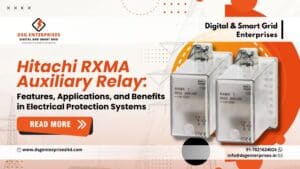
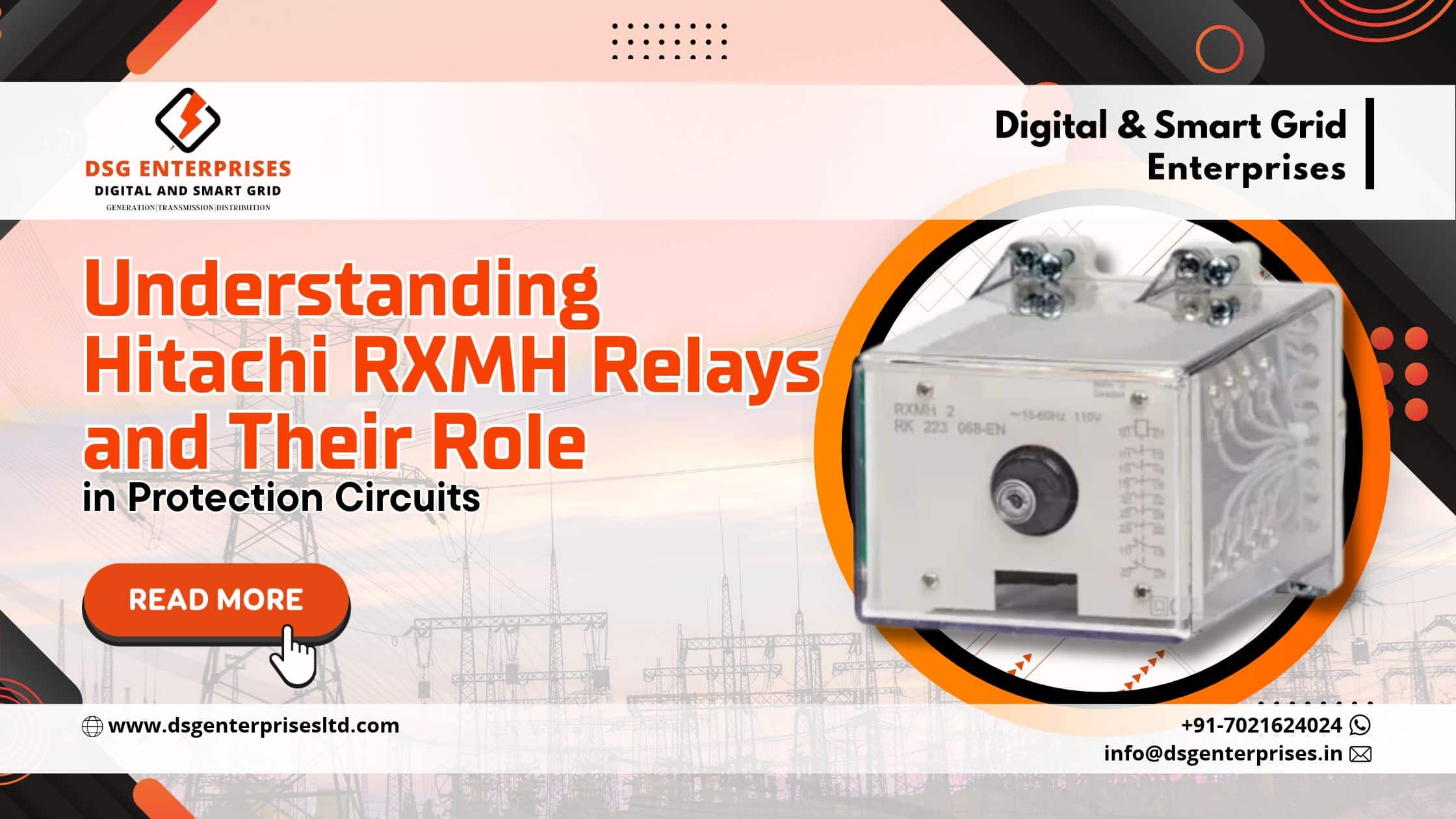
One failed trip command can turn a small fault into a major outage. The RXMH 2 is an auxiliary relay built with RXMH Relay heavy-duty bridge contacts. It works as a tripping relay or multi-contact output relay in protection circuits. Its eight heavy-duty contacts switch demanding loads and resist welding. They pass the trip command from a protective relay to the circuit breaker.
Protection systems depend on many devices working together. The Hitachi RXMH Auxiliary Relay is one of them, and engineers trust it for demanding trip duties. Furthermore, buyers want a reliable Hitachi RXMH 2 Relay Supplier for steady stock and clear support. This guide explains how the relay works, where it fits, and what to check before buying.
What Is the Hitachi RXMH Auxiliary Relay?
An auxiliary relay repeats and multiplies commands from the main protection relay. The RXMH 2 operates as a tripping relay, opening circuit breakers on command to clear faults quickly.
The main relay detects faults and makes decisions, while the auxiliary relay handles switching commands. This separation protects sensitive electronics from heavy trip currents and improves protection system reliability.
A strong trip output helps prevent delayed breaker operation and reduces potential damage to transformers, cables, and other equipment. Since numerical relays have limited output contacts and ratings, an auxiliary relay adds capacity without requiring a panel redesign.
Key RXMH 2 features include:
- Eight heavy-duty contacts: Support trip, alarm, and interlock circuits.
- Optional indicating flag: Manual reset provides clear status indication.
- High breaking capacity: Supports reliable contact operation.
- Contact-welding resistance: Improves trip circuit dependability.
- Compact design: Occupies two mounting seats on the panel.
How Do RXMH Relay Heavy-Duty Bridge Contacts Work?
RXMH Relay heavy-duty bridge contacts handle inductive loads in trip circuits by sharing arc stress across two contact gaps. This reduces contact damage and extends service life.
How the relay operates:
- The protection relay energizes the RXMH 2 coil.
- The armature moves and closes the bridge contacts.
- Current flows to the circuit breaker trip coil.
- The optional flag remains visible after operation.
- An operator manually resets the flag using the cover knob.
The contacts resist welding, helping prevent them from remaining stuck closed. Their high breaking capacity also supports reliable switching.
Inductive loads release stored energy when current stops, creating an arc across the contacts. Two gaps share this stress, reducing damage and helping maintain cleaner contact surfaces.
Reliable contact closure is essential because a failed trip command can prevent the circuit breaker from clearing a fault. Therefore, heavy-duty contacts help improve protection reliability and equipment safety.
Where Does the RXMH Fit in Protection Circuits?
Protection circuits follow a simple chain: a sensing device detects a fault, the main relay makes a decision, and the Hitachi RXMH Auxiliary Relay delivers the trip command. Substations commonly use 110 V or 220 V DC battery supplies for trip circuits.
When to use an auxiliary relay:
- Multi-contact output: Sends one signal to several circuits.
- Alarm and indication: Supports SCADA and annunciation.
- Interlocking and blocking: Coordinates protection schemes.
- Circuit breaker tripping: Energizes trip coils when the main relay sends a protection signal.
Common applications:
- Transformer panels: Trips high-voltage and low-voltage breakers.
- Feeder panels: Repeats trip signals for local and remote indication.
- Generator panels: Supports multiple trip outputs for safe shutdown.
- Busbar and breaker-failure schemes: Extend tripping functions.
During commissioning and planned shutdowns, test the complete trip path, including wiring and the RXMH 2 relay.
For reliable operation, keep trip wiring short and clearly labelled, match the coil voltage to the DC supply, and document every contact assignment and rating in the panel drawings.
Key Benefits for Engineers and Plant Managers
Design teams want devices that stay simple and dependable. The RXMH 2 delivers on both counts. Meanwhile, plant managers value fewer failures and faster fault tracing. Dependable operation can also offset the Hitachi RXMH Relay Price through lower downtime.
The main benefits include:
- High breaking capacity; the contacts switch trip coil loads with confidence
- Welding resistance; contacts stay serviceable after heavy operations
- Operating flag; technicians identify the operated relay quickly
- Push-button check; testers verify operation through a hole in the cover
- Compact build; two mounting seats keep panel layouts tidy
Panel Design Advantages
Panel builders appreciate the high output count. Eight contacts in one unit reduce the number of devices in a panel. Consequently, wiring stays shorter and neater. Fewer devices also mean fewer terminals to inspect.
Maintenance and Testing Advantages
The cover push-button lets testers check operation without dismantling the panel. Meanwhile, the flag shows which relay operated after a trip. As a result, fault analysis starts from clear evidence rather than guesswork. The RXMH Relay heavy-duty bridge contacts also lower the risk of stuck contacts after heavy duty.
Cost and Lifecycle Advantages
Reliable relays reduce emergency site visits. Fewer failures cut spare stock and repair time. Consequently, the total cost of ownership stays predictable. Procurement teams therefore look beyond the purchase quote.
How does the flag help during a fault? It stays visible after the armature releases. Therefore, technicians see the operated relay without searching event logs. This saves valuable time during restoration.
How to Choose a Hitachi RXMH 2 Relay Supplier
Quality matters, but support matters too. A good Hitachi RXMH 2 Relay Supplier offers genuine products, clear documentation, and prompt dispatch. As a supplier of Hitachi auxiliary relays in India, DSG Enterprises Ltd serves utilities, EPC contractors, and industrial plants. Compare every offer against the Hitachi RXMH Auxiliary Relay datasheet before ordering.
Check these points before you buy:
- Genuine Hitachi product; traceable supply and proper packaging
- Matching coil voltage and contact configuration for your panel
- Datasheets and application support from knowledgeable engineers
- Stock availability and realistic delivery timelines
- Warranty terms and responsive after-sales help
What affects the Hitachi RXMH Relay Price? Coil voltage, the flag option, order quantity, and delivery terms all play a part. Therefore, request a written quote that lists every specification. A clear Hitachi RXMH Relay Price quote also helps procurement teams compare offers fairly.
Follow these steps to request a quote:
- Note the coil voltage your panel needs.
- State whether you need the optional flag indicator.
- Confirm the quantity and delivery location.
- Share your delivery timeline with the supplier.
- Ask for datasheets together with the quotation.
Also ask about lead time for repeat orders. Utilities and EPC contractors often need matching batches across projects. A responsive team keeps commissioning schedules on track.
In addition, compare packaging and documentation, because unclear shipments delay commissioning. Finally, get a reference from similar projects.
Frequently Asked Questions
Q: What is the RXMH 2 relay used for?
The Hitachi RXMH Auxiliary Relay acts as a tripping or multi-contact output relay. It receives signals from a protection relay and operates eight heavy-duty contacts for circuit breaker tripping, alarms, and interlocks.
Q: Why does the RXMH use bridge contacts?
The heavy-duty bridge contacts close two points simultaneously, helping distribute arc stress and support high breaking capacity. Their resistance to contact welding improves reliability during demanding switching operations.
Q: How do I choose a supplier for this relay?
Choose a Hitachi RXMH 2 Relay Supplier that offers genuine products, datasheets, and technical support. Check coil voltage, availability, delivery timelines, warranty, and after-sales service before ordering.
Q: What affects the cost of this relay?
The Hitachi RXMH Relay Price depends on coil voltage, the optional flag indicator, order quantity, and delivery terms. Request a written quotation with complete specifications to compare offers accurately.
Conclusion
The Hitachi RXMH Auxiliary Relay plays a quiet but vital role in every protection circuit. Its RXMH Relay heavy-duty bridge contacts deliver trip commands with strength, while the optional flag simplifies fault tracing. Furthermore, clear flag indication helps crews restore supply faster. Consequently, engineers can build safer protection schemes with fewer worries.
Looking ahead, protection schemes will keep growing more complex. Yet the basic need stays the same: a strong command must reach the breaker every time. A well-chosen auxiliary relay makes that possible. Therefore, sound relay selection remains a lasting part of safe grid design.
Looking to buy the Hitachi RXMH Auxiliary Relay? Contact Digital and Smart Grid Enterprises at +91 7021624024 or info@dsgeneterprises.in for pricing, availability, and a quick quotation. Click here to explore our product range and place your inquiry today.