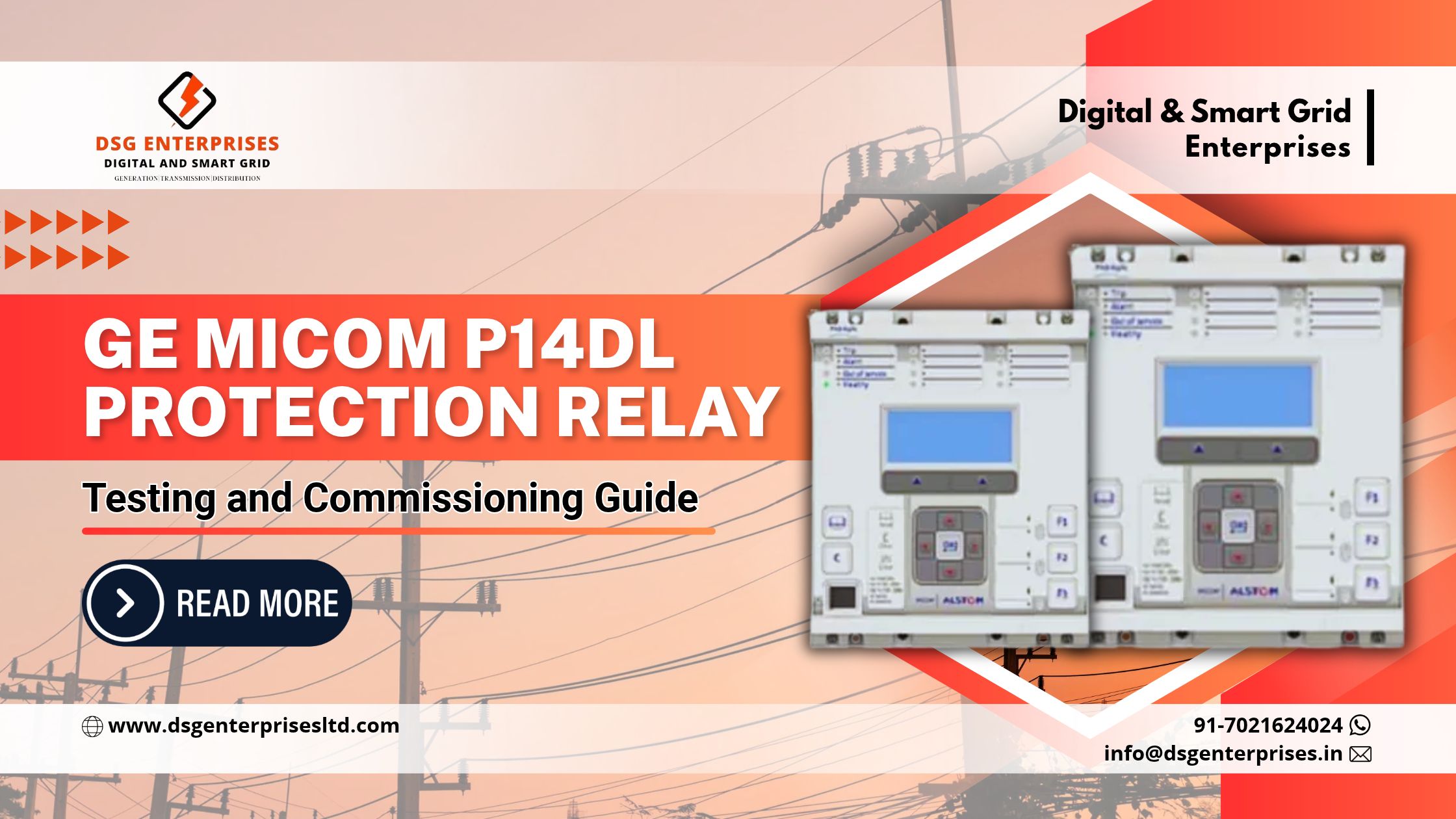
A wrong relay setting can sit unnoticed for years. Then a fault arrives, and the GE Micom P14DL must trip within milliseconds.
Testing and commissioning a distance relay means checking wiring, settings, measurements, and trip logic before energisation. Engineers inspect the panel, inject test signals, verify each protection zone, and confirm trip outputs. A finished checklist proves the GE P14DL Protection Relay will operate correctly during a real fault.
This guide explains each stage in plain language. The GE Alstom P14DL Relay protects critical lines, so every step deserves attention. Furthermore, buyers will learn how to source the GE Micom P14DL with confidence. Clear checklists reduce risk, cost, and downtime for everyone involved.
What Is the GE P14DL Protection Relay?
The GE Micom P14DL from the MiCOM P40 Agile platform protects transmission and sub-transmission lines at all voltage levels. The Micom Agile P14DL Relay supports single circuit breaker schemes with single-pole or three-pole tripping.
Utilities use this relay on critical lines carrying bulk power between substations. Its fast, selective tripping protects equipment, reduces outages, and maintains a stable power supply.
As a distance relay, it measures line impedance to determine fault distance and isolate faults without tripping healthy neighbouring lines. The GE Alstom P14DL Relay provides six distance zones in a full-scheme design, with dedicated measuring elements for each zone.
This design enables fast, selective responses to double-circuit, cross-country, and evolving faults. Therefore, testing teams must verify each zone separately against its protection function.
Key features to test include:
- Dual algorithm distance operation: Improves fault detection dependability.
- Aided directional earth fault protection: Supports communication-assisted schemes.
- Fault locator: Helps maintenance crews locate damaged sections faster.
- Autoreclose and check synchronism: Require separate functional checks.
- IEC 61850-9-2 process bus support: Enables digital substation connectivity through merging units.
- NERC CIP cybersecurity: Uses role-based access control, RADIUS, and SysLog to protect settings.
- Advanced binary inputs: Resist surges and unwanted wiring pickup.
Why Does Commissioning Matter for Distance Protection?
Even the best relay fails when commissioning is rushed. The GE P14DL Protection Relay depends on correct settings, wiring, and instrument transformer ratios. Why does this matter so much? One reversed CT connection can flip the directional decision.
Consider a simple example. A fault occurs near the end of a line, yet the relay waits for a delayed zone. The fault burns longer, equipment stress rises, and neighbouring protection may operate as well.
Zone reach settings need special care. Engineers commonly set Zone 1 at about 80 percent of the protected line impedance. This margin prevents overreach caused by measurement errors.
Commissioning also delivers clear benefits:
- Early wiring fault detection; crews fix problems before energisation
- Verified settings; the scheme matches the approved protection study
- Documented results; audits and future maintenance become easier
- Lower risk; fewer nuisance trips during the first months
Pre-Commissioning Checks Before Energising
Good preparation saves hours on site. What should engineers inspect first? Start with the panel, then move to drawings and settings. Teams working with the GE Micom P14DL should also read the manual beforehand.
Follow this checklist in order:
- Inspect the panel for damage, loose terminals, and correct labelling.
- Verify the auxiliary supply voltage against the relay rating.
- Check earthing; a solid earth connection protects people and electronics.
- Compare CT and VT wiring with the approved schematic drawings.
- Confirm the model code, firmware, and settings file match the approved study.
- Check binary input and output wiring against the trip and alarm schemes.
GE-branded models carry no internal batteries, so the GE Alstom P14DL Relay removes one routine maintenance check. However, engineers should still verify the clock and time synchronization source. Moreover, they should back up factory settings before changing anything. The Micom Agile P14DL Relay also deserves a firmware record for future audits.
How Do Engineers Test the Relay Step by Step?
A secondary injection test simulated signals fed into the relay is essential because it proves logic safely. Use a calibrated test set to check the GE P14DL Protection Relay without live power. Furthermore, keep the approved settings loaded throughout testing.
Follow this sequence:
- Load the approved settings and save a copy of the file.
- Inject balanced three-phase current and voltage; compare displayed measurements.
- Test each distance zone near its reach; verify direction and operating time.
- Check earth fault logic and the aided scheme signals.
- Verify autoreclose, check synchronism, and fault locator outputs.
- Confirm trip contacts, breaker control, and SCADA alarms.
- Complete an end-to-end breaker trip test and record the results.
When should engineers repeat these tests? They should repeat relevant tests after every setting change. Meanwhile, the GE Alstom P14DL Relay supports IEC 61850 communication, so teams must verify data points too. The Micom Agile P14DL Relay also records events; download and archive them.
Finally, review the event and disturbance records after the breaker test. These records confirm timing, signal order, and communication behaviour. Moreover, they give maintenance teams a useful baseline for future comparison. Additionally, compare each result with expected values and tolerances.
Common mistakes to avoid:
- Reversed CT polarity; it flips directional decisions
- Testing with default settings instead of the approved file
- Skipping the final breaker trip test
- Forgetting to restore blocked functions after testing
- Leaving test switches in the wrong position
- Ignoring front panel LED and alarm indications
How to Choose GE P14DL Numerical Relay Suppliers
Buyers need more than a catalogue entry. Reliable GE P14DL Numerical Relay Suppliers deliver genuine units, documentation, and technical support. As a supplier of GE and Alstom protection relays in India, DSG Enterprises Ltd also offers field services. Ask for references from similar projects before you finalise any purchase.
Check these points before you order:
- Authorised sourcing; genuine GE or Alstom products only
- Complete documents; manuals, test certificates, and datasheets
- Commissioning support; technical help during testing
- Clear delivery terms; realistic lead times and packaging
- Training options; engineers learn setting and testing methods
- Spare support; faster replacement when a unit fails
Price needs equal care. The GE P14DL Numerical Relay Price depends on model code, options, and order quantity. Therefore, share the full order code with every supplier. Likewise, compare each GE P14DL Numerical Relay Price quotation on total value, not only the lowest figure.
Engineers should join the buying discussion early. They know which options the project needs. As a result, purchase teams avoid mismatched firmware, wrong ports, or missing accessories.
Before ordering the GE Micom P14DL, confirm hardware options and communication ports. Reputable GE P14DL Numerical Relay Suppliers also share warranty terms openly. Finally, a clear GE P14DL Numerical Relay Price quotation should list taxes, delivery, and warranty. Meanwhile, plan delivery against the shutdown schedule so the relay arrives early.
Frequently Asked Questions
Q: What tests are needed before commissioning this relay?
The GE P14DL Protection Relay needs visual inspection, supply and wiring checks, settings verification, and secondary injection testing. Engineers also test each distance zone, earth fault logic, autoreclose, and trip outputs. Finally, they perform an end-to-end breaker trip test and record every result.
Q: Does the Micom Agile P14DL Relay support digital substations?
Yes. The relay works with traditional CT and VT inputs and also with digital substation designs. It supports IEC 61850-9-2 process bus connections through merging units. Therefore, engineers can plan both conventional and digital commissioning approaches for the same protection platform.
Q: Where can I find reliable GE P14DL Numerical Relay Suppliers?
Choose authorised distributors that offer genuine GE or Alstom products, documentation, and technical support. DSG Enterprises Ltd supplies GE and Alstom protection relays across India. Always request datasheets and confirm the full model code before placing an order with any supplier.
Q: What affects the GE P14DL Numerical Relay Price?
Model code, hardware options, communication ports, and order quantity all influence the final quotation. Delivery time and supplier services also matter. Therefore, request a detailed quote and compare total value instead of the lowest figure alone. Clear documentation helps you avoid hidden costs later.
Conclusion
Careful testing and commissioning protect every line that relies on the GE Micom P14DL. The GE Alstom P14DL Relay rewards teams that inspect, inject, verify, and document each step. As a result, operators gain dependable protection from the first day of service. Good records also help future maintenance teams.
Ready to source the relay? Compare trusted GE P14DL Numerical Relay Suppliers and request a clear GE P14DL Numerical Relay Price quotation today. Contact us at +91 7021624024 or email info@dsgenterprises.in. Plan early, and your next commissioning will run smoothly. Click here to explore our GE Transmission Protection Relay and enquire about the GE P14DL Relay today.