
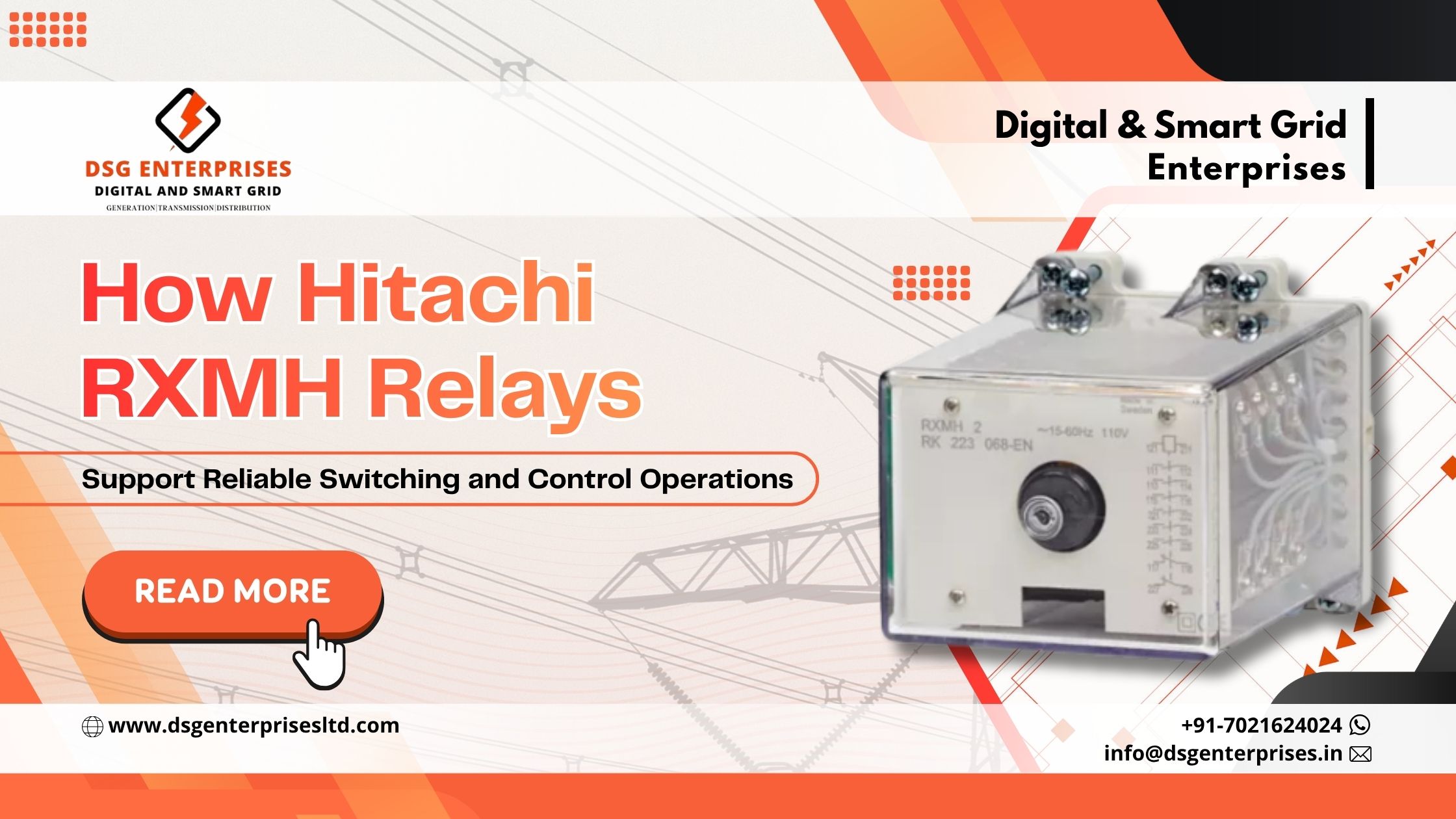
One welded contact can leave a faulty circuit breaker closed. That single failure can turn a small fault into a costly outage. How does the relay support reliable switching? The Hitachi RXMH Auxiliary Relay uses eight heavy-duty bridge contacts to carry and break large control currents. It resists contact welding and offers high breaking capacity. As a result, trip commands reach breakers without delay.
Power plants, substations, and factories across India need output relays that never hesitate. The RXMH Relay’s heavy-duty bridge contacts give protection schemes the strength to switch demanding loads. Furthermore, DSG Enterprises Ltd supplies protection relays across India and acts as a trusted Hitachi RXMH 2 Relay Supplier. This guide explains how the relay works, where it fits, and what buyers should check.
What Is the Hitachi RXMH Relay and How Does It Work?
The Hitachi RXMH Auxiliary Relay, also called the RXMH 2, is built for heavy output duty. Engineers use it as a tripping relay or as a protective multi-contact output relay. Therefore, it sits between a protection device and the circuit breaker.
A tripping relay is the unit that sends the open command to a breaker is essential because it multiplies contacts. Meanwhile, a single fault often needs several actions at once. The breaker must trip, an alarm must sound, and SCADA must log the event.
What happens during a trip? Here is the typical sequence:
- A protection relay detects a fault and sends a signal.
- The coil of the RXMH 2 energises, and the armature moves.
- The bridge contacts close across their fixed points.
- The contacts pass the trip command to the circuit breaker.
- The optional flag becomes visible to mark the operation.
The relay’s eight heavy-duty contacts handle these tasks together; as a result, designers need fewer extra relays. Therefore, wiring stays simple.
Control engineers value this arrangement for a simple reason. Protection devices often have limited output contacts. Moreover, those contacts may not suit heavy breaking duty. An auxiliary stage shares the load and protects the upstream device.
Why use an auxiliary stage at all? It keeps heavy switching away from sensitive protection outputs. Consequently, the main relay lasts longer, and maintenance teams spend less time on repairs. In short, the relay turns one protection signal into many dependable switching actions.
Why Do RXMH Relay Heavy-Duty Bridge Contacts Matter?
Contacts take the most stress in any relay. Every switching event creates heat and sparks. Consequently, weak contacts wear out, stick, or weld shut.
The RXMH Relay heavy-duty bridge contacts tackle this problem directly. A bridge contact — a moving bar that joins two fixed points is essential because it shares arc energy. Each gap absorbs part of the arc; therefore, the contact set lasts longer under load.
Key benefits include:
- High breaking capacity; the relay interrupts heavy control currents safely;
- High contact reliability; trip circuits close when engineers need them;
- Resistance to contact welding; a stuck contact cannot hold a circuit live.
Consider a practical example. A feeder breaker trips after a short circuit on a cable. The relay must close its contacts within moments and carry the trip current. Afterwards, the contacts must still open cleanly when the signal ends.
Furthermore, substations often face repeated operations during a busy year. Each operation adds wear to the contact surfaces. Therefore, a rugged contact design protects long-term reliability and reduces replacement cycles.
Reliability also supports safety. When a trip contact closes on demand, faults clear quickly. Consequently, equipment and people face less risk.
Why does welding deserve so much attention? A welded contact cannot open on command. As a result, a trip coil may stay energised and overheat. Moreover, operators lose control of the very circuit they want to isolate.
Where Does the Relay Fit in Switching and Control Circuits?
Wherever one input must drive many outputs, this relay adds value. Thanks to its RXMH Relay heavy-duty bridge contacts, it suits demanding trip and control duties. Typical uses include:
- Substation breaker tripping; the relay forwards trip commands from numerical relays;
- Control and relay panels; the relay multiplies output contacts for alarms and interlocks;
- Generator and transformer protection; the relay supports multiple trip paths;
- Industrial plants; the relay supports shutdown and isolation circuits.
When should engineers choose it? Select it when a scheme needs many contacts and strong contact reliability. Additionally, the Hitachi RXMH Auxiliary Relay pairs well with numerical relays that have limited output contacts.
Different industries also use the relay in different ways. Utilities rely on it in transmission and distribution substations. Meanwhile, EPC contractors specify it in new control panels for power plants. Plant managers, on the other hand, value it for retrofits and spares.
Consider a protection panel with one numerical relay and four outputs. The scheme needs eight trip and alarm paths. An auxiliary relay with eight heavy-duty contacts closes that gap neatly.
Furthermore, commissioning teams can test each contact quickly before they energise the panel. Consequently, handover moves faster.
Additionally, panel designers should plan the space early. The relay occupies two mounting seats, so layout drawings must reserve room. In short, the relay fits any panel that needs many heavy contacts from one command.
What Features Help Operators Monitor and Test the Relay?
Good visibility saves time during faults. The RXMH 2 offers an optional operating flag indicator. The flag becomes visible when the armature engages. It stays visible after disengagement, so operators can see which relay operated.
Furthermore, a knob on the cover resets the flag manually. The relay also includes a push-button reachable through a hole in the cover. This button supports quick operational checks. However, pressing it may operate real trip circuits, so engineers should isolate the trip circuit first.
A safe routine check looks like this:
- Isolate the trip circuit and confirm the breaker will not operate.
- Press the push-button through the cover hole.
- Confirm the flag appears and the contacts change state.
- Reset the flag with the cover knob.
- Restore the circuit and record the test.
Maintenance teams benefit from these features during inspections. The flag tells them which relay operated after an event. Consequently, fault analysis begins sooner, and restoration moves faster. Additionally, clear records help teams match relay operations with breaker events.
Training also becomes simpler. New technicians can learn the reset and test routine in minutes. Therefore, a plant spreads relay knowledge across its whole maintenance crew.
Why bother with routine checks? They reveal problems before a real fault arrives. As a result, the RXMH Relay heavy-duty bridge contacts stay ready for service. In short, the flag and push-button make the relay easy to read and easy to test.
What Affects Hitachi RXMH Relay Price and Supplier Choice?
Buyers often ask about cost first. However, price alone never tells the whole story. Several factors shape the final quotation:
- Model and options; a version with a flag indicator may differ from one without;
- Order quantity; larger orders often change unit pricing;
- Availability and lead time; stock position affects delivery schedules;
- Documentation and support; genuine supply includes proper datasheets.
Therefore, a low Hitachi RXMH Relay Price can hide risks. Mismatched or non-genuine parts may fail during a fault. A reliable Hitachi RXMH 2 Relay Supplier offers genuine stock, correct documentation, and technical guidance.
Before ordering, buyers should verify these points:
- The exact model and coil rating against the panel drawings;
- The contact arrangement against the protection scheme;
- The delivery schedule against the project timeline.
Planning also reduces cost surprises. Project teams should list every relay in the bill of materials. Then they can request one consolidated quotation. As a result, procurement managers compare offers on equal terms.
Spare parts deserve attention too. Utilities and plants often keep spare relays for fast replacement. Hence, early planning prevents long shutdowns when a unit fails.
A good supplier also answers technical questions quickly. Likewise, the Hitachi RXMH Relay Price should always match the confirmed specification. In short, smart buyers weigh specification, authenticity, and support alongside cost.
Conclusion
The Hitachi RXMH Auxiliary Relay gives protection schemes eight heavy-duty contacts, strong breaking capacity, and welding resistance. Its optional flag and push-button also simplify monitoring and testing. Therefore, it supports reliable switching in substations, control panels, and industrial plants. Buyers who compare the Hitachi RXMH Relay Price with specifications and authenticity make safer choices.
Choosing a dependable Hitachi RXMH 2 Relay Supplier matters as much as choosing the relay itself. Furthermore, the RXMH Relay heavy-duty bridge contacts show how small design details protect large power assets. Reliable control starts with contacts that open and close on command. In the end, every trip circuit is only as strong as its weakest contact.
The Hitachi RXMH Auxiliary Relay plays an important role in electrical switching and control circuits by supporting reliable signal transfer, contact multiplication, and coordinated switching operations. Its use in protection panels and substation control systems helps improve circuit coordination, ensure dependable device operation, and maintain overall system reliability. Selecting the right auxiliary relay also supports efficient control panel performance.
Looking to buy the Hitachi RXMH Auxiliary Relay? Contact DSG Enterprises Ltd for competitive pricing, product availability, and a detailed quotation. Call +91 7021624024 or email info@dsgeneterprises.in. Click here to explore our Heavy-duty compact tripping relay product page and submit your purchase inquiry today.