
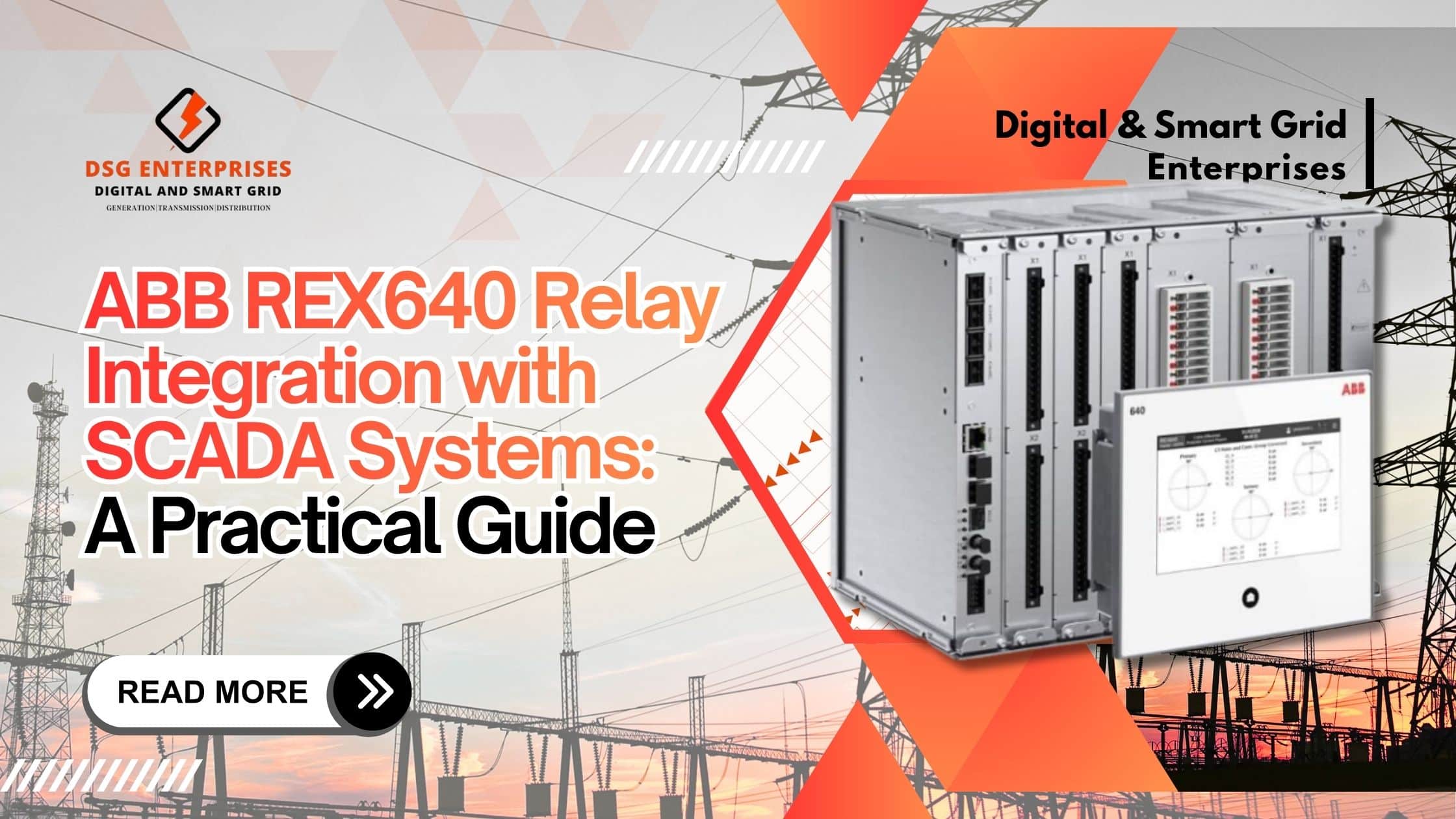
In today’s rapidly evolving power utility landscape, seamless communication between intelligent electronic devices and supervisory control systems has become mission-critical. The ABB REX640 Protection Relay stands at the forefront of this transformation, a sophisticated, multifunctional protection device built. To interface natively with modern SCADA environments. Whether you are a seasoned protection engineer or a systems integrator sourcing solutions, understanding. How to effectively integrate this relay into your SCADA architecture can dramatically improve. Operational efficiency, system reliability, and fault response times.
This practical guide walks through the technical fundamentals, communication architecture, configuration steps, and key considerations for engineers and procurement teams, including insights. On ABB REX640 Numerical Relay Suppliers and ABB REX640 Numerical Relay Price factors that directly impact project planning and budgeting.
What Is the ABB REX640 Protection Relay?
The ABB REX640 Protection Numerical Relay is a next-generation, bay-level protection and control relay developed by ABB. For medium-voltage feeder, transformer, motor, generator, and busbar protection applications. However, designed with a modular hardware architecture and a powerful processing engine. It delivers high-speed, high-accuracy protection functions alongside advanced automation capabilities.
- Platform: Built on ABB’s Relion® 650 series platform, ensuring long-term software consistency and scalability across your entire protection fleet.
- Protection Functions: Supports over 100 IEC 61850-compliant protection and control functions including overcurrent, distance, differential, voltage, frequency, and directional protection.
- Communication Ports: Equipped with multiple Ethernet ports supporting IEC 61850 Edition 2, MODBUS TCP/IP, DNP3, and IEC 60870-5-104 natively out of the box.
- Display & HMI: Features a full-colour graphical display with an intuitive local HMI for on-site engineering, monitoring, and fault record retrieval without requiring a laptop.
- Recording: Provides disturbance recorder, sequence-of-events recorder, and fault locator functions that feed directly into SCADA historian systems for post-event analysis.
Why SCADA Integration Matters for Modern Substations
Moreover, the shift from traditional electromechanical relays to intelligent electronic devices like the ABB REX640 Numerical Relay has fundamentally changed how substation operators interact with protection equipment. Therefore, SCADA integration enables real-time remote monitoring, automated fault isolation, predictive maintenance analytics, and centralized event logging, capabilities that reduce operational costs and dramatically shorten mean time to restoration (MTTR).
- Remote Visibility: Operators gain real-time access to measured values, protection status, and alarm conditions from a central SCADA workstation without dispatching field crews to the substation.
- Automated Control: Breaker operations, protection setting group changes, and interlock commands can be executed remotely through the SCADA system, eliminating manual field intervention.
- Event & Fault Data: Disturbance records and event logs are automatically transferred to SCADA historians, enabling thorough post-fault analysis and regulatory compliance reporting.
- Asset Performance: Metered values from the REX640’s built-in energy metering function support utility-grade billing and load flow analysis directly from the SCADA platform without additional metering hardware.
Communication Protocols Supported by the ABB REX640
The ABB REX640 Protection Numerical Relay is distinguished by its rich native protocol stack. Understanding which protocol aligns with your SCADA platform is the first critical engineering decision in any integration project.
- IEC 61850 Ed. 2 (GOOSE & MMS): The preferred protocol for modern digital substations, enables peer-to-peer protection logic, horizontal communication between IEDs, and vertical reporting to SCADA over a station bus LAN.
- IEC 60870-5-104 (over TCP/IP): Widely adopted by utility SCADA systems globally, ideal for command/response architectures in legacy and hybrid environments with existing RTU infrastructure.
- MODBUS TCP/IP: Suitable for industrial SCADA and DCS platforms where MODBUS remains the communication backbone; uses simple register-based data mapping that is easy to configure.
- DNP3 (Serial & TCP/IP): Common in North American utilities; supports time-stamped data, class-based polling, and unsolicited reporting for efficient bandwidth utilization.
- IEC 60870-5-103: For connecting to legacy protection master stations via serial RS-485 links in brownfield substation upgrade projects.
- PROFIBUS DP: Available for integration into process automation environments where the relay functions alongside PLCs or DCS controllers in industrial settings.
Step-by-Step SCADA Integration Architecture
Step 1 — Define the Communication Layer
Before configuration begins, establish the physical and logical communication topology. The REX640 integrates into a substation LAN via its dedicated Ethernet ports. For IEC 61850 deployments, a redundant RSTP-enabled station bus switch ensures high-availability communication paths to the Gateway RTU or directly to the SCADA server.
- Ethernet Ports: The relay provides two front RJ-45 ports and rear SFP ports, plan redundant ring or star topology depending on your substation LAN design requirements.
- VLAN Segmentation: Separate GOOSE traffic (horizontal) from MMS client/server traffic (vertical) using VLAN tagging on the station switch to prevent broadcast storms from impacting time-critical protection logic.
- Redundant Communication: For mission-critical feeders, configure dual Ethernet ports with PRP (Parallel Redundancy Protocol) or HSR (High-availability Seamless Redundancy), both supported natively by the REX640 hardware.
Step 2 — Configure the IED Using PCM600
ABB’s Protection and Control IED Manager (PCM600) is the engineering tool used to configure the REX640’s protection functions, I/O mappings, and communication parameters. This desktop application generates the IED Capability Description (ICD) file, the foundational document for IEC 61850 substation integration.
- Application Configuration: Define protection function instances, set group parameters, interlocking logic, and auto-reclose sequences within PCM600’s graphical function block editor interface.
- Signal Mapping: Map physical binary inputs and outputs to logical nodes in the IEC 61850 data model; assign GOOSE subscriptions for inter-relay protection communication schemes.
- Communication Settings: Assign IP addresses, VLAN IDs, GOOSE App-IDs, and MMS server parameters, all validated automatically by PCM600 before uploading to the relay.
Step 3 — Configure the SCADA Gateway / RTU
For most utility SCADA systems, a Substation Gateway (RTU or communication processor) acts as the aggregation point, collecting data from multiple IEDs and translating it into the master station protocol (typically IEC 60870-5-104 or DNP3).
- Data Point Mapping: Map REX640 logical nodes (measurements, status, control) to RTU data points; define data object classes for polling priority and threshold-based spontaneous reporting.
- Time Synchronization: Configure SNTP or IEEE 1588 PTP time sync on both the REX640 and RTU to ensure microsecond-accurate time-stamping of events, critical for post-fault sequence-of-events analysis.
- Direct-to-SCADA (Gatewayless): In modern IEC 61850 substation architectures, the REX640 can communicate directly to the SCADA server via MMS, eliminating the traditional RTU layer and reducing communication latency.
Step 4 — SCADA Database Integration and Alarming
- Tag Database: Import REX640 data points into your SCADA tag database (OSIsoft PI, iFIX, Wonderware, ETAP PSMS, etc.) using SCL import tools or manual tag creation via the SCADA vendor’s engineering environment.
- Alarm Philosophy: Configure SCADA alarm priorities aligned with REX640 protection classes, trip alarms as P1/critical, warning conditions as P2/high, and communication alarms as P3/medium priority.
- Trending: Enable periodic metered value reporting (current, voltage, power, energy, power factor) to the SCADA historian for load trending, capacity planning, and regulatory compliance reporting.
Step 5 — Factory Acceptance Testing (FAT) and Commissioning
- End-to-End Communication Test: Simulate protection operations using a secondary injection test set and verify that trip events, measurements, and alarms appear correctly in the SCADA HMI with accurate timestamps.
- Control Test: Verify that SCADA-initiated control commands (CB open/close, setting group change) operate the REX640 outputs correctly, with appropriate access authority levels enforced per user role.
- Cybersecurity Validation: Test role-based access control (RBAC) settings and verify that unauthorized SCADA clients cannot initiate control operations, a mandatory requirement under IEC 62351 cybersecurity standards.
Cybersecurity Considerations for ABB REX640 SCADA Integration
The ABB REX640 Protection Relay incorporates built-in cybersecurity features aligned with IEC 62351 and NERC CIP requirements, essential in today’s threat landscape for operational technology networks.
- Authentication: Supports user authentication with role-based access control, ensuring only authorized personnel can modify protection settings or initiate control commands remotely via SCADA.
- Encrypted Communication: TLS encryption is supported for MMS and web-based communication channels, protecting sensitive data in transit between the relay and upstream SCADA systems.
- Audit Logging: All configuration changes and control actions are logged with timestamps and user credentials, critical for compliance reporting and post-incident forensic investigation.
- Firmware Integrity: Signed firmware packages ensure that only authenticated ABB software updates can be applied to the relay hardware, preventing malicious code injection attacks.
ABB REX640 Numerical Relay Suppliers — Procurement Guidance
Sourcing the ABB REX640 Protection Numerical Relay through the right channel ensures genuine product authentication, proper configuration documentation, and access to ABB’s full technical support ecosystem throughout the project lifecycle.
- Authorized ABB Distributors: Always prioritize purchase through ABB-authorized channel partners who provide genuine hardware, valid warranty cards, factory calibration certificates, and access to PCM600 licensing and updates.
- Regional ABB Offices: ABB operates direct sales and technical support offices across India, the Middle East, Southeast Asia, and Europe, ideal for large utility or EPC procurement volumes requiring project-specific engineering support.
- Independent MV Switchgear Integrators: Many certified ABB REX640 Numerical Relay Suppliers also supply pre-configured relays within medium-voltage panels (VCB panels, RMU units), reducing on-site engineering effort and commissioning time.
- Online B2B Platforms: Verified industrial B2B portals list authorized dealers; however, always request the ABB authenticity certificate and model number confirmation before finalizing procurement from any new vendor.
- Spares & Replacement Projects: For brownfield projects replacing legacy relays, confirm that your selected supplier can provide legacy migration documentation and PCM600 project file conversion services to minimize engineering rework.
ABB REX640 Numerical Relay Price — Key Cost Factors
The ABB REX640 Numerical Relay Price is not a fixed figure, it varies based on several hardware and software configuration variables. Understanding these cost drivers helps project managers build accurate protection system budgets from the outset.
- Hardware Configuration: The base relay price increases with additional I/O expansion modules (binary input cards, output relay cards, analogue measurement modules) required for specific feeder or transformer protection schemes.
- Communication Modules: Ethernet communication cards with PRP/HSR redundancy, optical fibre SFP modules, or serial communication cards for MODBUS/DNP3 are priced as optional hardware additions to the base unit.
- Protection Software Licences: Advanced protection functions such as differential protection, distance protection, and arc flash detection require additional software activation keys priced separately from the base relay unit cost.
- PCM600 Engineering Tool: The PCM600 engineering software licence is a project cost item, always factor in the engineering tool licence cost alongside hardware for an accurate total-cost-of-ownership analysis.
- Quantity & Project Volume: Large utility projects procuring 20 or more relays typically benefit from negotiated volume pricing through ABB regional offices or authorized distribution partners.
- Region & Import Duties: Import duties, local taxes, and freight logistics impact. The final landed cost of the relay, particularly relevant for projects across South Asia, Africa, and Southeast Asia. Where logistics add significantly to project cost.
Indicative Price Ranges (2025–2026):
- Base Relay Unit (standard I/O): USD 2,500 to USD 5,000 depending on region and hardware configuration
- With Full Protection Suite Licences: USD 5,000 to USD 10,000+ for advanced functions, including differential, distance, and arc flash detection
- Complete Panel-Mounted Solution: USD 12,000 to USD 25,000+ when integrated within an MV VCB or RMU panel by a certified OEM integrator
Common Integration Challenges and How to Solve Them
- Interoperability Issues: Not all SCADA systems natively support IEC 61850 Edition 2. Validate your SCADA platform’s MMS client certification against the REX640’s server profile using. The vendor’s IOP test reports before project commencement.
- GOOSE Latency: Ensure GOOSE messages are not routed through managed switches with deep packet inspection enabled. As this adds unacceptable latency to protection-critical inter-relay communication and can compromise scheme performance.
- Time Synchronization Drift: In SCADA environments without IEEE 1588 PTP, SNTP time sync can result in multi-millisecond drift. Implement a GPS-disciplined NTP server at the substation level for accurate event timestamping.
- Configuration File Management: Maintain version control for PCM600 project files and SCL configuration files. Using a dedicated IED configuration management system, especially critical in multi-relay substations with complex interdependent protection schemes.
Conclusion
The ABB REX640 Protection Numerical Relay represents a definitive leap forward in substation intelligence, combining. Comprehensive protection, native multi-protocol communication, and enterprise-grade cybersecurity in a single bay-level device. When properly integrated with SCADA systems using the structured approach outlined in this guide. It transforms a protection relay into a fully networked, data-rich node within your operational technology infrastructure.
For engineers, the REX640 rewards careful engineering discipline, from protocol selection and PCM600 configuration through. To SCADA database integration and cybersecurity hardening. Procurement professionals, engaging authorized ABB REX640 Numerical Relay Suppliers and thoroughly understanding. The total cost drivers behind ABB REX640 Numerical Relay price, ensure both technical and financial project success from day one. For pricing or inquiries, feel free to contact us at +91 7021624024 or email info@dsgenterprises.in. Our experienced technical team is here to guide you at every stage, from choosing the right product to ensuring reliable after-sales support. Click here to explore our complete range of products and learn more.