Feeder faults cost Indian industries several lakhs of rupees every single hour of downtime. A single undetected earth fault can trip an entire production line without warning. That is exactly the risk the GE Alstom P14NB Relay was engineered to eliminate.
In short, the GE Alstom P14NB Relay is a numerical feeder protection device built on the MiCOM P40 Agile platform. It delivers current, voltage, and frequency protection for overhead lines, cables, and busbars. It also supports IEC 61850, Modbus, and IEC 60870-5-103 protocols out of the box.
Feeder protection sits at the heart of every reliable power network. Whether you run a steel plant, a commercial complex, or a utility substation, this relay keeps your feeders safe. It brings transmission-grade engineering down to distribution and industrial voltage levels. This article explains why that matters for buyers across India, and what to check before you specify one.
What Is the GE Alstom P14NB Relay?
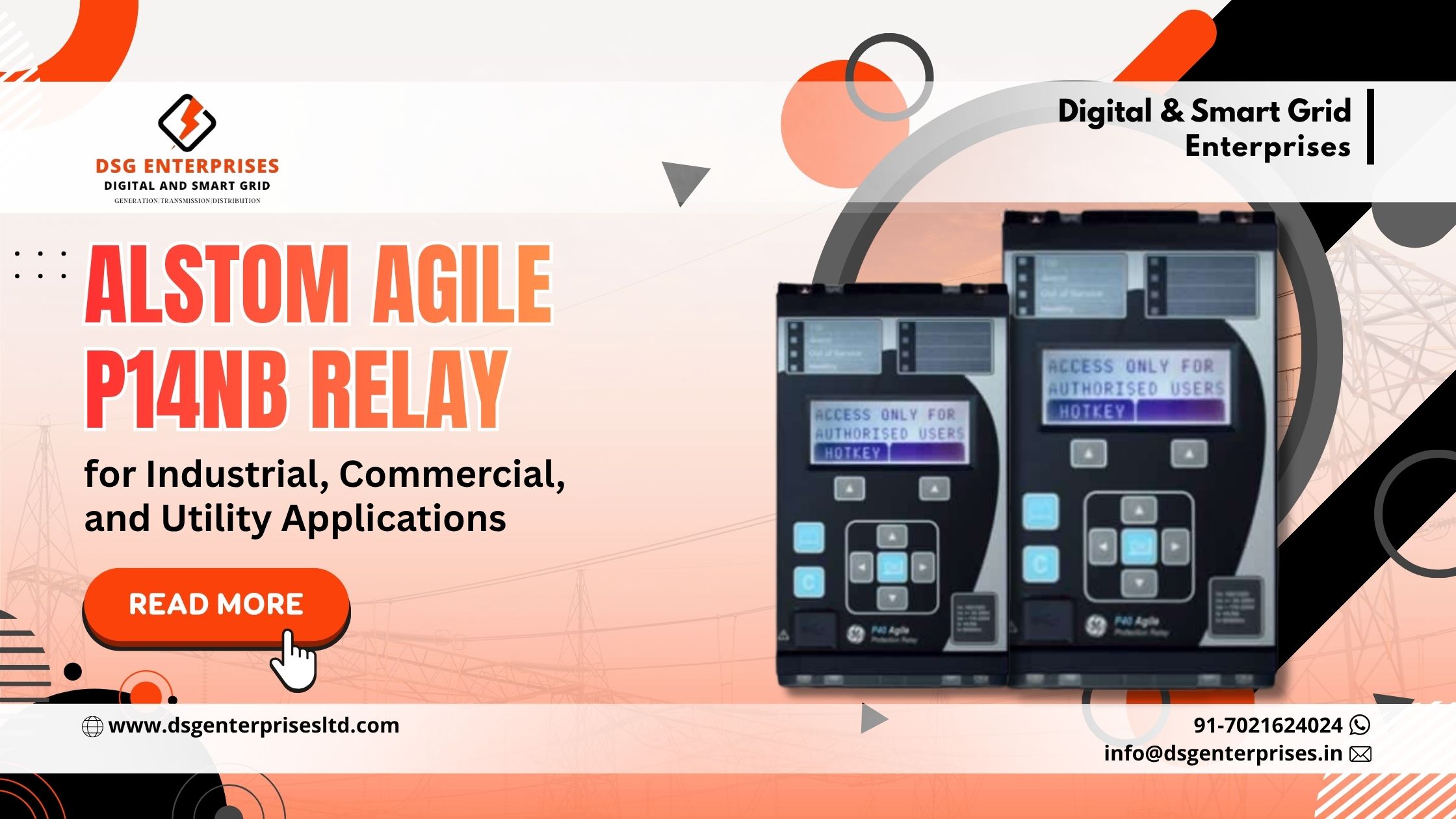
This relay is a non-directional feeder protection IED from the MiCOM P40 Agile family. It integrates the protection, control, and monitoring functions in a single compact unit. Engineers use it for overhead lines, underground cables, busbars, and distributed generation feeders.
A numerical relay is a microprocessor-based device that digitizes signals to detect faults and is essential for modern grids. It replaces slower, bulkier electromechanical relays. This device applies that technology across solidly-earthed, resistance-earthed, and Petersen coil systems alike, without any redesign.
Why does this matter for a buyer? Because one relay platform can now serve nearly every earthing configuration found across Indian industrial and utility networks. Engineers no longer need to stock several relay families for different substations.
This flexibility also supports new-build projects and retrofit upgrades equally well. As a result, plant engineers save on training, spares, and commissioning time. In short, one platform handles nearly every feeder configuration a project might demand.
Why Do Engineers Prefer the P14NB Protection Relay?
Engineers choose the P14NB Protection Relay because it minimizes both footprint and lifecycle environmental impact. GE’s Agile design uses fewer components without sacrificing protection depth. Consequently, panel builders save valuable cabinet space during retrofit projects.
Furthermore, the relay’s multi-stage independent protection elements support a variety of tripping curves. It operates across four separate setting groups, so operators can switch protection profiles quickly during network changes. This proves useful for utilities managing seasonal load shifts or planned outages.
Key reasons engineers specify this relay include:
- Current, voltage, power, and frequency comprehensive protection functions;
- High impedance fault detection, load encroachment, and switch-onto-fault logic;
- Rate of change of frequency protection with full-scheme auto-reclose;
- Transient earth fault detection (TEFD) and synchrocheck functions for parallel networks.
Core Protection and Control Features
Protection quality depends on how many fault conditions a relay can catch before damage spreads through a network. This relay covers an unusually wide protection scope for a feeder-class device. Therefore, it suits demanding industrial loads as well as utility feeders under one specification.
Industry practice recommends redundant protection stages for critical feeders; this relay satisfies that with four independent setting groups. As a result, engineers can pre-configure primary and backup protection without reprogramming during emergencies or fault events.
Notable protection and control capabilities include:
- Multi-stage overcurrent and earth fault elements with selectable tripping curves;
- Load encroachment blocking to prevent nuisance trips during heavy loading conditions;
- Fault locator function for faster line restoration after an outage;
- Full-scheme auto-reclose logic built for overhead feeder resilience.
How Does the P14NB Feeder Protection Relay Handle Metering and Monitoring?
Beyond fault clearance, feeder relays must also support day-to-day monitoring tasks for plant and substation teams. This relay includes comprehensive metering and power-up diagnostics as standard. This helps maintenance teams verify relay health without extra field instruments.
What makes this relay stand out is its two-stage circuit breaker failure detection combined with breaker condition monitoring. Consequently, operators get early warning before a breaker becomes unreliable in service. This reduces unplanned outages significantly across a facility.
Switchgear supervision features include:
- CT and VT supervision to detect wiring or sensor faults early;
- Full trip circuit supervision (TCS) for breaker trip path integrity;
- Switch control and status monitoring for up to eight connected devices;
- Storage for up to 2,048 events and 10.5 seconds of disturbance records.
Advanced Communication Capabilities
Modern substations rely on digital communication as much as they rely on protection logic. This relay supports up to two Ethernet ports, with optional redundancy protocols like RSTP or PRP/HSR. This ensures communication does not fail even if one network path drops unexpectedly.
An IEC 61850 connection, a global standard protocol for substation automation communication, is essential for interoperability. It lets relays, gateways, and SCADA systems exchange data seamlessly. The GE Alstom P14NB Relay supports IEC 61850 and DNP3 running concurrently on the same Ethernet network.
Communication highlights include:
- SNTP or IRIG-B time synchronization for accurate event timestamps across a substation;
- Support for Modbus, DNP 3.0, IEC 60870-5-103, and Courier/K-Bus protocols;
- Concurrent IEC 61850 and DNP3 Ethernet operation without conflict;
- Auxiliary voltage flexibility from 24V to 240V for varied station supplies.
Where Should You Deploy the GE Alstom Agile P14NB Relay?
Deployment flexibility is one of the strongest selling points of this relay family. The GE Alstom Agile P14NB Relay works equally well in industrial plants, commercial buildings, and utility substations. Therefore, one relay specification often covers an entire multi-site rollout across a company.
As a supplier of protection relays across India, we often see this relay specified for steel and cement plants. It also appears in EPC-managed substation projects for state electricity boards and private developers alike.
Typical deployment scenarios include:
- Industrial feeder protection for manufacturing plants and process industries;
- Commercial complex incomers and distribution feeders;
- Utility distribution and sub-transmission feeder protection schemes;
- Distributed generation interconnection points requiring fast fault isolation.
Why Sourcing and Support Matter for Feeder Protection Relays
Buying a numerical relay is not just a technical decision; it is a long-term reliability commitment for any facility. Procurement managers must consider spares availability, testing support, and firmware updates over the relay’s service life. A poor sourcing choice can leave a substation stranded during a critical fault event.
When you specify the GE Alstom P14NB Relay, working with an authorized supplier ensures genuine hardware and proper commissioning support. This matters because counterfeit or grey-market relays often lack proper firmware validation. Consequently, protection coordination studies may not match actual relay behavior in the field.
Consider these sourcing priorities before placing an order:
- Verified authenticity and factory-calibrated settings on delivery;
- Access to type test certificates and IEC compliance documentation;
- Local commissioning and testing support for faster site acceptance;
- Long-term spares and firmware support across the relay’s operational life.
Frequently Asked Questions
Q: What is this GE/Alstom feeder relay used for?
This relay protects feeders, overhead lines, and underground cables in industrial, commercial, and utility networks. It provides overcurrent, earth fault, and load protection, while supporting monitoring and communication through IEC 61850, Modbus, and DNP3. It can also protect busbars, transformers, and distributed generation connections.
Q: How does this relay differ from older electromechanical relays?
This numerical relay uses digital signal processing for faster, more accurate fault detection. It also stores event and disturbance records, supports remote communication, and requires less maintenance than electromechanical relays, reducing downtime and long-term costs.
Q: Which earthing systems support this relay platform?
The relay supports solidly earthed, resistance-earthed, and Petersen coil earthed systems. This versatility allows one relay model to serve different network configurations, simplifying spares planning and technician training.
Q: What communication protocols does this feeder relay support?
The device supports IEC 61850, Modbus, DNP 3.0, IEC 60870-5-103, and Courier/K-Bus protocols. Dual Ethernet ports with redundancy options enable integration with SCADA and substation automation systems.
Conclusion
The GE Alstom P14NB Relay stands out as a versatile, transmission-grade protection device for today’s feeders. It suits industrial, commercial, and utility applications equally well. From multi-stage protection to advanced IEC 61850 communication, this relay covers the full scope of feeder management in one platform.
If your project demands reliable feeder protection with strong local support, this relay deserves serious consideration. Reach out to a trusted GE/Alstom distributor to discuss configuration, pricing, and commissioning for your next substation upgrade.
At Digital & Smart Grid Enterprises, we provide reliable protection solutions with the GE Alstom P14NB Relay, designed for industrial, commercial, and utility power systems. With dependable protection functions, accurate fault detection, and flexible application capabilities, the P14NB helps improve electrical safety, system reliability, and operational continuity. Click here to inquire about the Feeder Protection System price or discuss your protection requirements. Contact us at +91 7021624024 or email info@dsgeneterprises.in. Choose reliable relay protection for your critical power systems. Connect with our specialists today.