
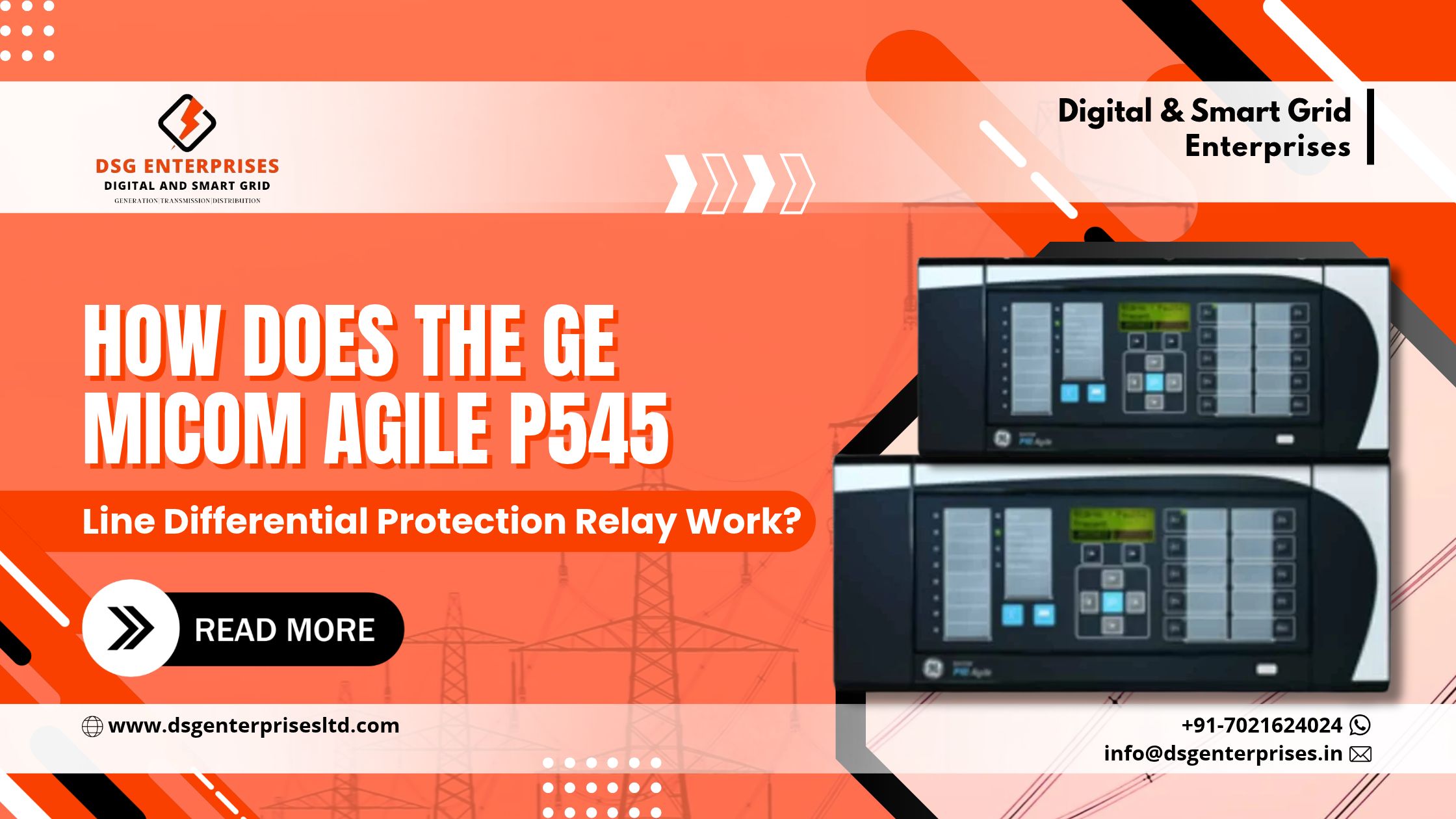
A fault on a transmission line gives protection engineers only milliseconds to act. The GE MiCOM P545 answers by watching both ends of the line at once.
The GE MiCOM P545 Line Differential Relay works by comparing the current entering a line with the current leaving it. Relays at each end share measurements over a communication channel. If the two values do not match, a fault exists inside the line. The relay then trips both breakers within about one cycle.
The MiCOM Agile P545 Protection Relay belongs to the MiCOM P40 Agile family, which GE inherited from Alstom. Utilities use it on overhead lines and cables at transmission voltage levels. This guide explains the working principle in plain language. Furthermore, it covers features, communication links, and buying points.
What Does the MiCOM Agile P545 Protection Relay Protect?
Utilities use the MiCOM Agile P545 Protection Relay for high-voltage overhead lines and underground cables. It supports two- and three-terminal line protection across HV and EHV networks. The relay also provides distance and earth-fault backup functions.
Key protection and control features include:
- Phase-segregated current differential (ANSI 87): Monitors each phase independently.
- Distance protection (ANSI 21): Provides backup protection if the communication channel fails.
- Directional earth-fault protection: Detects earth faults, including high-resistance faults within its operating range.
- Single- and three-pole tripping: Supports different tripping modes based on fault conditions.
- Autoreclose and check synchronising: Supports supply restoration after temporary faults.
- Breaker failure protection: Initiates backup tripping if the main breaker fails to open.
- Fault location: Estimates the distance to the fault to assist maintenance teams.
- Programmable scheme logic: Allows engineers to configure trip and alarm logic for site requirements.
Why does an integrated design matter?
Combining multiple functions in one relay can reduce the number of relay types, simplify maintenance, and lower spare-part requirements. Engineers can enable the functions required for each application. Some utilities also use two relays per line to provide redundant main protection.
Consider a 220 kV line connecting two substations. If lightning causes an insulator flashover, the differential protection detects the fault and initiates tripping. With suitable communication and system configuration, both ends can isolate the faulted line section.
The fault locator estimates the fault distance, while event records capture data for analysis. Engineers can review these records to investigate the fault.
Overall, the MiCOM Agile P545 Protection Relay combines line differential protection, backup functions, and reclosing capabilities in one platform.
How Does the GE MiCOM P545 Line Differential Relay Compare Currents?
The operating principle is based on Kirchhoff’s Current Law. Current entering a healthy line should equal current leaving it. Any significant difference may indicate an internal fault.
A differential relay compares currents at both line ends to detect faults within the protected zone. It provides fast, selective protection without relying on time delays for coordination with neighbouring relays.
How does the differential protection work?
- Current measurement: CTs at both line ends measure the phase currents.
- Digital sampling: The relay converts measured currents into digital values.
- Data exchange: It sends current samples to the remote relay through a communication channel.
- Current comparison: Each relay compares local and remote currents for every phase.
- Fault detection: If differential current exceeds the configured bias threshold, the relay initiates tripping.
How does the relay prevent false tripping?
The relay uses a dual-slope bias characteristic to maintain stability during heavy through-current conditions. This helps prevent unwanted operation caused by CT errors or saturation.
At higher through-currents, the bias increases to improve stability. At lower currents, the relay maintains sensitivity to internal faults. Engineers configure both slopes according to line and CT requirements.
Why does operating speed matter?
At 50 Hz, one cycle lasts 20 milliseconds. Therefore, a trip within approximately one cycle provides a fast response to internal faults.
In simple terms, the relay trips when the currents measured at both line ends differ beyond the configured operating threshold.
How Does the P545 Keep Differential Protection Secure?
Speed means little without security. A relay that trips for healthy conditions can cause an outage as costly as a missed fault. Real lines carry charging current, unequal CTs, and noisy signals. The GE MiCOM P545 Line Differential Relay handles each challenge with a dedicated feature.
- Charging current compensation; long lines and cables draw capacitive current that would otherwise look like a fault.
- CT ratio compensation; the relay copes with mismatched ratios, even 1 A versus 5 A secondaries
- CT supervision; it compares negative sequence current at both ends to find a failed CT
- Neutral differential; it boosts sensitivity to resistive earth faults on heavily loaded lines
- Backup elements; overcurrent protection can run permanently or only during channel outages
- Direct intertripping; the relay can send a trip command to the remote end through the same channel
A current transformer, a device that scales line current to a safe level, is essential because the relay trusts it. Therefore, engineers should verify CT ratios and polarity during commissioning.
Why does this matter? A wrong polarity can make a healthy line look faulty. Likewise, a failed CT can create a false differential current.
The supervision feature spots these problems before they cause a wrong trip. Commissioning tests should therefore include a through-fault stability check and a channel delay test. Overall, these features keep the relay fast without sacrificing security.
How Do Communication Channels Link the Line Ends?
Differential protection requires a reliable communication channel between both relays. Engineers can select different link types based on network availability. Both ends must also synchronise their current samples accurately. The GE MiCOM P545 Line Differential Relay monitors active communication channels independently.
Key communication options include:
- Direct optical fibre: Supports 850 nm, 1300 nm, and 1550 nm wavelength interfaces.
- Multiplexed links: Connects the relay to standard communication equipment through interface units.
- GPS synchronisation: Uses a P594 module when transmission and reception paths differ.
- Dual channels: Provides a backup link during primary channel failure.
- Rear-port protocols: Supports Courier, IEC 60870-5-103, DNP3.0, or IEC 61850, depending on the ordered configuration.
How do both relays synchronise their data?
The relays exchange timing information along with current samples. They calculate communication delays and align the received data for accurate comparison.
What happens if the communication channel fails?
The relay can use backup distance or overcurrent protection elements. These can operate as permanent parallel protection or as fallback protection, depending on the configuration. Channel error statistics also help engineers identify communication problems early.
When is GPS synchronisation required?
GPS synchronisation is useful when multiplexed networks use different transmission and reception paths. A GPS timing pulse helps align sampling clocks at both ends.
Overall, reliable communication and accurate synchronisation are essential for effective differential protection.
What Should Buyers Know About GE P545 Relay Suppliers and GE P545 Relay Price?
A line protection relay can remain in service for decades, making supplier support as important as cost. Authorised GE P545 Relay Suppliers should provide genuine products, order code guidance, and warranty support.
As a supplier of GE and Alstom protection relays in India, DSG Enterprises Ltd understands the key factors affecting the GE P545 Relay Price:
- Order Code: Hardware options determine the available inputs, outputs, and communication ports.
- Communication Interface: Fibre and multiplexed link options affect the configuration.
- Protocol Choice: The rear-port protocol is selected during ordering.
- Accessories: GPS modules and test blocks can increase the total cost.
- Lead Time: Stock availability influences delivery schedules.
- Warranty: Manufacturer coverage and local service support help protect the investment.
- Documentation: Manuals and setting software support installation and commissioning.
How to Choose the Right Supplier
Supplier reliability is equally important. Genuine products should include factory documentation and traceable serial numbers. Unverified refurbished or counterfeit units may affect protection system reliability.
Before purchasing, request the complete order code from each GE P545 Relay Supplier. Compare technical support, commissioning assistance, warranty terms, and spare-part availability. This helps prevent configuration mismatches and procurement delays.
Also, verify the firmware version and required documentation before approving the purchase order. A complete order code and reliable supplier help keep procurement costs and project schedules under control.
Frequently Asked Questions
Q: What does the GE MiCOM P545 Line Differential Relay protect?
It protects overhead lines and underground cables with two or three terminals. Its functions include phase-segregated differential protection, distance protection, directional earth fault protection, and single-pole or three-pole tripping. It also supports autoreclosing and check synchronising.
Q: Does the MiCOM Agile P545 Protection Relay need a dedicated fibre link?
No. It supports direct optical fibre and multiplexed networks through suitable interface units. GPS synchronisation helps when transmission and reception delays differ. Backup distance or overcurrent elements can protect against communication failures.
Q: Who are reliable GE P545 Relay Suppliers in India?
Reliable suppliers provide genuine relays, complete documentation, and order code guidance. DSG Enterprises Ltd supplies GE and Alstom protection relays across India. Buyers should verify the order code, firmware requirements, and communication options before purchasing.
Q: What affects the GE P545 Relay Price?
The price depends on hardware options, communication interfaces, selected protocols, and accessories such as GPS modules. Delivery time and supplier support also affect the overall cost. Suppliers generally prepare quotations using the complete order code.
Q: How does the relay avoid false trips?
It uses a dual-slope bias characteristic, charging current compensation, and CT supervision. The bias characteristic improves stability during heavy through-current conditions. CT ratio compensation addresses mismatched secondary currents, while neutral differential protection improves sensitivity to resistive earth faults on loaded lines.
Conclusion
The GE MiCOM P545 Line Differential Relay compares current at every line end and trips only for internal faults. Charging current compensation, CT supervision, and flexible communication keep the MiCOM Agile P545 Protection Relay both fast and secure. As a result, utilities trust it on critical transmission circuits. Its universal design also reduces spares and training for maintenance teams.
Engineers should weigh protection features, communication needs, and the GE P545 Relay Price together when planning a line scheme. DSG Enterprises Ltd also supplies related GE MiCOM models, such as the P742 busbar differential relay. Ultimately, a protection scheme works best when its designers understand how the relay thinks. That understanding turns a complex device into a dependable guardian of the line.
The GE MiCOM P545 Line Differential Relay provides advanced protection for transmission lines and cables through differential protection, fault detection, and high-speed tripping. Its advanced protection functions and communication capabilities help isolate faults quickly, minimise equipment damage, and improve overall power system reliability. Looking to buy the GE MiCOM P545 Line Differential Relay? Contact DSG Enterprises Ltd for competitive pricing, product availability, and a detailed quotation. Call +91 7021624024 or email info@dsgeneterprises.in. Click here to explore our GE Busbar Protection System range and submit your purchase inquiry today.


