
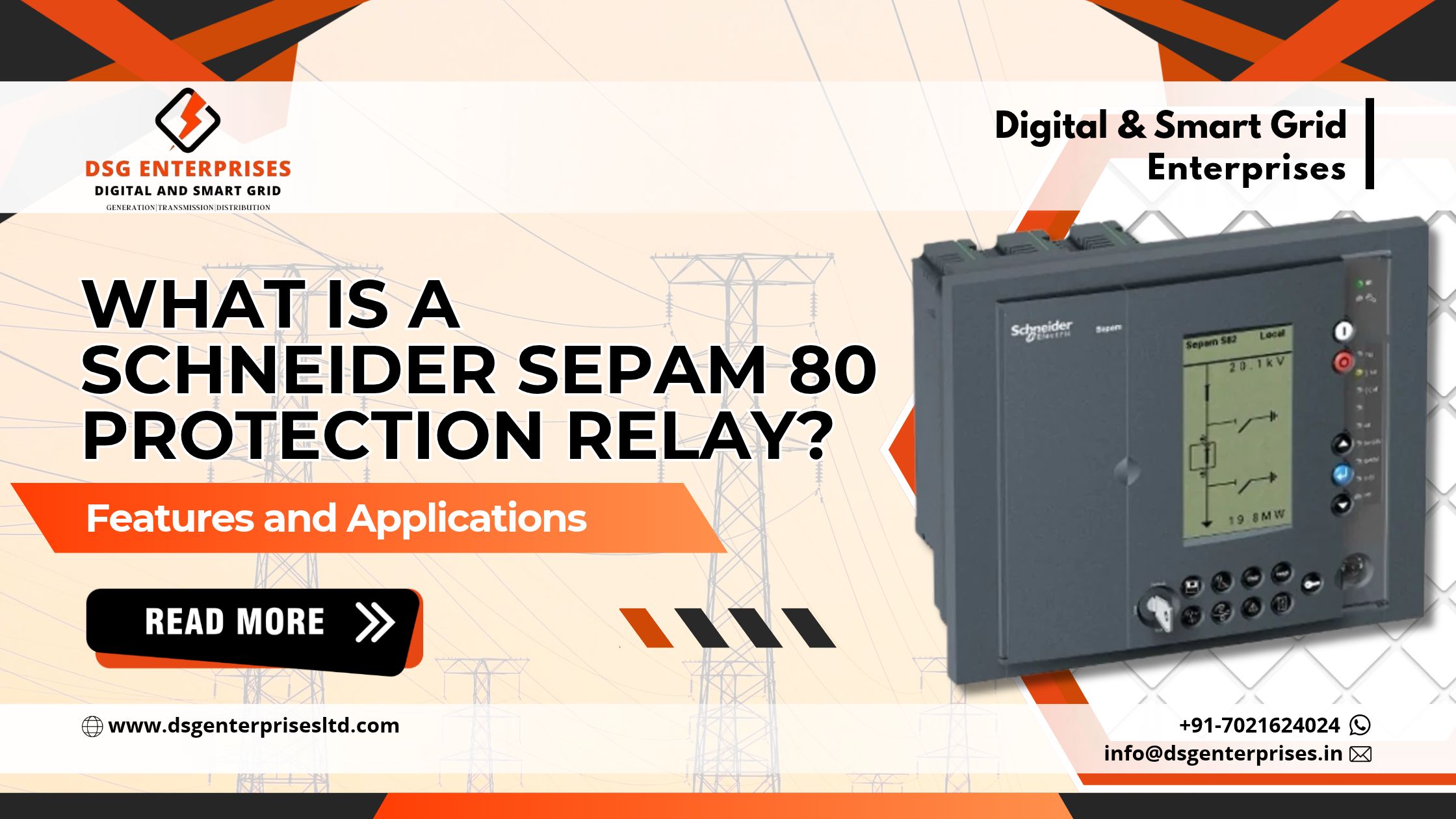
Power systems fail without warning. A short circuit, an overload, or a voltage dip can damage costly equipment in seconds. That is why every medium voltage network needs a reliable protection relay.
The Schneider SEPAM 80 Relay is one of the most trusted options for this job. It watches your electrical system around the clock, detects faults fast, and trips the right breaker before damage spreads.
In this guide, you will learn what the relay is, how it works, what features it offers, and where engineers use it. We also explain how to choose the right model and supplier.
What Is a Schneider SEPAM 80 Relay?
The Schneider SEPAM 80 Relay is a digital protection and control relay made by Schneider Electric. It belongs to the Sepam family, which covers medium voltage protection from simple feeders to complex machines.
Think of it as a smart guard for your switchgear. It measures current, voltage, and other values in real time. When it spots a problem, it sends a trip command to the circuit breaker. It also records the event so your team can study what happened.
The Schneider SEPAM Series 80 Protection Relay sits at the high end of the Sepam range. It suits demanding applications where you need more inputs, more protection functions, and more flexibility than a basic relay offers.
How Does the SEPAM 80 Relay Work?
The relay follows a simple cycle. First, current and voltage sensors feed signals into the unit. Next, the relay compares these readings with the limits you set. If a value crosses a limit for too long, the relay acts. Finally, it trips the breaker, raises an alarm, and logs the event.
Because the relay is digital, it reacts in milliseconds. It also works with many protection curves, so you can match it to your network’s needs.
Key Features of the Schneider SEPAM 80 Relay
Here are the main features that make this relay popular with engineers:
- Wide protection range: The relay covers overcurrent, earth fault, directional, voltage, frequency, and thermal protection in one device.
- Differential protection: Select models protect transformers, motors, and generators with differential functions (ANSI 87T, 87M, and 87G).
- Advanced user interface: A large screen shows a mimic diagram of your cubicle, so operators can read the status at a glance.
- Programmable logic: You can build custom control logic with Logipam, a ladder-based tool, instead of adding extra hardware.
- Flexible inputs and outputs: Optional modules add more digital inputs, relay outputs, and analog connections.
- Temperature monitoring: Add-on modules read RTD sensors, which helps you protect motors and transformers from overheating.
- Strong communication options: The relay supports Modbus and IEC 61850, among other protocols, so it connects easily to SCADA systems.
- Disturbance recording: The relay captures fault data and waveforms, which speeds up root cause analysis.
- Modular design: You can start simple and add modules later as your site grows.
SEPAM Series 80 Models and Their Uses
Schneider groups the series by application. Each family carries a letter that tells you where it fits best.
- S80 family (substation): These relays protect incoming lines, feeders, and busbar sections in a substation.
- T80 family (transformer): These units guard power transformers and include differential protection for fast fault clearing.
- M80 family (motor): These models protect motors and add functions such as start-up control and thermal overload.
- G80 family (generator): These relays protect generators and generator-transformer units against internal and external faults.
- B80 family (busbar): These devices monitor voltage on busbars and support load shedding and similar tasks.
- C80 family (capacitor): These relays protect capacitor banks from unbalance and overload.
Always check the exact model code before you buy. The right letter and number make a big difference in function and cost.
Where Do Engineers Use the SEPAM 80 Relay?
This relay fits many industries. Below are the most common applications:
- Utility substations: Utilities use it to protect feeders and incoming lines in distribution networks.
- Oil and gas plants: Operators rely on it to protect large motors and generators in harsh sites.
- Cement and steel plants: These plants run heavy motors, so they need strong thermal and start-up protection.
- Power generation: Generator sets use the relay for stator, rotor, and loss-of-field protection.
- Data centers and hospitals: These sites cannot afford downtime, so they use the relay to isolate faults quickly.
- Water and wastewater plants: Pumps and motors run for long hours here, and the relay keeps them safe.
- Mining and marine sites: Engineers choose it for its stable performance in tough conditions.
Benefits of Using a SEPAM 80 Relay
Why do so many teams pick this relay? Here are the top reasons:
- Higher safety: Fast fault clearing protects both people and equipment.
- Less downtime: Accurate trips isolate only the faulty section, so the rest of the plant keeps running.
- Lower cost over time: One relay replaces several single-function devices, which saves space and wiring.
- Easy maintenance: Self-diagnostics alert you to issues before they become failures.
- Better data: Event logs and waveforms help you fix root causes, not just symptoms.
- Future-ready design: Modular add-ons let you expand without replacing the whole relay.
In addition, the familiar Sepam setup software makes commissioning simple. Technicians who know other Sepam relays learn this one quickly.
How to Choose the Right SEPAM 80 Relay
Picking the wrong model wastes money and time. Follow these steps:
- Define the application: Decide whether you protect a feeder, transformer, motor, generator, or capacitor bank.
- List the protection functions: Note every function you need, such as differential, directional, or thermal.
- Count your inputs and outputs: Add up your digital I/O and sensor needs, and plan for optional modules.
- Check the communication needs: Confirm that the relay supports your SCADA protocol.
- Review the sensor type: Confirm whether you use standard CTs, VTs, or low-power sensors.
- Plan for the future: Choose a model with room to grow.
Choosing a Schneider SEPAM 80 Protection Relay Supplier
The relay matters, but the source matters just as much. A weak supplier can sell you a wrong model, a counterfeit, or an old stock unit. Therefore, check these points before you place an order:
- Genuine products: Ask for original Schneider Electric items with proper packaging and labels.
- Technical support: Pick a supplier whose team can help you choose a model and set it up.
- Stock and lead time: A reliable Schneider SEPAM 80 Protection Relay Supplier keeps common models ready and gives clear delivery dates.
- Warranty and documents: Request datasheets, certificates, and warranty terms in writing.
- After-sales service: Look for help with spare parts, upgrades, and troubleshooting.
- Clear pricing: Avoid hidden fees and vague quotes.
If you need help with model selection, reach out to [Your Company Name]. Our team supplies original Sepam relays and guides you from selection to delivery.
Conclusion
The Schneider SEPAM 80 Relay gives you strong protection, flexible control, and clear data in one compact device. It serves utilities, factories, plants, and critical facilities around the world. Moreover, its modular design lets you grow your system without a full replacement.
To get the best results, match the relay family to your application, plan your inputs and outputs, and buy from a supplier you trust. A little planning now prevents costly outages later.
We, Digital and Smart Grid Enterprises are the leading Schneider SEPAM relay Suppliers, traders, Distributors and exporters in Mumbai. Schneider Protection Relays These Protection Relays are built to withstand the most rigorous conditions. They include all protection functions for motors, substation feeders, and transformers in any distribution system, as well as ZSI applications. For pricing or inquiries, feel free to contact us at +91 7021624024 or email info@dsgenterprises.in. Our experienced technical team is here to guide you at every stage, from choosing the right product to ensuring reliable after-sales support. Click here to explore our complete range of products and learn more