
India’s power grid keeps growing. New substations come up every year, and old lines need stronger protection. Because of this, utilities and EPC contractors look for relays that act fast and stay reliable for decades.
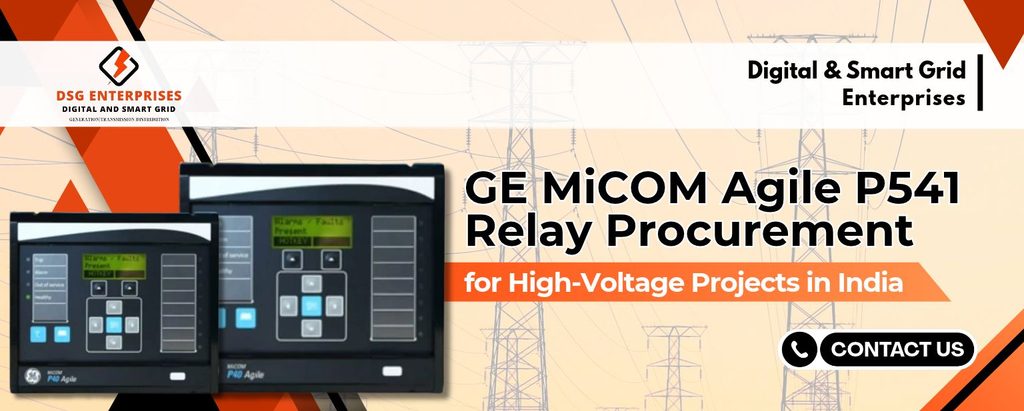
The GE MiCOM Agile P541 Relay is a popular choice for line protection on high-voltage networks. It protects transmission lines with current differential technology. However, buying it is not as simple as placing an order. You must match the model to your project, check the supplier, and plan the delivery.
This guide explains how to buy the relay the right way. You will learn what it does, what to check, and how to avoid common mistakes.
What Is the GE MiCOM Agile P541 Relay?
The P541 belongs to the MiCOM Agile P54x family, which GE designed for line protection. It is a line current differential relay. It compares the current at one end of a line with the current at the other end. If the two values do not match, the relay finds a fault inside the line and trips the breaker quickly.
The MiCOM Agile P541 Numerical Relay also offers backup functions such as overcurrent and earth fault protection. It records faults and events. Moreover, it supports modern communication protocols that fit digital substations.
Here is why engineers choose it:
- Fast fault clearing: Differential protection isolates internal faults quickly, which limits damage to the line and equipment.
- High selectivity: The relay trips only for faults inside its protected zone.
- Flexible communication: It works with fibre optic links between the line ends.
- Rich data: Fault and event records help engineers study every disturbance.
- Proven design: The MiCOM range has a long track record in utilities around the world.
Where Do Indian Projects Use the P541?
Indian utilities use line differential relays on important transmission lines. These lines carry heavy loads, so a slow trip can cause big losses.
Typical applications include:
- 132 kV and 220 kV lines: State transmission utilities protect short and medium lines with differential schemes.
- 400 kV lines: Critical corridors need fast, selective protection.
- Underground cable feeders: Cable circuits suit differential protection well.
- Short interconnectors: Distance protection may struggle on short lines, but differential protection works well.
- Industrial and renewable projects: Solar and wind evacuation lines often need reliable line protection too.
Because every project differs, always confirm the exact relay model against your protection scheme.
Key Factors to Check Before You Buy
A wrong order wastes time and money. Therefore, review these points before you request a quote.
- Model and variant: Check the case size, input and output count, and software options. Confirm the full model code with your design team.
- Auxiliary supply: Match the relay’s DC supply range to your station battery voltage.
- CT and VT inputs: Confirm the rated current (1 A or 5 A) and the number of inputs you need.
- Communication ports: Verify the protocol, such as IEC 61850 or IEC 60870-5-103, along with fibre and Ethernet options.
- Differential channel: Check the fibre interface type and the distance between line ends.
- Firmware version: Ask for the firmware version and confirm it suits your scheme.
- Standards and approvals: Make sure the relay meets the standards your utility requires.
- Documentation: Request datasheets, manuals, test reports, and settings software details.
How to Choose a GE MiCOM P541 Relay Supplier
The supplier matters as much as the product. A good GE MiCOM P541 Relay supplier protects you from fake parts, late deliveries, and weak support.
Look for these qualities:
- Genuine product proof: Ask for original packaging, serial numbers, and authenticity documents.
- Clear traceability: The supplier should tell you where the relay comes from.
- Technical knowledge: A good team can discuss model codes, settings, and wiring.
- Stock and lead time: Ask for honest delivery dates, and confirm them in writing.
- Warranty terms: Read what the warranty covers and how long it lasts.
- Support after sale: You may need help with commissioning, firmware, or spare parts.
- Indian project experience: A supplier who knows local utilities understands tender needs, testing, and paperwork.
- GST-ready billing and logistics: Smooth invoicing and safe transport keep your site on schedule.
Above all, avoid sellers who offer very low prices without paperwork. Cheap offers often hide used, refurbished, or counterfeit units.
Step-by-Step Procurement Process
A clear process reduces risk. Follow these steps.
- Define the scheme: Confirm the line length, voltage level, and protection philosophy.
- Prepare the specification: List the exact model code, options, and communication needs.
- Shortlist suppliers: Pick companies with proven experience and good references.
- Request quotations: Ask each supplier for price, lead time, and warranty in writing.
- Compare offers: Look beyond price. Check technical fit, support, and delivery terms.
- Verify authenticity: Confirm documents before you pay.
- Place the order: Share a purchase order with a full technical description.
- Inspect on arrival: Check the model code, serial number, and condition of each relay.
- Test and commission: Run secondary injection tests and verify the settings before energizing.
Why Planning Early Saves Money
High-voltage projects run on tight schedules. A late relay can hold up the entire substation. Furthermore, an outage on a major line costs far more than the relay itself.
Plan your procurement alongside your design work. Share the specification early, and ask your supplier to confirm stock. In addition, consider ordering a spare relay with the main order. This approach protects your timeline and your budget.
Frequently Asked Questions
What is the GE MiCOM Agile P541 Relay used for?
It protects transmission lines and cables with current differential protection. It detects internal faults quickly and trips the circuit breaker.
Is the MiCOM Agile P541 Numerical Relay suitable for 400 kV lines?
Yes, engineers use differential relays like the P541 on high-voltage lines. However, always confirm the final choice with your protection design.
How do I find a reliable GE MiCOM P541 Relay supplier in India?
Check authenticity proof, technical skill, warranty terms, delivery records, and after-sales support. Ask for references from similar projects.
Conclusion
Buying the GE MiCOM Agile P541 Relay takes more than a quick quote. You must match the model to your scheme, verify the supplier, and plan the delivery. Moreover, careful checks on communication, settings, and documents prevent costly surprises.
Follow the steps in this guide, and your high-voltage project will move forward with confidence. Start by finalizing your specification, then contact trusted suppliers for a clear, written offer.
We are a dedicated and well-defined GE Relay Supplier in India that will help to improve the efficiency of every industry’s operations and functioning. We, Digital and Smart Grid Enterprises, are the leading GE/ALSTOM brand’s numerical relays & auxiliary relays suppliers in India. GE offers a wide range of single-function and auxiliary relays, along with a portfolio of accessories, to support high-performing and reliable protection and control systems for safe power worldwide. We supply GE’s protection portfolio for applications including overcurrent, voltage, frequency, differential, directional, timing, and distance protection. For pricing or inquiries, feel free to contact us at +91 7021624024 or email info@dsgenterprises.in. Our experienced technical team is here to guide you at every stage, from choosing the right product to ensuring reliable after-sales support. Click here to explore our complete range of products and learn more