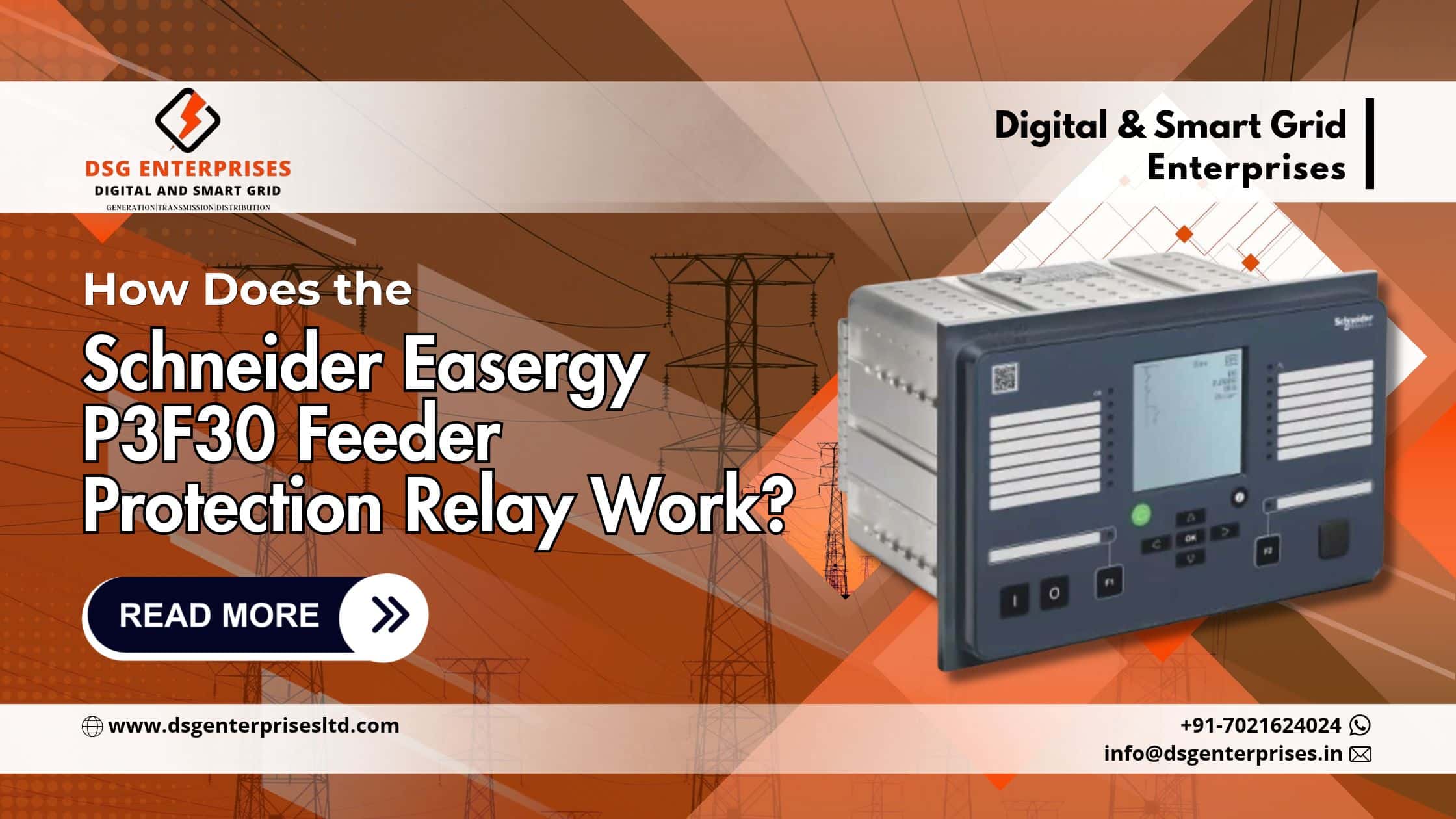
Power faults happen fast. A short circuit can damage cables, transformers, and switchgear within seconds. That is why every medium-voltage feeder needs a smart protection device. The Schneider Easergy P3F30 relay is one of the most trusted options for this job.
This guide explains how the relay works in plain language. You will also learn about its key functions, its benefits, and how to choose a reliable supplier.
What Is the Schneider Easergy P3F30 Relay?
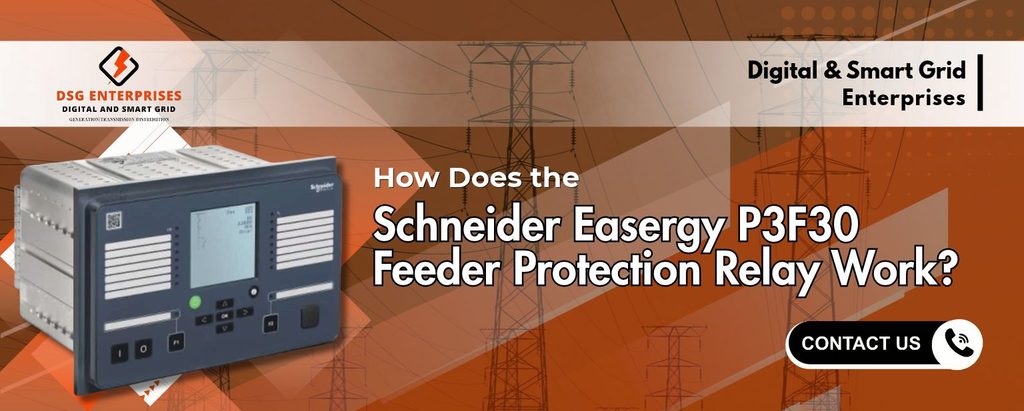
The Schneider Easergy P3F30 relay is a digital protection device from the Easergy P3 range. It guards medium-voltage feeders in substations, factories, and utility networks. In short, it watches your electrical line all day and acts when something goes wrong.
The Schneider Easergy P3F30 Feeder Protection Relay also measures current and voltage, records events, and talks to your control system. Therefore, it works as both a guard and a data source for your plant.
The Basic Working Principle
The relay follows a simple loop: sense, compare, decide, act. Here is how each step works.
- Sensing: Current transformers (CTs) and voltage transformers (VTs) step down the high network values into small, safe signals. These signals enter the relay’s analog inputs.
- Measuring: The relay’s processor converts these signals into digital data. It then calculates current, voltage, frequency, and power values in real time.
- Comparing: The relay checks every measured value against the limits you set. These limits are called settings or pickup values.
- Deciding: When a value crosses its limit, a timer starts. The timer can be instant or delayed, depending on the protection curve you choose.
- Acting: If the fault stays active after the delay, the relay sends a trip command to the circuit breaker. The breaker opens and isolates the faulty section.
Because the whole process takes only milliseconds to a few seconds, the rest of your network keeps running safely.
Key Protection Functions
The P3F30 offers a wide set of protection functions. The exact list depends on the model and configuration, so always confirm with the official datasheet. Common functions include:
- Overcurrent protection: The relay detects high current from short circuits or heavy overloads. It trips the breaker after the set time delay.
- Earth fault protection: The relay detects current leaking to the ground. This function matters because earth faults are the most common fault type on distribution feeders.
- Directional protection: The relay checks the direction of current flow. As a result, it trips only for faults in the protected direction, which helps in ring and parallel networks.
- Thermal overload protection: The relay models the heat in cables or equipment. It warns or trips before insulation gets damaged.
- Voltage and frequency protection: The relay watches for undervoltage, overvoltage, and frequency changes. Consequently, it helps protect sensitive loads and generators.
- Circuit breaker failure protection: If the breaker does not open, the relay sends a backup trip signal to the upstream breaker.
- Auto-reclosing: After a temporary fault, such as a tree branch touching an overhead line, the relay can close the breaker again. This restores power quickly.
How Protection Curves and Time Grading Work
Protection settings do not work alone. They must coordinate with other relays in the network. For example, a feeder relay should trip before the upstream incomer relay does.
The P3F30 supports standard inverse-time curves and definite-time settings. Here is the difference:
- Definite time: The relay trips after a fixed delay once current passes the limit.
- Inverse time: The relay trips faster as the current gets higher. A large fault clears quickly, while a small overload gets more time.
Engineers use these options to build a selective system. In other words, only the closest breaker to the fault opens, and the healthy parts of the network stay live.
Smart Features Beyond Protection
Modern relays do more than trip breakers. The Schneider Easergy P3F30 relay adds several useful tools.
- Measurement display: The front panel shows live current, voltage, and power data. Operators read values without extra meters.
- Event and fault recording: The relay logs every trip, alarm, and setting change with a time stamp. Engineers use these logs to find the root cause of a fault.
- Disturbance recording: The relay captures waveforms before and after a fault. This data makes post-fault analysis much easier.
- Programmable logic: You can create custom logic for interlocking, alarms, and control schemes without extra hardware.
- Communication ports: The relay supports common industrial protocols for SCADA integration. Check the datasheet for the protocols available on your exact model.
- Easergy Pro software: Engineers use this tool to set up, test, and monitor the relay from a laptop.
Where Do Engineers Use the P3F30?
You will find this relay in many settings. Typical applications include:
- Utility substations: The relay protects outgoing distribution feeders.
- Industrial plants: It guards main and sub-feeders in factories, cement plants, and refineries.
- Commercial buildings: It protects medium voltage supply lines in malls, hospitals, and data centers.
- Renewable energy sites: It secures collector feeders in solar and wind farms.
Benefits of Using the P3F30 Relay
Why do so many engineers choose this relay? The main reasons are clear:
- Fast fault clearing: Quick tripping limits equipment damage and downtime.
- Better safety: Fast isolation reduces the risk to people and property.
- Flexible setup: One device covers many protection needs, so you save panel space and wiring costs.
- Easy diagnostics: Detailed logs shorten troubleshooting time.
- Future-ready design: Communication options help you connect to smart grid and monitoring systems.
Simple Installation and Testing Tips
Good protection depends on correct setup. Follow these steps for best results.
- Check CT and VT ratios: Enter the correct ratios in the relay settings. Wrong ratios cause wrong readings and wrong trips.
- Verify wiring: Confirm all CT polarity and terminal connections before you energize the panel.
- Run secondary injection tests: Inject test current and voltage to prove that every function trips at the set value.
- Back up your settings: Save the configuration file after commissioning. You can then restore it quickly if you replace the relay.
- Review settings regularly: Network changes may require new coordination studies.
How to Choose a Trusted P3F30 Protection Relay Supplier
The quality of your supplier matters as much as the relay itself. A good P3F30 protection relay supplier helps you avoid delays, fake parts, and poor support. Look for these qualities:
- Genuine products: Ask for original packaging, serial numbers, and proof of authenticity.
- Technical support: Choose a supplier whose team can answer setup and application questions.
- Stock availability: Fast delivery helps you finish projects on time.
- Clear warranty: A written warranty shows the supplier stands behind the product.
- Transparent pricing: Honest quotes list the model, order code, and any extra accessories.
- Good track record: Read customer reviews and ask for references from past projects.
Conclusion
The Schneider Easergy P3F30 relay senses current and voltage, compares them with your settings, and trips the breaker when a fault appears. Moreover, it records data and connects to your control system, which makes your network safer and easier to manage.
If you plan a new substation or want to upgrade an old panel, the P3F30 deserves a close look. Furthermore, pick a trusted supplier so you receive genuine products and real technical help. Contact your supplier today to discuss your feeder protection needs and request a quote.
We, Digital and Smart Grid Enterprises, are the leading Schneider Relay Suppliers, traders, distributors, and exporters in India, so contact us to get the Schneider Numerical Relays Price List and get a quote. Schneider Relays are used in a wide range of medium-voltage and high-voltage protective applications. We have a large selection of Schneider MiCOM, VAMP, SEPAM, and Easergy Relays. Get Schneider Numerical Relays for Your Power System Now. For pricing or inquiries, feel free to contact us at +91 7021624024 or email info@dsgenterprises.in. Our experienced technical team is here to guide you at every stage, from choosing the right product to ensuring reliable after-sales support. Click here to explore our complete range of products and learn more.