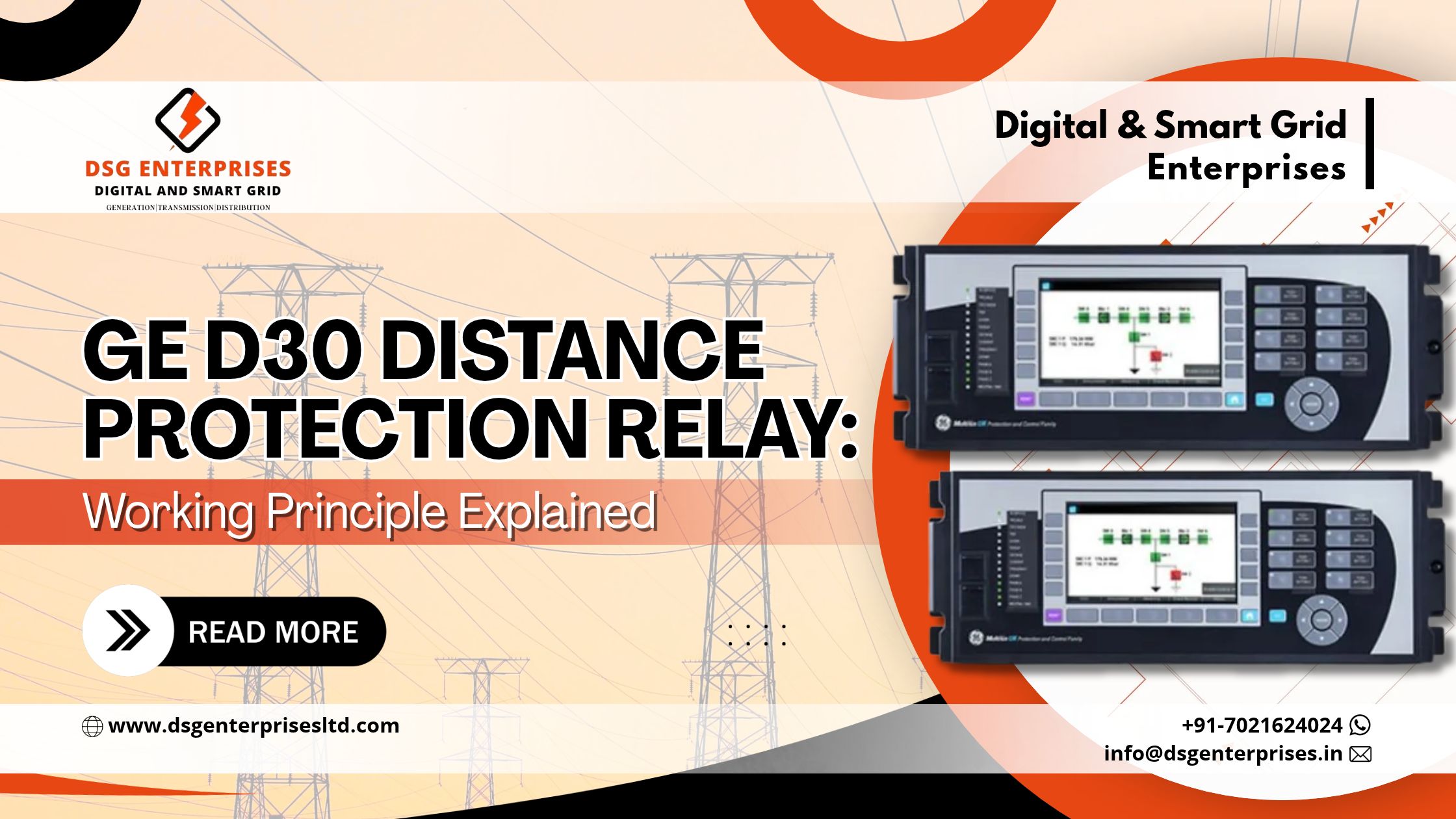
Power lines face faults every day. Lightning strikes, falling trees, and equipment failure can all cause a short circuit. When that happens, the grid needs a fast and accurate response. That is where the GE MiCOM D30 Relay comes in. This article explains how the relay works, step by step, in simple words.
What Is the GE MiCOM D30 Relay?
The GE MiCOM D30 Relay is a microprocessor-based device that protects transmission and sub-transmission lines. It watches voltage and current on the line, finds faults, and trips the circuit breaker in milliseconds.
Many engineers know it as the GE D30 Distance Protection Relay. The name comes from its core job: it measures the “distance” to a fault, based on impedance. It does not need a communication link to make a basic trip decision. That makes it a dependable choice for line protection.
Why Distance Protection Matters
Simple overcurrent relays struggle on meshed networks. Fault current can change with generation levels and system layout. A distance relay solves this problem because it relies on impedance, which stays closely tied to line length.
Here are the main benefits:
- Stable reach: The relay protects a fixed portion of the line, even when source strength changes.
- Fast clearing: Quick trips limit equipment damage and keep the grid stable.
- Selective action: The relay trips only for faults in its zone, so healthy parts of the network stay online.
- Backup role: Outer zones also protect neighboring lines if their own relays fail.
GE D30 Distance Protection Relay: Working Principle
The working principle is easy to follow once you break it into steps.
1. The Relay Measures Voltage and Current
Voltage transformers (VTs) and current transformers (CTs) feed signals into the relay. These signals are scaled-down copies of the real line values. The relay samples them thousands of times per second.
2. The Relay Filters the Signals
Faults create noise, harmonics, and DC offset. The relay uses digital filters to extract the fundamental-frequency values. As a result, the relay sees clean data and avoids false decisions.
3. The Relay Calculates Impedance
Next, the relay divides voltage by current. This gives the apparent impedance seen from the relay location. Because line impedance is proportional to length, the result tells the relay how far away the fault is.
- Normal load: The relay sees high impedance because voltage is high and current is moderate.
- Fault condition: The relay sees low impedance because current rises sharply and voltage drops.
4. The Relay Compares Impedance With Its Zones
The relay compares the measured impedance against set boundaries, called zones. Engineers define these zones during setup.
- Zone 1: Covers most of the protected line, usually about 80 to 85 percent. It trips instantly.
- Zone 2: Reaches past the line end and covers the full line plus part of the next one. It trips after a short delay.
- Zone 3: Reaches further as remote backup. It trips after a longer delay.
Always check the product manual for the exact number of zones and available settings on your D30 model.
5. The Relay Chooses a Characteristic Shape
The relay plots impedance on an R-X diagram. The zone boundary can take different shapes. The D30 supports both common styles:
- Mho characteristic: A circle through the origin. It works well on long lines and has natural directional behavior.
- Quadrilateral characteristic: A four-sided shape. It gives better coverage for high-resistance ground faults.
6. The Relay Identifies the Fault Type
The relay uses separate measuring elements for phase faults and ground faults. It also detects which phases are involved, so it can select the right trip action. If the line supports it, single-pole tripping and auto-reclosing keep power flowing during short-lived faults.
7. The Relay Trips the Breaker
When the impedance enters a zone and the timer expires, the relay sends a trip command. The breaker opens and isolates the fault. The relay also records event data for later study.
Key Features of the GE MiCOM D30 Relay
The relay offers more than basic distance protection. Here are the features users value most:
- Power swing detection: The relay tells the difference between a real fault and a stable power swing. It blocks unwanted trips during swings.
- Load encroachment: This function stops false trips when heavy load pushes impedance toward the zone.
- Fuse failure detection: The relay spots a blown VT fuse and blocks distance elements to avoid mistaken trips.
- Pilot schemes: Teleprotection logic such as permissive and blocking schemes speeds up clearing across the whole line.
- Event and fault recording: Detailed records help engineers find root causes quickly.
- Communication options: Modern protocols connect the relay to SCADA and substation automation systems.
Where Engineers Use the GE D30
Utilities and industries apply this relay in many places:
- Sub-transmission lines: Primary protection for medium-voltage and high-voltage feeders.
- Industrial networks: Protection for large plants with long internal cable runs or overhead lines.
- Backup protection: A second relay on critical lines for added security.
- Renewable plant connections: Protection for lines that link wind and solar farms to the grid.
Tips for Setting the Relay Correctly
A good relay still needs good settings. Follow these tips:
- Run a short-circuit study first: Real fault data gives you accurate reach values.
- Confirm line impedance: Use tested or calculated values, not rough estimates.
- Coordinate with neighbors: Check that your Zone 2 and Zone 3 times work with the next relay.
- Test after setting: Use a secondary injection test set to prove each zone works.
- Update firmware wisely: Read the release notes and plan a safe upgrade window.
What to Check When You Buy
Buying protection equipment takes care. A wrong order wastes time and money. Consider these points:
- Order code: Match the model code to your voltage, I/O, and communication needs.
- Authenticity: Ask for original packaging, serial numbers, and test certificates.
- Warranty and support: Choose a seller that offers technical help and clear return terms.
- Delivery time: Confirm stock status and lead time before you commit.
GE D30 Protection Relay Supplier
A trusted GE D30 Protection Relay supplier should provide genuine units, correct documents, and fast support. Ask the supplier for datasheets, order code guidance, and references from past projects. A good partner also helps with commissioning questions after delivery.
GE D30 Protection Relay Price
The GE D30 Protection Relay price depends on several factors:
- Configuration: More I/O, higher-end communication, and extra functions raise the cost.
- Condition: New, refurbished, and surplus units sell at different levels.
- Quantity: Bulk orders often receive better rates.
- Market conditions: Lead times and availability can influence quotes.
Because options vary so much, request a written quote based on your exact order code.
Conclusion
The GE MiCOM D30 Relay measures impedance, compares it with set zones, and trips the breaker when a fault appears inside a zone. Its blocking functions, flexible characteristics, and fast clearing make it a solid choice for line protection. Choose a trusted supplier, set the relay with care, and test it well. Then it will protect your network for years.
We, Digital and Smart Grid Enterprises are the leading GE Numerical Relays suppliers, traders, and exporters in India. GE / Alstom numerical relays offer a wide range of protection portfolios for applications including Transmission Protection systems, Generator Protection, reliable Feeder Protection relays, Transformer Protection, Busbar Protection, Motor Protection management, Multifunction Servers, Gateways & RTUs, Network Stability & Control, Specialized Protection, and Substation Controllers & Switches, etc. For pricing or inquiries, feel free to contact us at +91 7021624024 or email info@dsgenterprises.in. Our experienced technical team is here to guide you at every stage, from choosing the right product to ensuring reliable after-sales support. Click here to explore our complete range of products and learn more


