A single slow trip can turn a minor fault into a plant-wide shutdown. In many substations, a small auxiliary relay decides how fast that fault clears.
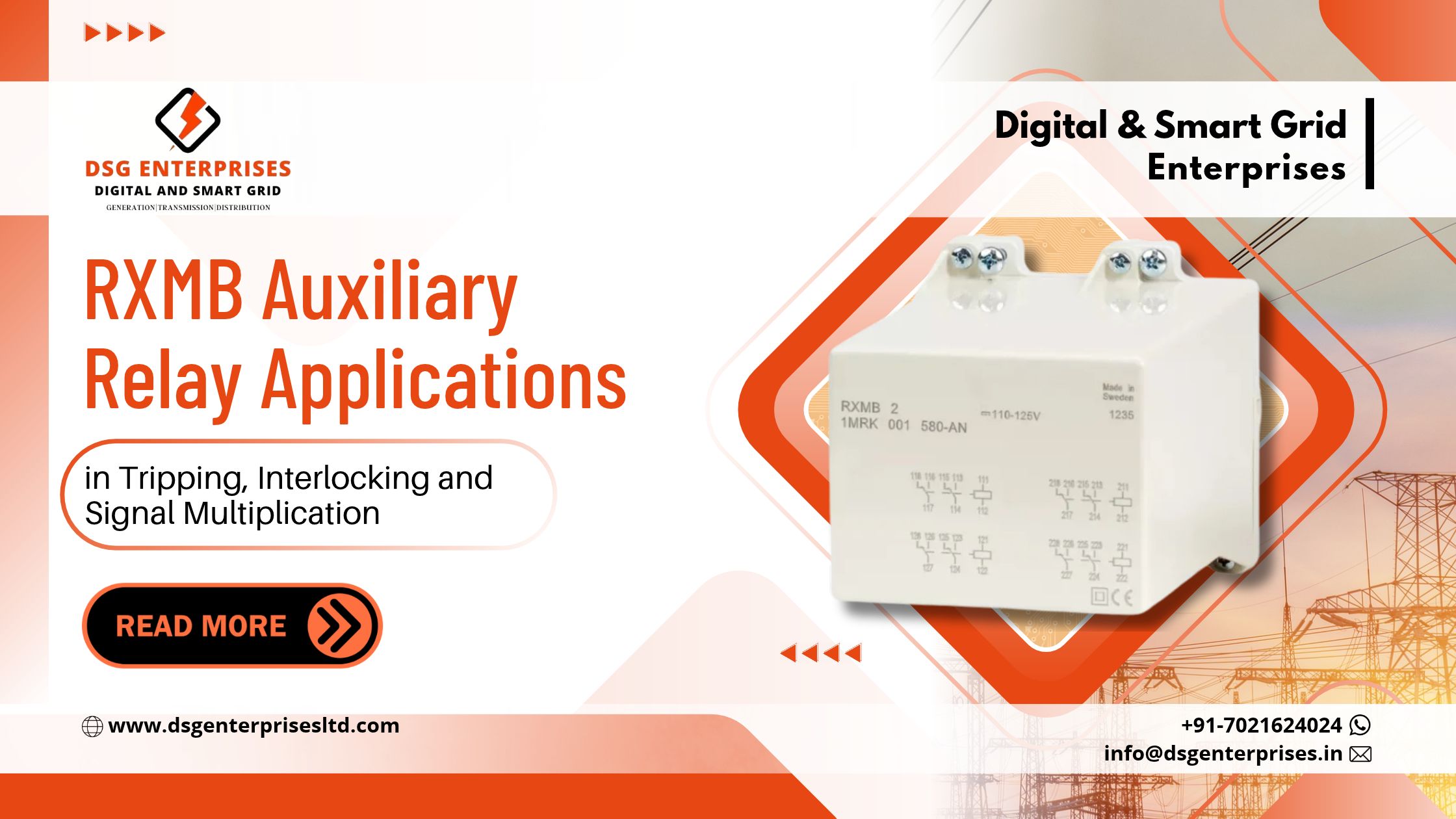
The Hitachi RXMB High Speed Relay plays this role in protection panels across India’s power and industrial sectors. It repeats trip commands, enforces interlocks and multiplies signals for control rooms. Furthermore, engineers value its compact size and wide contact choices. This guide explains where it works best and how to select it.
Why Auxiliary Relays Matter in Protection Schemes
A main protection relay detects the fault. However, it rarely has enough output contacts to handle every follow-up action. Auxiliary relays fill that gap by receiving one command and acting on many circuits at once.
- Protection relays have limited output contacts; auxiliary relays extend them.
- Trip circuits need fast, dependable action; delays increase equipment damage.
- Control rooms need clear signals; auxiliary relays repeat them reliably.
- Panel builders need compact parts; small relay modules save valuable space.
Think of a busy 11 kV substation. One transformer fault must open breakers, raise alarms and start recorders. Without auxiliary relays, the protection relay would run out of contacts quickly.
Auxiliary relays also add a layer of protection themselves. They separate sensitive electronic outputs from heavier switching loads. As a result, protection relays last longer and behave more predictably.
Consequently, designers treat auxiliary relays as essential building blocks. The Hitachi RXMB Auxiliary Relay belongs to this group. It targets fast, repeatable switching in tripping, interlocking and signalling duties.
Understanding the Hitachi RXMB Auxiliary Relay
The RXMB family comes in two main versions. Each version serves a slightly different panel need. Therefore, knowing the difference helps you specify the right unit.
Both versions focus on speed and flexibility. Both also keep the footprint small, which matters inside crowded relay panels. In addition, both fit older Hitachi panel layouts, so retrofits need little rework.
RXMB 1 Features
The RXMB 1 offers many contact and coil configurations. It works as a pin-compatible replacement for the RXMA 1 and RXMM 1 relays. Some versions pack up to four individual relays into one module.
- Wide range of contact configurations
- Pin compatibility with RXMA 1 and RXMM 1
- High-speed operation suited to trip auxiliary functions
- DC and AC versions; some versions include LED indication
RXMB 2 Features
The RXMB 2 builds on the RXMB 1 with extra contacts and faster operation. It also matches the contact configurations of the older RXMA 2. As a result, it suits replacement of older standard applications.
- Up to 15 contacts or 10 change-over contacts
- Faster operation on pick-up and drop-out
- Option with four independent relays; each has two change-over contacts
- Pin compatibility with RXMA 2
Overall, the Hitachi RXMB High Speed Relay gives designers flexibility without enlarging the panel. That balance explains its steady use in new builds and upgrades alike.
RXMB Applications in Tripping Circuits
Tripping is the most critical job for any auxiliary relay. When a protection relay issues a trip, every millisecond counts. A fast auxiliary relay passes that command on without hesitation.
Trip Repeat and Multiple Breaker Tripping
One protection output often has to trip several devices. For instance, a transformer fault may need to open both the HV and LV breakers. The Hitachi RXMB High Speed Relay repeats the command across many contacts at once.
- Trip repeat for breakers located far from the main relay
- Simultaneous tripping of incoming and outgoing feeders
- Initiation of breaker failure schemes
- Start of disturbance recorders and alarm annunciators
Trip Auxiliary Duty in Practice
Panel designers often place the relay right beside the protection relay output. The protection relay energises it, and the contacts then fan out to each trip coil. This arrangement keeps heavy trip currents away from delicate protection outputs. It also lets engineers add more trip paths later without touching the protection relay settings.
Why Speed Matters
Moreover, high-speed operation shortens fault clearing time. Shorter clearing time reduces stress on cables, transformers and switchgear. In addition, LED indication on some versions shows technicians which unit operated. Thus, the Hitachi RXMB Auxiliary Relay also supports faster fault analysis.
RXMB Applications in Interlocking Schemes
Interlocking prevents unsafe switching. For example, it stops an operator from closing a breaker onto an earthed section. Auxiliary relays hold the logic that enforces these rules. Each rule becomes a simple contact path that either permits or blocks an action.
Common Interlocking Uses
- Blocking breaker closing when an earth switch is closed
- Preventing parallel operation of two incoming sources
- Locking out reclosing after a permanent fault
- Blocking selected protection stages during maintenance
Meanwhile, interlocking also covers auxiliary supply checks. For instance, a relay can block closing when the control supply fails. These checks protect both operators and equipment. Moreover, they make switching sequences predictable, which reduces human error during busy shutdowns.
Why the RXMB Suits Interlocking
The RXMB 2 offers many contacts in one housing. Furthermore, that keeps panel wiring tidy. Fewer relays mean fewer terminal points and fewer loose connections.
Likewise, the Hitachi RXMB Auxiliary Relay reduces the relay count in busy interlocking panels. The RXMB 1 also comes in DC and AC versions, so it fits varied supply designs.
Signal Multiplication and Contact Expansion
Signal multiplication turns one input signal into many identical outputs. A single protection contact may need to feed SCADA, alarms, a PLC and other relays. Auxiliary relays also keep those circuits electrically separate.
- One input drives alarms, SCADA and remote indications
- Separate contacts isolate different control circuits from each other
- Change-over contacts give both normally open and normally closed outputs
- Four independent relays in one module save panel space
The Hitachi RXMB Auxiliary Relay handles this multiplication duty with ease. Its many contact options let one coil serve several circuits. Therefore, designers rarely need extra relays for expansion.
Furthermore, signal multiplication helps maintenance teams. Each output serves one purpose, so a fault in one circuit does not disturb the others. Technicians can then isolate and test circuits one at a time. Consequently, commissioning moves faster and fault finding becomes simpler.
Compact Relay Logic Assemblies
The RXMB 1 suits compact auxiliary relay logic assemblies. Its multi-relay modules let designers build logic blocks in small footprints. As a result, panels stay neat and easy to maintain.
Meanwhile, the Hitachi RXMB High Speed Relay delivers repeated signals quickly enough for time-critical logic. Slow repeat signals can upset breaker failure timing or transfer schemes. Fast repetition avoids that risk.
Selecting and Buying the RXMB Relay
Choosing the right version saves time during commissioning. Start with the coil supply, then check the contact count. Finally, confirm the mounting and pin layout. Skipping these checks often leads to wiring changes at site.
Selection Checklist
- Coil supply: DC or AC
- Contact type: normally open, normally closed or change-over
- Operating speed needed for pick-up and drop-out
- LED indication, if technicians want visual confirmation
- Compatibility with existing RXMA or RXMM installations
- Number of independent relays needed in one module
Using this list, the Hitachi RXMB High Speed Relay fits both new panels and retrofits. Likewise, the Hitachi RXMB Auxiliary Relay simplifies upgrades of older RXMA and RXMM designs.
Choosing a Hitachi RXMB Relay Supplier
Procurement teams usually ask two questions first. Who can deliver genuine units, and what will the Hitachi RXMB Relay Price be? A dependable Hitachi RXMB Relay Supplier provides genuine products, clear documentation and technical guidance.
Moreover, a good Hitachi RXMB Relay Supplier helps with version selection and replacement mapping. DSG Enterprises supplies Hitachi auxiliary relays to buyers across India.
Understanding Hitachi RXMB Relay Price
The Hitachi RXMB Relay Price depends on the version, contact configuration and coil voltage. Order quantity also plays a role. Therefore, buyers should compare quotes on identical specifications.
A low Hitachi RXMB Relay Price means little if support is missing. Total cost also includes delivery, testing and downtime. Ask every Hitachi RXMB Relay Supplier about stock, lead time and warranty.
Conclusion
The Hitachi RXMB High Speed Relay helps panels trip fast, interlock safely and multiply signals cleanly. Its two versions cover everything from compact logic assemblies to contact-heavy schemes. Likewise, the Hitachi RXMB Auxiliary Relay eases replacement of older RXMA and RXMM units.
The right version, a trusted Hitachi RXMB Relay Supplier and a fair Hitachi RXMB Relay Price shape the outcome. Good protection often depends on small parts doing their job quickly and correctly. Engineers rarely notice these relays until something goes wrong. In the end, reliable auxiliary relays keep every larger system safe.
The Hitachi RXMB High Speed Relay supports reliable operation in electrical protection and control circuits. Its applications in tripping, interlocking, and signal multiplication help improve switching coordination, ensure dependable signal transmission, and support fast protection circuit operation. Selecting the right auxiliary relay helps maintain reliable substation performance and efficient control system operation. Looking to buy the Hitachi RXMB High Speed Relay? Contact DSG Enterprises Ltd for competitive pricing, product availability, and a detailed quotation. Call +91 7021624024 or email info@dsgeneterprises.in. Click here to explore the comprehensive range of Hitachi Auxiliary Relays and submit your purchase inquiry today.