What happens to your control circuit when the auxiliary supply suddenly fails? With many relays, the contacts fall back, and the circuit state is lost. That one moment can upset a process, confuse an operator, or hide a fault.
A latching design solves this problem neatly. The Hitachi RXMD Bistable Relay holds its last contact position even when power disappears. Engineers in power utilities and industrial plants trust it for exactly this reason. This guide explains how it works, where it fits, and what buyers should check first.
What Makes the Hitachi RXMD Bistable Relay Different
Most auxiliary relays need steady coil power to hold their position. The RXMD works differently. It remembers its last state without drawing continuous current.
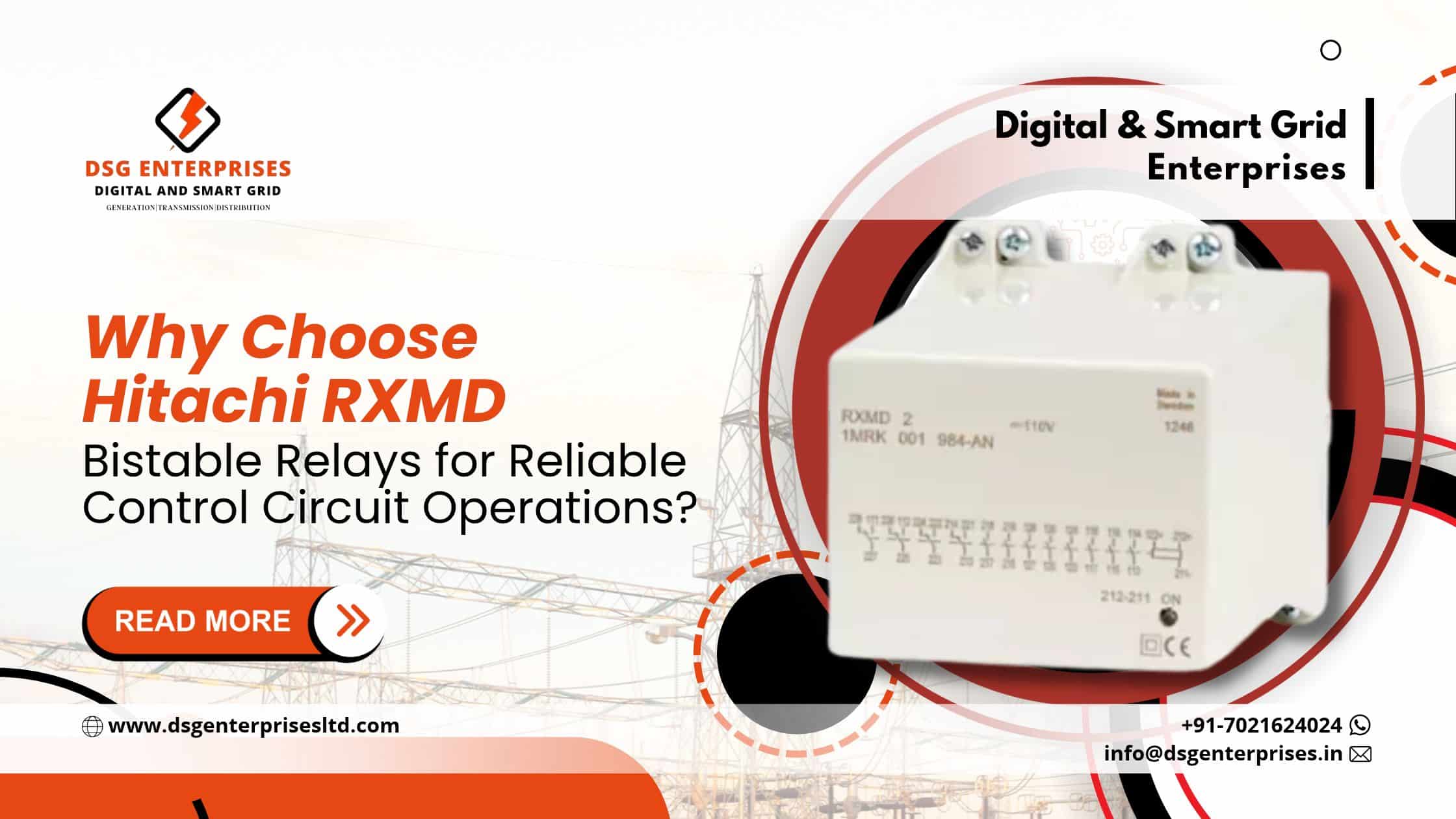
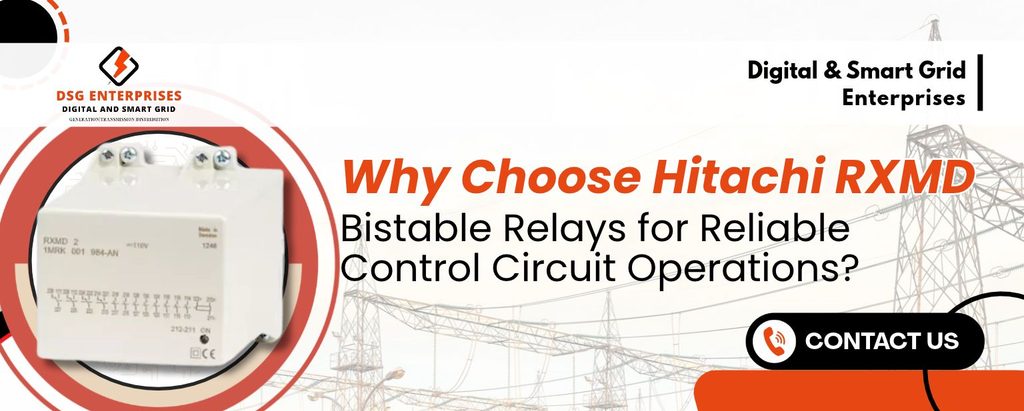
The range includes the RXMD 1 and RXMD 2 models. Both suit general power system latching installations. Furthermore, they serve electrical operations in protection and control circuits.
Here is what sets the design apart:
- Memory without power; the contacts stay in place when the supply voltage drops.
- Fast action; the operating time is roughly 4 milliseconds.
- Robust encapsulation; the sealed build suits corrosive or polluted atmospheres.
- Versatile contacts; change-over contacts handle both making and breaking duties.
As a result, the Hitachi RXMD Auxiliary Relay range gives designers a simple way to retain circuit status. Therefore, many layouts no longer need extra holding circuits. That saves wiring effort, panel space, and commissioning time.
Meanwhile, plant operators gain peace of mind. A brief supply dip no longer scrambles the control logic. The relay simply stays in the state the operator last chose.
Not only that, the design suits pulse-driven control. A short command moves the contacts, and the relay then rests. This approach keeps coil heating low and extends the working life of the relay.
How the Two-Winding Design Works
The RXMD is a bistable, remanence-type auxiliary relay. It carries two separate windings. Each winding has one clear job.
- The first winding operates the contacts into one position.
- The second winding resets the contacts to their original position.
Remanence simply means the magnetic parts keep a trace of magnetism after the current stops. Consequently, the contacts stay where the last winding left them. Think of a light switch; you flip it once, and it stays there until you flip it back.
Continuous or Pulse Operation
You can energise the windings continuously or with a short pulse. Pulse operation is popular because the coil draws power only for a moment. Meanwhile, the contacts hold their position if the supply voltage drops.
This behaviour makes the Hitachi RXMD Bistable Relay a dependable choice for memory functions. Typical examples include breaker status, trip memory, and alarm retention. Moreover, the medium-duty contacts handle common control loads comfortably.
Why Two Windings Matter
Two windings give the designer clear, separate control paths. One signal sets the relay; another signal resets it. As a result, the logic stays easy to read, test, and troubleshoot.
Furthermore, this arrangement avoids confusion during maintenance. Technicians know exactly which command moved the contacts. That clarity shortens fault-finding time on busy panels.
The Hitachi RXMD Auxiliary Relay therefore suits both new projects and retrofits. Engineers can add it to an existing scheme without redesigning the whole circuit. As a result, upgrades stay quick and low in risk.
Key Features of the Hitachi RXMD Auxiliary Relay
Beyond latching, the Hitachi RXMD Auxiliary Relay brings several practical strengths. These features help maintenance teams and panel builders alike. Each one reduces risk in daily operation.
- LED indication of the activated coil; technicians see the relay state at a glance.
- High-speed operation; control signals act quickly and consistently.
- Medium-duty contacts; they suit general control and auxiliary switching.
- Long mechanical life; the relay survives a very large number of operations.
- High resistance to shock and vibration; this protects against switchgear movement and nearby breaker operations.
- Low power consumption; panels run cooler, and auxiliary supplies carry less burden.
Notably, the LED indication deserves special attention. During commissioning, engineers can see which coil is active without a meter. In addition, fault finding becomes faster during outages.
Low power consumption helps in large panels. Dozens of coils can add up to real heat and real load. Latching operation keeps both under control.
Shock and vibration resistance also matters in real installations. Breakers slam, motors hum, and panel doors close hard. A sturdy Hitachi RXMD Auxiliary Relay keeps its contacts steady through all of it.
Where Engineers Use These Relays
The Hitachi RXMD Bistable Relay fits many protection and control circuits. Its memory function helps wherever a circuit must remember an event. Below are common uses.
- Trip memory; the relay holds a trip condition until an operator resets it.
- Circuit breaker control schemes; latched states support open and close logic.
- Alarm and annunciation circuits; the relay keeps an alarm visible after the fault clears.
- Interlocking schemes; the relay remembers permissive states across supply dips.
- Industrial control panels; latching reduces continuous coil heating.
Panel builders also value the compact footprint. One Hitachi RXMD Bistable Relay can replace a relay, a holding contact, and extra wiring. This keeps panels tidy and easier to maintain.
These uses appear across substations, power plants, process industries, and EPC projects. Furthermore, the sealed construction supports sites with dust or corrosive air. As a result, the relay suits coastal plants, chemical units, and heavy industry.
Benefits for Procurement and Maintenance Teams
Technical strengths matter, but business benefits matter too. Procurement managers and plant leaders want predictable operation and low lifecycle cost. The relay delivers on both counts.
- Fewer failures; long mechanical life and shock resistance support dependable service.
- Lower energy use; low power consumption eases the load on auxiliary supplies.
- Faster maintenance; LED indication speeds up testing and troubleshooting.
- Stable operation; the contacts hold position through supply dips.
- Simpler spares; one Hitachi RXMD Auxiliary Relay model can serve several control schemes.
- Clear diagnostics; operators read the coil status directly from the LED.
Many buyers ask about the Hitachi RXMD Relay Price early in the process. However, price tells only part of the story. A genuine product from a dependable Hitachi RXMD Relay Supplier protects uptime and avoids costly replacements. Together, these benefits protect uptime and reduce maintenance effort.
Furthermore, EPC contractors value consistent supply. Projects run on tight schedules, and missing relays stall panel dispatch. Therefore, a supplier with stock and technical knowledge adds real value.
Choosing a Hitachi RXMD Relay Supplier and Understanding Price
Buying the right relay matters as much as choosing the right model. A reliable Hitachi RXMD Relay Supplier provides genuine products, correct variants, and timely support. Otherwise, wrong ratings can delay commissioning.
In addition, think about long-term support. Protection and control schemes stay in service for decades. Therefore, you need a partner who answers questions long after delivery.
Check these points before ordering:
- Model variant; confirm whether you need the RXMD 1 or RXMD 2.
- Coil voltage; match the auxiliary supply of your panel.
- Contact arrangement; confirm the change-over contacts suit your scheme.
- Quantity and delivery schedule; plan stock around project timelines.
- Documentation and technical support; clear datasheets save engineering time.
Meanwhile, the Hitachi RXMD Relay Price depends on variant, coil rating, and order volume. Therefore, request a quotation with your exact specifications.
A clear Hitachi RXMD Relay Price quote should list the model, coil rating, quantity, and delivery time. A trusted Hitachi RXMD Relay Supplier can also advise on suitable alternatives. Compare the Hitachi RXMD Relay Price against lead time and support, not cost alone.
Conclusion
The Hitachi RXMD Bistable Relay offers memory, speed, and durability in one compact package. Its two-winding design keeps contacts in position through supply drops. Moreover, the Hitachi RXMD Auxiliary Relay adds LED indication and low power use for simpler daily operation. Choosing a dependable Hitachi RXMD Relay Supplier completes the picture.
Looking ahead, control systems will only grow more demanding. Substations and plants need components that hold their state through disturbances and keep operators informed. A latching design with fast action and clear LED status supports that goal. Early planning with the right specification also prevents costly rework later.
Ready to specify the right relay for your project? Share your coil voltage and quantity at +91 7021624024 or info@dsgeneterprises.in and request the Hitachi RXMD Relay Price from DSG Enterprises Ltd. Visit the RXMD product page for details and enquiries.