
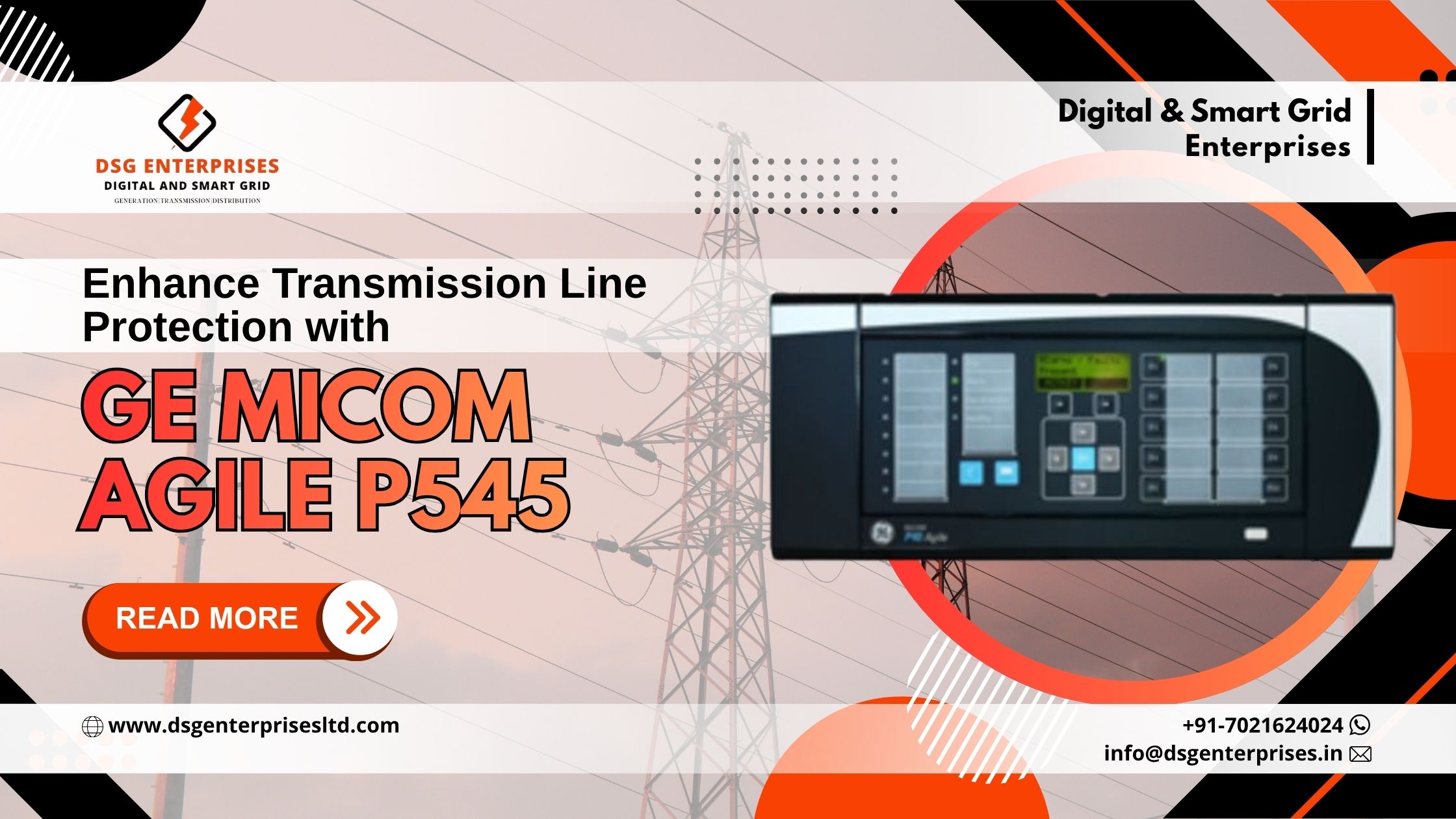
What happens when a fault hits a 400 kV line and the protection hesitates? A few extra cycles can damage costly equipment, trip healthy circuits, and shut down large industrial areas.
That risk explains why utilities demand fast and selective protection. The GE MiCOM P545 Line Differential Relay delivers exactly that for overhead lines and underground cables. Engineers value its speed; meanwhile, buyers often compare GE P545 Relay Suppliers before they finalize an order.
This blog explains how the relay works, what it offers, and what buyers should check. Protection engineers, EPC contractors, and procurement teams will all find practical answers here.
Why Transmission Lines Need Smarter Protection
Transmission lines carry bulk power over long distances. Consequently, a single fault can spread quickly through the grid. Protection schemes must clear faults in milliseconds, yet they must stay stable during healthy conditions.
Older schemes often struggle with several real-world challenges:
- Heavy load flow can mask resistive earth faults; as a result, relays may miss them.
- Unequal CT ratios at the two line ends complicate differential settings.
- Long lines and cables create communication delays between terminals.
- In-zone transformers add ratio and inrush complications.
Speed also protects equipment. Transformers, breakers, and conductors endure severe stress during faults. Fast clearing limits thermal and mechanical damage; moreover, it preserves system stability.
Reliability affects revenue too. An unnecessary trip on a major line interrupts supply and costs money. Therefore, security matters as much as speed.
Grid growth adds more pressure. Renewable plants, new industrial loads, and longer interconnections change fault current levels. Consequently, simple schemes may lose sensitivity or selectivity.
Line differential protection answers this need because it compares current at both ends of the line. If the currents do not match, a fault exists inside the protected zone. The relay then trips quickly and precisely. This principle offers high selectivity because it ignores faults outside the zone.
How the MiCOM Agile P545 Protection Relay Works
The MiCOM Agile P545 Protection Relay belongs to the MiCOM P40 platform. It offers high-speed current differential protection for lines and cables of any length. In addition, it includes resident sub cycle distance protection, with 1/3 pole tripping.
Here is the basic operating logic:
- The relay at each line end measures the local current.
- A communication channel exchanges that data between the terminals.
- Each relay compares both measurements continuously.
- A mismatch beyond the set bias triggers a trip.
The channel can use direct fiber optic links or multiplexed digital links. Moreover, the relay works with 56/64 kbps and 2 Mbps channels. It also tolerates unequal transmit and receive path delays, such as those on SDH/SONET networks. MPLS differential channels work as well.
Reliable channels are critical for differential schemes. Therefore, engineers monitor the link and plan for communication failure. The distance function keeps the line protected in such cases.
Distance protection complements the differential function. It adds main and backup protection inside the same device. As a result, engineers can avoid a separate distance relay in many applications.
Directional earth fault protection adds further coverage. Together, these functions deliver strong speed, security, and selectivity.
Key Features of the GE MiCOM P545 Line Differential Relay
The GE MiCOM P545 Line Differential Relay combines differential, distance, overcurrent, and autoreclose protection in one device, reducing the need for multiple relay models.
Key protection features include:
- Distance Protection: Five quadrilateral or mho zones with true subcycle operation, based on the MiCOM Agile P443 design.
- Power Swing Detection: Setting-free detection ensures stable operation during power swings.
- Neutral Differential Protection: Improves sensitivity to resistive earth faults, even under heavy load.
- Transient Biasing: Typically reduces CT knee-point requirements by around 25%.
- Flexible Configuration: Supports in-zone transformers and unequal line-end CT ratios.
- CT Supervision: Operates with or without voltage inputs to prevent unwanted tripping.
Reduced CT knee-point requirements can lower CT size and project costs, while CT supervision helps prevent false trips and generates alarms.
Communication, Cybersecurity, and Durability
Modern substations require reliable communication, strong cybersecurity, and equipment that withstands harsh conditions. The MiCOM Agile P545 Protection Relay addresses these requirements through:
- IEC 61850: Edition 1 and 2 support for substation integration.
- Redundant Ethernet: Supports self-healing ring, RSTP, dual homing, PRP, and HSR.
- InterMiCOM64: Transmits eight digital signals over teleprotection links.
- Cybersecurity: Includes NERC CIP security features.
Redundant Ethernet maintains communication during network failures, while cybersecurity features support utility security requirements.
The relay also features standard harsh-environment coating to protect against corrosive gases such as H2S and SO2, making it suitable for substations in industrial environments. GE-branded models have no internal batteries, reducing maintenance and simplifying air-freight logistics. Its binary inputs also comply with ESI48-4 EB2.
Additionally, standard communication protocols enable easy integration with SCADA and automation systems, allowing operators to monitor faults and events in real time.
Where the P545 Fits in Real Projects
Utilities and industries use this relay wherever lines demand dual-layer security. The MiCOM Agile P545 Protection Relay suits several practical scenarios:
- HV, EHV, and UHV overhead lines where speed and selectivity matter most.
- Underground cable circuits that need unit protection.
- Dual redundant main protection, where two relays duplicate each other.
- Lines with in-zone transformers or unequal CT ratios.
- Sites that want fewer spare relay types.
Consider a 220 kV double-circuit line feeding an industrial region. The utility wants dual main protection on every circuit. Two relays can then share the duty and back each other up. This arrangement improves dependability without adding unfamiliar equipment.
Likewise, a utility replacing ageing relays can standardize on one platform across many lines. The universal design cuts training effort, because technicians learn one platform instead of several. Spares holding drops too; consequently, lifecycle cost falls.
Project managers should weigh this saving when they review GE P545 Relay Price quotations. Indeed, the GE MiCOM P545 Line Differential Relay often reduces both engineering and maintenance workload.
Note that the P544 and P546 variants target feeders with two circuit breakers, such as breaker-and-a-half layouts. Engineers should therefore match the model to the busbar arrangement.
Commissioning teams benefit as well. A familiar platform shortens testing time and reduces errors. Moreover, spare parts planning becomes simpler across the whole network.
Buying Guide: GE P545 Relay Suppliers and GE P545 Relay Price
Buying protection relays involves more than comparing numbers. Genuine products, correct configuration, and reliable support matter equally. Therefore, a careful approach to GE P545 Relay Suppliers pays off over the project life.
Check these points before choosing among GE P545 Relay Suppliers:
- Authenticity: confirm genuine GE/Alstom origin and valid documentation.
- Configuration: match the order code to your communication and I/O needs.
- Technical support: ask about commissioning and engineering help.
- Delivery: check lead times and export capability.
- After-sales service: confirm warranty terms and spares availability.
Documentation also deserves attention. Ask for datasheets, manuals, and test certificates before you confirm the order. Moreover, check whether the supplier can arrange training and site commissioning.
Meanwhile, the GE P545 Relay Price depends on several factors. Suppliers usually quote it per project instead of listing a fixed figure. Typical price drivers include:
- Model variant and order code.
- Communication interface options.
- Order quantity.
- Delivery location and timeline.
Therefore, compare quotations on a like-for-like basis. A low GE P545 Relay Price that skips documentation or support can cost more later. Lead time also affects schedules, so confirm availability early.
Conclusion
Fast and selective line protection keeps transmission networks stable. The GE MiCOM P545 Line Differential Relay delivers current differential and subcycle distance protection in one platform. Furthermore, it brings strong communication, cybersecurity, and durability features. Its universal design also reduces spares, training effort, and lifecycle cost.
Choosing the right hardware is only half the task. Buyers should evaluate the MiCOM Agile P545 Protection Relay with trusted GE P545 Relay Suppliers. A transparent GE P545 Relay Price matters too. With that approach, the GE MiCOM P545 Line Differential Relay can protect valuable lines for many years.
Looking to enhance transmission line protection with the GE MiCOM P545 Line Differential Relay? Digital and Smart Grid Enterprises offers GE MiCOM P545 protection solutions designed for reliable fault detection, line differential protection, and improved power system performance. For GE MiCOM P545 Relay pricing, availability, and technical support, contact us at +91 7021624024 or email info@dsgeneterprises.in. Our technical team can assist with product selection and application requirements. Click here to explore our GE Transmission Protection Relay and enquire today.


