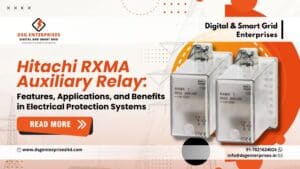
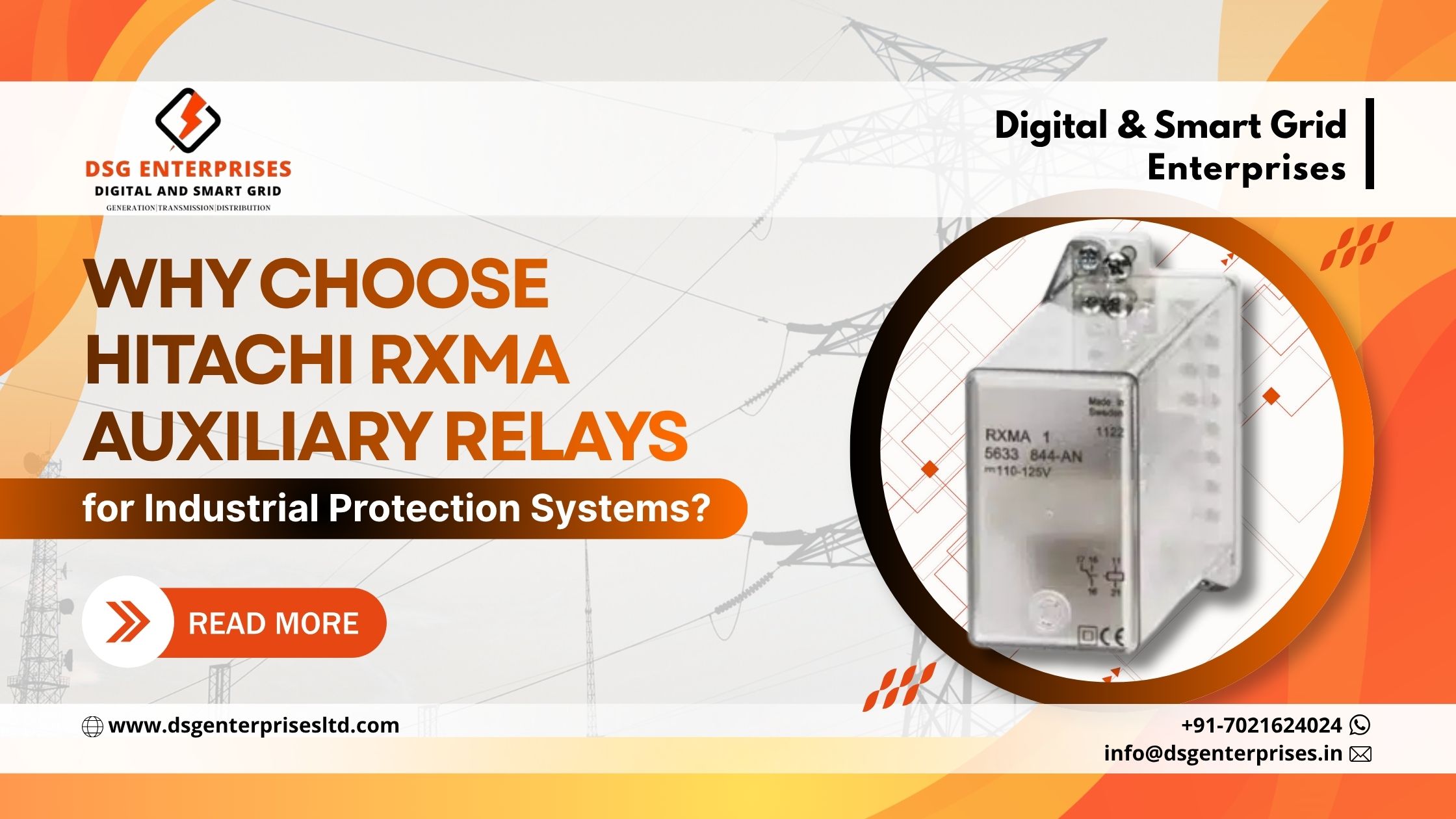
One loose contact in a protection panel can turn a small fault into a costly shutdown. That risk explains why engineers trust the humble RXMA relay.
Why choose the Hitachi RXMA General Purpose Relay? It offers up to 15 contacts, low power consumption, and twin-contact reliability. Engineers use it for tripping, interlocking, signalling, and contact multiplication. As a result, panels stay simpler, and protection circuits stay dependable.
The Hitachi RXMA General Purpose Relay also serves as a dependable Hitachi RXMA Auxiliary Relay in control panels. It comes in two versions, the RXMA 1 and the RXMA 2. Both suit plants that need many reliable contacts without heavy power draw. Together, they cover small and large panels alike.
What Is the Hitachi RXMA General Purpose Relay?
This relay repeats and multiplies control signals within protection schemes. Since protection devices have limited output contacts, auxiliary relays provide additional switching points.
For example, one protection relay may need to trip a breaker, activate an alarm, and start a disturbance recorder. An auxiliary relay provides separate contacts for these operations.
An all-purpose relay is an electrical switch device that amplifies control signals. It adds contacts and simplifies protection panel wiring.
RXMA 1 at a Glance
The RXMA 1 provides up to 7 contacts for control, signalling, and protection applications. It supports DC operation, while AC operation is available through RTXE diodes.
It fits a single COMBIFLEX modular relay seat. Its low power consumption and long mechanical life make it suitable for compact control panels.
RXMA 2 at a Glance
The RXMA 2 features a larger plug-in terminal plate and provides up to 15 contacts. Its burden is below 2 W, making it suitable for applications requiring multiple switching contacts.
The larger terminal plate also accommodates additional wiring. This makes the RXMA 2 useful for demanding tripping and signalling schemes.
The modular design of Hitachi auxiliary relays allows engineers to combine them with compatible test switches and accessories. Overall, the RXMA range offers options for both compact and high-contact applications.
Key Features That Support Reliable Industrial Protection
Reliability is essential in protection circuits. The Hitachi RXMA Auxiliary Relay offers dependable contact operation, low power consumption, and flexible configurations for different panel designs.
Key features
- Contact count: Up to 7 contacts on the RXMA 1 and 15 on the RXMA 2.
- Twin contacts: Bifurcated contacts provide two contact points for improved connection reliability.
- Low power consumption: RXMA 2 burden remains below 2 W.
- Mechanical life: Designed for long-term control and signalling applications.
- Supply flexibility: Supports DC operation directly and AC operation through RTXE diodes.
- Modular design: RXMA 1 fits into one COMBIFLEX relay seat.
How do twin contacts help?
Bifurcated contacts provide two separate contact points. This helps maintain electrical contact if dust affects one point. Consequently, they support reliable signal switching in industrial environments.
Why is low power consumption important?
Protection panels often contain several relays connected to one DC supply. Lower power consumption reduces the overall auxiliary load. This helps simplify battery and charger capacity planning.
What does supply flexibility offer?
Control voltages vary across installations. Flexible supply options help engineers select suitable relay configurations for different projects. They can also simplify spare-parts planning.
Why does mechanical life matter?
Auxiliary relays operate repeatedly throughout their service life. Durable construction supports consistent switching and helps reduce maintenance requirements between scheduled outages.
Where Do Engineers Use the RXMA in Protection Panels?
Engineers use the Hitachi RXMA 2 Auxiliary Relay when one signal must operate multiple circuits. It supports tripping, blocking, interlocking, and signalling duties across protection systems.
Common applications include:
- Tripping: Transfers protection commands to circuit breaker trip circuits.
- Blocking: Prevents selected functions from operating during specific fault conditions.
- Interlocking: Prevents unsafe switching sequences between devices.
- Signalling: Sends alarm and status indications to control rooms.
- Contact multiplication: Converts one command into multiple outputs.
- Breaker-position repetition: Shares breaker status with other panels and circuits.
For example, a feeder protection relay detects a fault and sends one trip signal. The RXMA 2 repeats this signal to the breaker coil, alarm annunciator, and disturbance recorder. This ensures every required device receives the command.
Why use separate contacts for each circuit?
Separate contacts help isolate individual circuits. A fault in an alarm circuit is less likely to affect the trip circuit. Clear contact assignments also simplify testing and commissioning.
When is breaker-position repetition needed?
A breaker-position repeat relay mirrors the breaker’s status for remote circuits and other panels. It is useful whenever connected systems must respond to the breaker’s open or closed state. Without this signal, operators may have limited visibility of switchgear status.
How Does the RXMA Simplify Panel Design?
Panel builders often face limited space and increasing contact requirements. The Hitachi RXMA General Purpose Relay addresses these needs by providing multiple contacts in one modular unit. Its low burden also helps reduce the load on the DC supply.
Key benefits include:
- Fewer auxiliary relays: Up to 15 contacts can reduce the number of separate units required.
- Simplified wiring: Grouped contacts keep connections organised.
- Consistent mounting: The COMBIFLEX seat supports a standardised panel layout.
- Lower supply burden: Low power consumption suits panels with multiple relays.
Why do spare contacts matter?
Project requirements can change during design. Spare contacts provide flexibility without major rewiring, helping teams manage late changes.
How does this benefit project teams?
Fewer relays mean fewer wiring terminations and fewer potential loose connections. This simplifies panel inspection and commissioning.
The modular design also supports maintenance. Technicians can identify, test, and replace units more easily. Consistent mounting reduces panel variations, while standardising on one relay family helps simplify spare inventory.
When should you choose RXMA 1 instead?
Choose the RXMA 1 when seven contacts or fewer are sufficient. Select the RXMA 2 when the application requires more than seven contacts. This helps match the relay to the contact requirement without unnecessary oversizing.
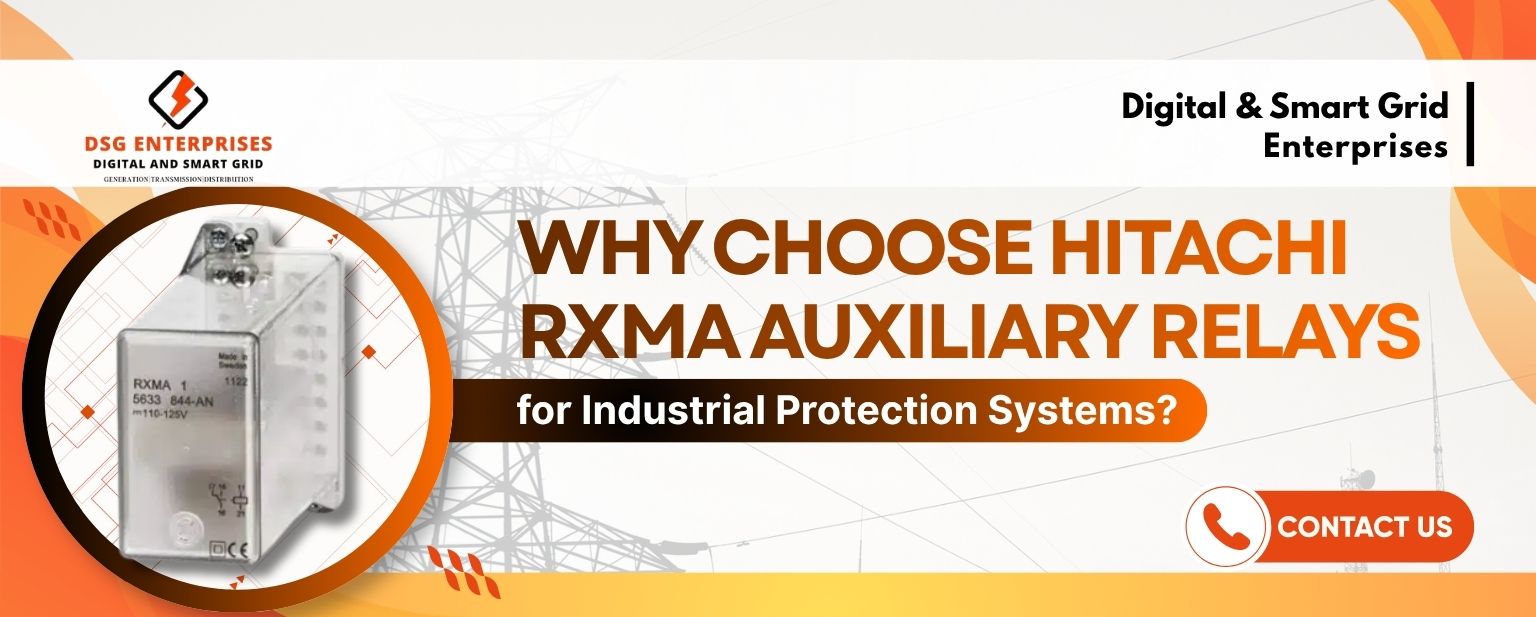
How to Choose a Reliable Hitachi RXMA Relay Supplier?
Even the best relay fails when the wrong variant reaches the site. A dependable Hitachi RXMA Relay Supplier confirms the version, contact count, and operating details before dispatch. Furthermore, good suppliers understand protection schemes, not just catalogues.
Check these points before ordering:
- Genuine products with traceable origin
- The correct version, either RXMA 1 or RXMA 2
- Clear technical documentation for every order
- Experience with Indian utilities, EPC contractors, and industrial plants
- Support for related items, such as COMBITEST test switches and relay accessories
Why does supplier knowledge matter so much? Auxiliary relays look similar, yet small differences change circuit behaviour. A knowledgeable team spots mismatches before they reach site. No c szvsih, commissioning proceeds without unpleasant surprises.
What should you ask before placing an order? Ask for the exact version and operating details. Ask whether the supplier can confirm the contact arrangement. Finally, ask how the supplier handles urgent project schedules.
As a supplier of protection relays in India, DSG Enterprises Ltd also lists Hitachi auxiliary relays and measuring relays. It also offers numerical relays from other brands. Therefore, buyers can source related items in one place. A well-equipped Hitachi RXMA Relay Supplier helps buyers avoid specification errors.
Frequently Asked Questions
Q: What is the Hitachi RXMA General Purpose Relay used for?
It repeats and multiplies control signals in protection and control panels. Common applications include tripping, blocking, interlocking, signalling, and contact multiplication. The RXMA 2 can also repeat breaker-position signals. Its twin contacts and low burden support reliable operation in industrial installations.
Q: How many contacts does the RXMA relay provide?
The RXMA 1 provides up to 7 contacts, while the RXMA 2 offers up to 15. Both versions use twin contacts to support contact reliability. Designers can select the model based on circuit requirements and available panel space.
Q: Can the Hitachi RXMA Auxiliary Relay work on AC supply?
The RXMA 1 operates directly on DC supply. For AC applications, jun rcxh CKZN tlrhna. Always check the relay datasheet and supply specifications before finalising the design.
Q: What should buyers check before choosing a Hitachi RXMA Relay Supplier?
Check the relay version, contact count, operating specifications, and technical documentation. Also, consider the supplier’s experience with protection panels and availability of compatible accessories, such as test switches.
Q: What is the difference between the RXMA 1 and RXMA 2?
The RXMA 2 has a larger terminal plug-in plate and provides up to 15 contacts, compared with 7 for the RXMA 1. Its burden is below 2 W, making it suitable for applications where low power consumption is important.
Conclusion
The Hitachi RXMA General Purpose Relay brings high contact counts, low power consumption, and a twin-contact design to industrial panels. As a dependable Hitachi RXMA Auxiliary Relay, it handles tripping, interlocking, and signalling without crowding the panel. Furthermore, the RXMA 1 and RXMA 2 cover both small and large contact needs.
Equally important, a knowledgeable Hitachi RXMA Relay Supplier ensures that the right variant reaches the right panel. Both versions appear on the DSG Enterprises Ltd product page. Ultimately, protection systems succeed through small, reliable parts, and relays like the RXMA prove that point every day.
Looking to buy the Hitachi RXMA General Purpose Relay for reliable industrial protection systems? DSG Enterprises offers Hitachi RXMA Auxiliary Relay solutions designed for dependable signal multiplication, tripping, interlocking, and control panel applications. For Hitachi RXMA Relay pricing, availability, and technical support, contact us at +91 7021624024 or email info@dsgeneterprises.in. Our technical team can assist with product selection and application requirements. Click here to explore our Hitachi Auxiliary Relay solutions and enquire about the Hitachi RXMA General Purpose Relay today.