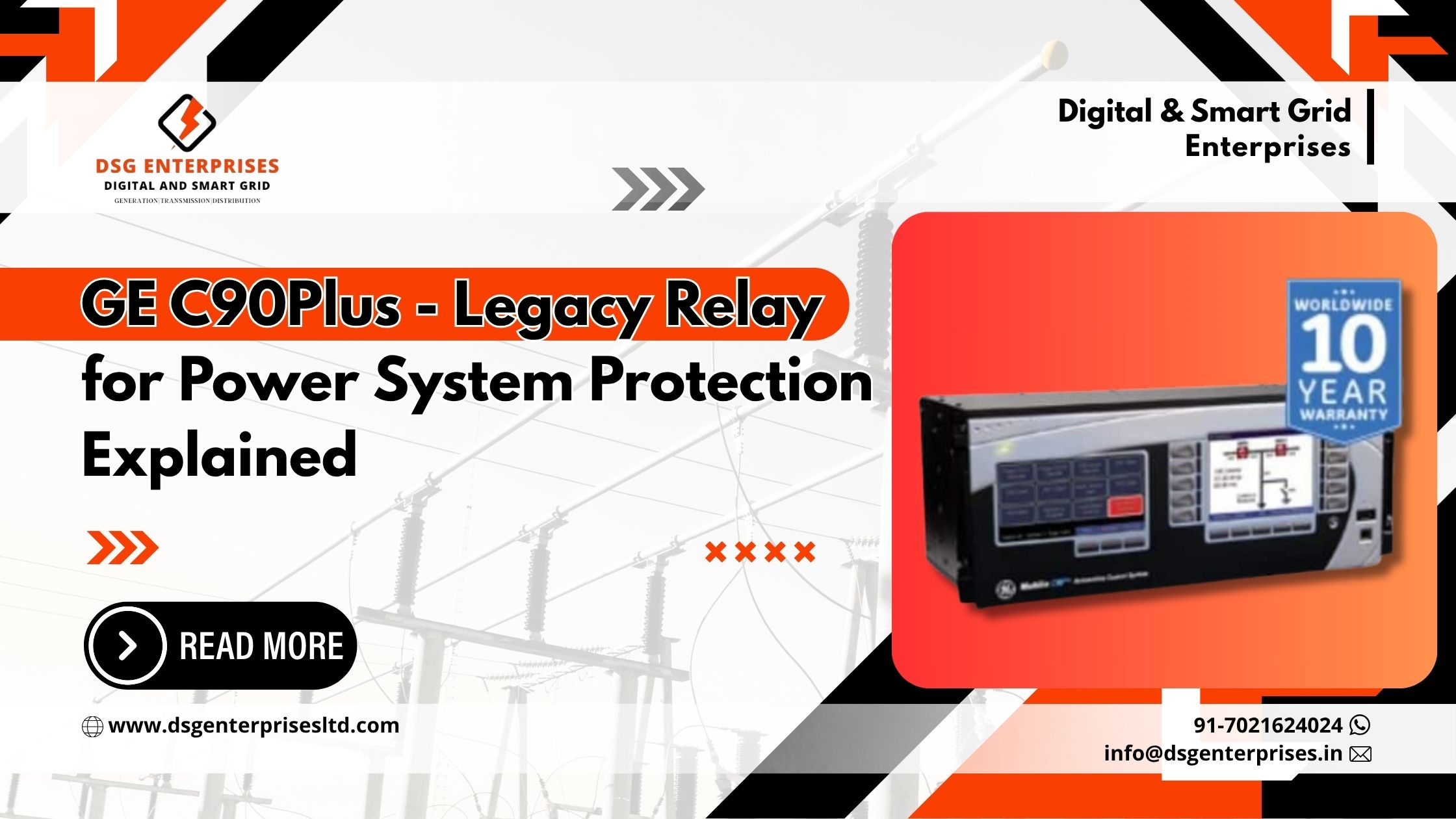
Blackouts cost industries millions every year. One weak link in a substation can trigger a cascading grid failure within seconds. This controller is a multifunction automation device built for bay protection, control, and fast load shedding. It replaces several standalone devices with one platform. As a result, panel space, wiring, and long-term maintenance costs all drop for utilities and EPC contractors.
For decades, protection engineers have relied on rugged, field-proven relays to keep power grids stable during emergencies. This blog explains what the GE C90Plus Relay does. It also covers why this legacy controller still matters and how it fits into modern substations. Finally, it explains how buyers can source it reliably across India.
What Is This Legacy Multilin Controller?
The Multilin automation controller is designed for high-end bay control applications. It consolidates protection, control, and disturbance recording into a single device. This design choice simplifies panel layout considerably.
A substation automation controller is a device that manages protection, monitoring, and switching logic for a bay or feeder. This function matters because it reduces the number of separate panels an engineer must maintain. Consequently, plants achieve faster fault response with fewer failure points to troubleshoot.
The platform supports several core functions:
- Advanced bay control and monitoring;
- Fast, power-balance load shedding;
- Frequency and voltage-based load shedding;
- Custom bus transfer schemes;
- Substation alarm concentration and annunciation;
- Stand-alone breaker protection and monitoring.
This flexibility means one device can cover several roles that once needed separate hardware. It also cuts the number of vendors a plant must manage during commissioning. Many installations also pair the controller with existing SCADA systems over standard communication protocols, which simplifies integration into brownfield substations. Engineers can add or remove I/O modules as bay requirements change. This lets the same platform scale from a small feeder bay to a large transmission bay.
Why Do Engineers Still Choose This Legacy Relay?
Many newer relays exist today, yet this legacy controller remains active across India’s power sector. Utilities often keep proven hardware running rather than replace an entire protection scheme overnight.
Furthermore, spare parts, firmware support, and trained technicians are still widely available for this platform. As a result, maintaining an existing installation is often more economical than a full retrofit. Why spend heavily on new hardware when a proven system still performs well?
Here is why plant managers keep this relay in service:
- Field-tested reliability across transmission and industrial sites;
- Compatibility with existing SCADA and substation wiring;
- Lower retraining costs for experienced protection teams;
- Proven performance during blackout and emergency load-shed events;
- Long operational history that supports predictable maintenance planning.
When a relay has run without major failure for years, teams rarely rush its replacement. Engineers weigh risk carefully before touching a working protection scheme. Budget cycles also favor extending an asset’s life wherever safety allows it. Total cost of ownership often favors the incumbent relay once training and integration costs are considered. Site engineers also value predictable behavior. A relay that has survived years of fault events carries fewer unknowns than a brand-new model still building its record.
How Does the GE C90Plus Handle Load Shedding?
Load shedding protects a grid from total collapse when generation cannot meet demand. The GE C90Plus Relay was purpose-built for this exact scenario. It remains one of its strongest capabilities today.
A load-shedding scheme is a set of automated actions that disconnect non-critical loads during frequency or voltage drops. This function is essential because it prevents a small imbalance from spiraling into a full regional blackout.
The relay offers several load-shedding tools:
- Multiple stages of frequency-based load shedding;
- Multiple stages of voltage-based load shedding;
- Fast, power-balance shedding for sudden generation loss;
- Dedicated protection logic running at 1 msec scan rate.
How fast is that in practice? A 1 msec response lets the relay isolate a fault before it spreads to nearby equipment. GE’s published specifications note the controller supports thousands of lines of programmable logic. This flexibility lets engineers tailor load-shed thresholds to each site’s demand profile, which matters most during sudden generation loss. Generator protection teams often integrate this load-shed logic directly with turbine and governor controls for smoother recovery after a disturbance. This coordination helps a plant ride through a partial outage instead of tripping fully offline. As a result, restoration time shortens for everyone downstream.
What Makes the C90Plus GE Architecture Reliable?
Reliability starts with hardware built to survive harsh substation conditions. The C90Plus GE design includes rugged casing, wide-range power supplies, and redundant communication ports for continuous operation.
Beyond the physical build, the controller offers dual-breaker failure protection and synchro-check functions for multi-breaker bays. Therefore, operators gain confidence even in complex switching arrangements where several breakers must coordinate closely.
Key architecture strengths include:
- Direct and teleprotection elements via inter-relay communication cards;
- Multi-breaker synchro-check with single or three-pole auto-reclosing;
- Pre-configured and customizable HMI displays for faster diagnostics;
- High-end fault and disturbance recording for post-event analysis;
- Dedicated automation logic capable of running thousands of program lines.
As a supplier of protection relays and substation automation systems in India, we often see these features simplify commissioning. When a panel builder trusts the underlying hardware, project timelines shrink noticeably. Fewer surprises during testing also mean fewer delays before energization. Redundant hardware paths also help plants meet strict uptime targets set by regional grid codes. Post-fault disturbance records further help engineers investigate root causes quickly, rather than relying on guesswork after an outage.
Where Can You Find GE C90 Relay Suppliers in India?
Sourcing genuine hardware matters as much as choosing the right relay model. Buyers should always verify authorized GE C90 Relay Suppliers before placing an order for any protection scheme.
Working with an authorized distributor protects against counterfeit units, mismatched firmware, and voided warranties. In addition, established suppliers typically offer testing, calibration, and retrofitting support alongside the hardware itself.
When evaluating suppliers, consider these points:
- Proven experience with GE and Alstom protection relays;
- In-house testing and commissioning capability;
- Access to genuine spare parts and firmware updates;
- After-sales technical support for panel integration;
- A track record with similar transmission or industrial projects.
What happens if you skip this step? Buyers who purchase from unverified channels risk mismatched firmware or units without valid warranty coverage. That risk alone can delay commissioning by weeks. Ensure long-term reliability from day one with an experienced, authorized partner. Many established suppliers also offer panel wiring, factory acceptance testing, and site commissioning as bundled services. This bundled approach saves buyers from coordinating multiple vendors separately for a single protection scheme.
What Determines the Price of a GE C90 Relay?
Budgeting accurately requires understanding what drives the final quotation for this equipment. Several factors shape pricing for any given protection project.
Price of GE C90 Relay Price depends on configuration complexity, I/O count, communication protocols and HMI options. Furthermore, retrofitting an existing panel typically costs less than a full greenfield installation with new switchgear.
Buyers should request quotes that clearly break down these items:
- Base unit cost for the selected configuration;
- Optional modules, such as extra I/O or communication cards;
- Testing, commissioning, and training charges;
- Warranty terms and long-term support pricing;
- Freight, installation, and site-acceptance testing fees.
When quotes are itemized this way, procurement teams can compare suppliers fairly. A low headline number sometimes hides missing modules or short warranty terms. Therefore, always ask for a full scope breakdown before approving any purchase order. Pricing is also dependent on the volume of projects so buyers ordering multiple units should always ask for a bulk quotation. Lead time can shift pricing too, since expedited delivery on custom configurations often carries a premium.
Frequently Asked Questions
Q: What is this legacy GE relay used for?
This multifunction automation relay provides bay protection, control, and fast load shedding. It replaces multiple standalone devices, reducing panel space, wiring complexity, and maintenance requirements for utilities and EPC contractors.
Q: Is this legacy relay still supported?
Yes. The platform remains supported through spare parts, firmware updates, and trained technicians across India. Many utilities retain existing installations because retrofitting a proven relay can be more cost-effective than replacing the entire protection scheme.
Q: How fast does the relay respond during a fault?
The relay executes protection logic at a 1 msec rate, enabling rapid fault isolation and load shedding. This helps limit equipment damage and prevent localized faults from spreading.
Q: What determines the price of this relay?
Pricing depends on configuration complexity, I/O count, communication protocols, HMI options, and installation type. Request itemized quotes covering the base unit, optional modules, testing, commissioning, and warranty for accurate budgeting.
Conclusion
The GE C90Plus Relay continues to prove its value in substations that demand dependable bay control and rapid load shedding. Its consolidated design, rugged architecture, and field-tested performance explain why it remains active across India’s power sector today.
When planning a purchase or retrofit, work only with verified suppliers and compare pricing transparently. Confirm firmware and spare-parts support before signing off. Then contact an experienced distributor for accurate quotes and expert guidance on your next protection upgrade.
At Digital & Smart Grid Enterprises, we provide reliable solutions and expert support for GE C90Plus Legacy Relays, helping utilities and industries maintain dependable power system protection while extending the operational life of existing equipment. Our team supports legacy relay requirements, maintenance, replacement planning, and modernization to improve system reliability and minimize unexpected downtime. Click here to inquire about the GE Numerical Relays price, availability, or lifecycle support requirements. Contact us at +91 7021624024 or email info@dsgeneterprises.in. Keep your legacy protection systems reliable with trusted technical expertise and support. Connect with our specialists today.