Power lines face storms, lightning, falling trees, and equipment faults every day. When a fault hits, your protection system has only milliseconds to react. The right relay keeps the grid stable and your people safe.
The GE MiCOM P841 relay is a well-known name in transmission line protection. Many engineers search for it together with “distance protection,” and that deserves a clear answer. In this guide, you will learn what the relay does, how it works with distance protection, and what to check before you buy or replace one.
What Is the GE MiCOM P841 Relay?
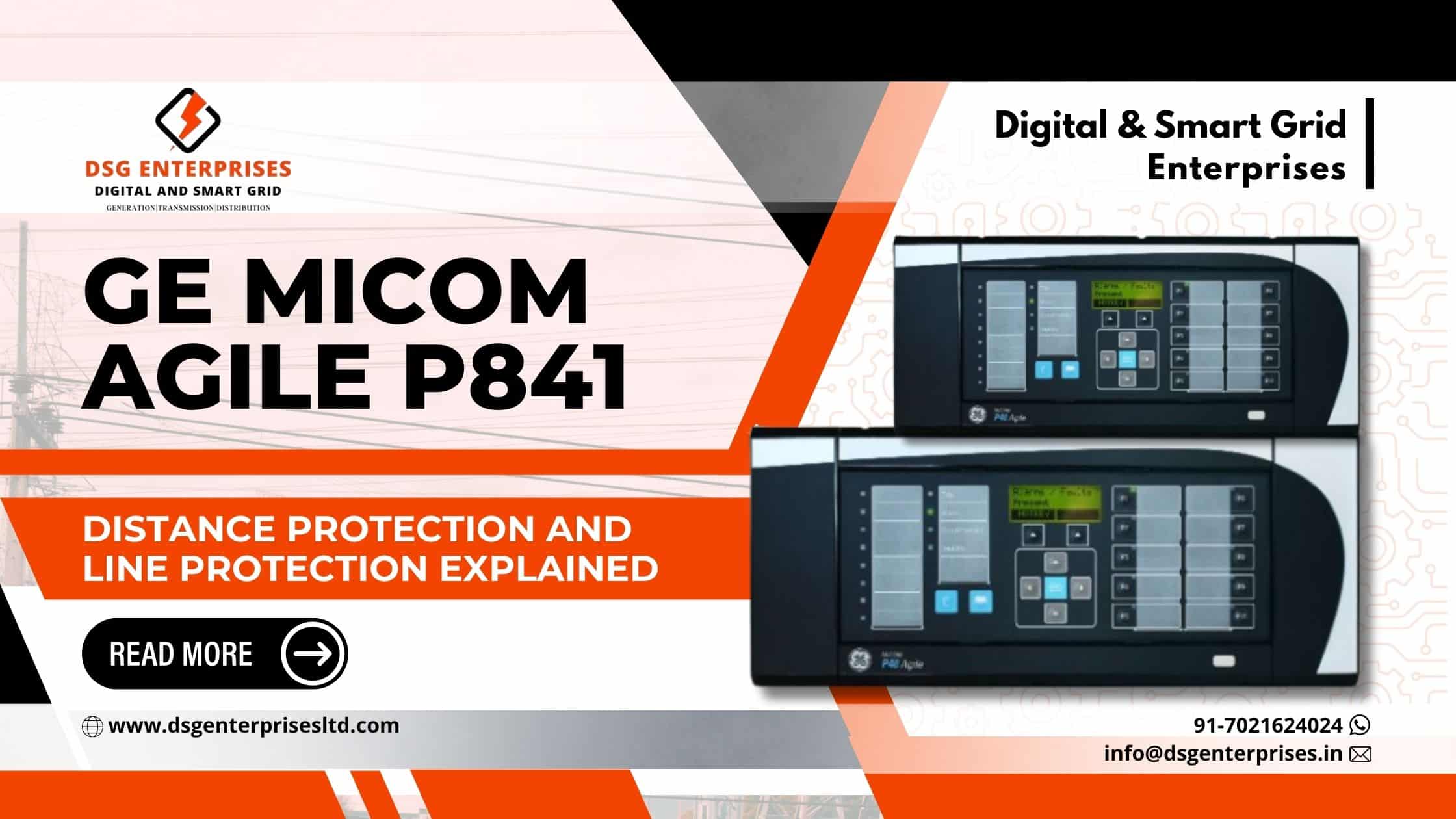
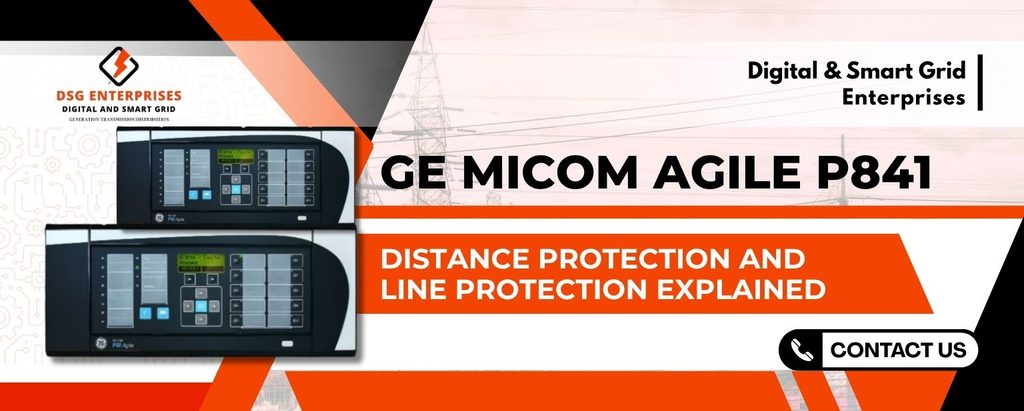
The GE MiCOM P841 relay belongs to the MiCOM Agile P40 family from GE Grid Solutions. GE describes it as a multifunction line terminal IED. In simple words, it controls and backs up the protection of a transmission or sub-transmission feeder bay.
The MiCOM Agile P841 Protection Relay comes in two models:
- P841A: Manages a line terminal fed by a single circuit breaker.
- P841B: Manages a line terminal fed by two circuit breakers, such as ring bus, mesh, double-bus, or breaker-and-a-half layouts.
Distance Protection in Plain Words
Distance protection measures voltage and current on the line. From these two values, the relay calculates impedance. Impedance grows with distance, so the relay can tell how far away a fault sits.
Here is why engineers like this method:
- Fast tripping: The relay clears faults inside its zone in a short time.
- Clear zones: Zone 1 covers most of the protected line, while Zone 2 and Zone 3 reach further for backup.
- Good coverage: It works well on long overhead lines and cables.
- Easy coordination: Settings follow the line length, so teams can plan them with ease.
Meanwhile, the line still needs more than fast tripping. It needs smart control after the trip. That is where the P841 steps in.
What Line Protection Needs Beyond the Trip
A trip clears the fault, but the job does not end there. Most faults on overhead lines are temporary. A lightning strike or a branch contact often disappears in seconds. As a result, you want the line back in service quickly and safely.
A complete line protection scheme must:
- Detect the fault: Find it fast and find it correctly.
- Isolate the fault: Open the right breakers without delay.
- Back up failures: Act if a breaker does not open.
- Restore power: Close the breaker again when it is safe.
- Record the event: Save data so engineers can study what happened.
Key Features of the MiCOM Agile P841
Based on GE’s published information, the P841 offers a strong set of tools for line terminals.
- Autoreclose control: It manages single or dual breaker reclose schemes, including leader-follower logic for two-breaker bays.
- Synchrocheck: It checks that both sides of the line match before it closes a breaker.
- Breaker failure protection: It gives transmission-class backup when a breaker fails to clear a fault.
- Single-pole and three-pole tripping: It supports both modes, with separate monitoring for each pole.
- Backup protection elements: It includes directional overcurrent, earth fault, voltage, and frequency functions.
- Graphical scheme logic: Engineers build control and interlocking logic in the software without extra hardware.
- Operator controls: Ten programmable function keys and tri-color LEDs help staff read the bay status at a glance.
- Disturbance recording: The relay stores fault data for later review.
- Digital substation support: It works with IEC 61850 and offers redundant Ethernet options such as PRP, HSR, and RSTP.
Why the P841 Suits Dual Breaker Bays
Dual breaker layouts add complexity. Two breakers feed one line, so the relay must decide which breaker closes first and when the second one follows. If this logic is weak, the system risks a bad reclose.
The P841B solves this problem with built-in leader-follower reclosing. In other words, it keeps the closing order clear and safe. This makes it a strong fit for breaker-and-a-half and ring bus stations.
How the P841 Works With a Distance Relay
Let us walk through a simple fault event:
- A fault occurs: Lightning hits the line.
- The distance relay trips: It spots the impedance change and sends a trip command.
- The breaker opens: The line goes dead, and the arc dies out.
- The P841 starts autoreclose: After a set delay, it prepares to close the breaker.
- Synchrocheck confirms: The relay checks voltage and angle on both sides.
- The breaker closes: Power returns to the line.
- Breaker failure stands guard: If the breaker had stuck, the P841 would trip the neighboring breakers.
Because each device has a clear job, the scheme stays simple and reliable.
Latest Update: P841 Is a Legacy Product
Here is something buyers should know. GE now lists the P841 as a legacy model under last-time buy. GE points customers to the newer P84 (MiCOM 5th Generation) as the alternative.
The P84 brings:
- Form, fit, and function match: It fits in the same panel space as the older P841A and P841B.
- Easy swap: Old terminal blocks plug straight onto the new relay, so you leave the wiring in place.
- Same software: MiCOM S1 Agile supports both the legacy and new relays.
- Better hardware: A faster processor and a graphical display come as standard.
Still, thousands of P841 relays remain in service worldwide. Therefore, teams need spares, repairs, and replacement advice for years to come.
How to Choose a GE MiCOM Agile P841 Relay Supplier
A good GE MiCOM Agile P841 Relay supplier does more than ship a box. Since the P841 is now a legacy item, supplier quality matters even more. Check these points before you order:
- Genuine product proof: Ask for the order code (CORTEC), serial number, and software version.
- Clear stock status: Confirm if the relay is new, surplus, or refurbished.
- Warranty terms: Get the warranty period in writing.
- Technical support: Choose a supplier whose team understands protection schemes.
- Documentation: Look for datasheets, manuals, and test reports.
- Fast delivery: Ask for lead times, especially for urgent outages.
- Replacement advice: A strong supplier can guide you toward the P84 when needed.
Best Practices for Installing and Testing
Good hardware still needs good setup. Follow these steps:
- Check the order code: Match the hardware to the old relay’s model.
- Apply rated current and voltage: Do this during secondary injection testing to confirm CT and VT connections.
- Test the logic: Run the autoreclose and breaker failure schemes with real test sets.
- Save your settings: Keep a backup file in MiCOM S1 Agile.
- Review the records: Check event and disturbance logs after each test.
Frequently Asked Questions
What is the GE MiCOM P841 relay used for?
Utilities use it for control and backup protection on transmission and sub-transmission line bays. It handles autoreclose, synchrocheck, and breaker failure protection.
Does the P841 offer distance protection?
No, not as its main role. GE provides main distance protection in the P44x range. The P841 works alongside it and adds control and backup functions.
What is the difference between P841A and P841B?
The P841A suits one circuit breaker per line. The P841B suits two breakers, as in ring bus or breaker-and-a-half layouts.
Conclusion
The GE MiCOM P841 relay gives line bays strong control, smart reclosing, and reliable breaker failure protection. Although it does not replace a distance relay, it completes the line protection scheme. Used together, the two devices clear faults fast and restore power with care.
If you plan a new project, look at the P84 first. If you maintain an existing station, find a trusted supplier who can offer genuine parts and clear technical help. Either way, a well-planned scheme protects your assets, your crew, and your customers.
We, Digital and Smart Grid Enterprises, are the leading GE Numerical Relays suppliers, traders, and exporters in India. GE / Alstom numerical relays offer a wide range of protection portfolios for applications including Transmission Protection systems, Generator Protection, reliable Feeder Protection relays, Transformer Protection, Busbar Protection, Motor Protection management, Multifunction Servers, Gateways & RTUs, Network Stability & Control, Specialized Protection, and Substation Controllers & Switches, etc. For pricing or inquiries, feel free to contact us at +91 7021624024 or email info@dsgenterprises.in. Our experienced technical team is here to guide you at every stage, from choosing the right product to ensuring reliable after-sales support. Click here to explore our complete range of products and learn more.