
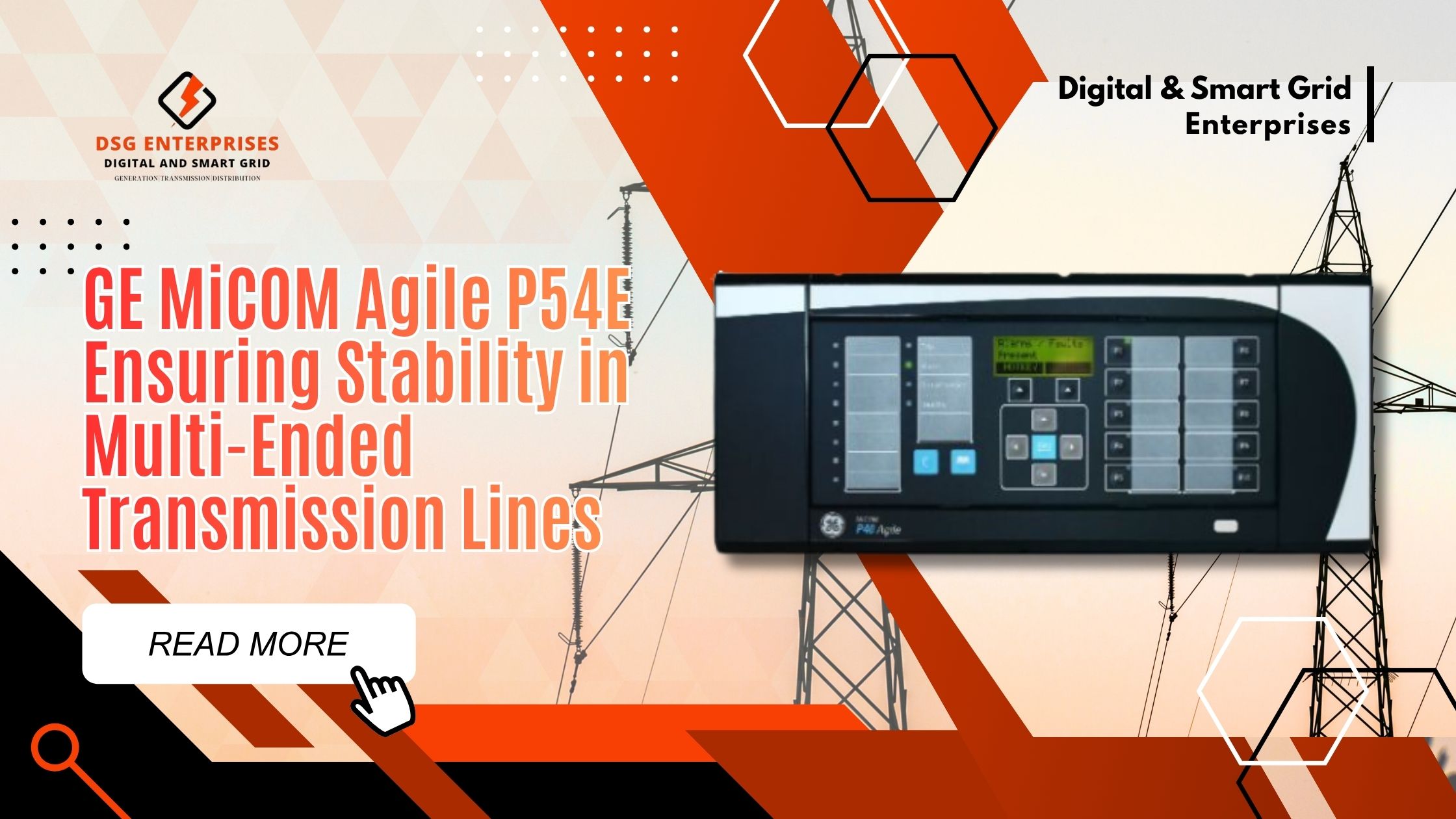
A transmission line fault that goes undetected for even a fraction of a second can collapse an entire power grid. In multi-ended networks where three or more substations share a single transmission line, that risk multiplies dramatically. Traditional distance protection relays simply weren’t designed to handle this complexity.
The GE Micom P54E Relay was built specifically for this challenge. It delivers fast, dependable protection for multi-ended and tapped transmission lines where conventional relays struggle. Furthermore, the GE Micom P54E Protection Relay uses advanced current differential technology to detect faults accurately regardless of how complex the network topology is. In this blog, we’ll explore exactly how this relay ensures stability in some of the most demanding transmission network configurations in the world.
What Makes Multi-Ended Transmission Lines So Difficult to Protect?
A standard two-ended transmission line is relatively straightforward to protect. Power flows in from one end and out the other. However, a multi-ended line has three or more connection points, and power can flow in from any direction depending on network conditions.
This creates serious challenges for conventional distance protection. Distance relays measure impedance to calculate how far away a fault is. However, in a multi-ended network, the feed from multiple sources distorts this measurement. Consequently, the relay may either fail to detect a real fault or trip incorrectly for a fault outside its protection zone.
Why multi-ended lines present unique protection challenges:
- Infeed effect: current from multiple sources changes the apparent impedance seen by the relay
- Outfeed effect: power flowing out of a tapped load point further distorts distance measurements
- Changing power flow directions: network switching changes which ends are feeding or receiving power
- High-resistance fault detection; resistive faults are difficult to detect accurately with impedance-based relays
- Coordination complexity: Setting multiple relays to coordinate correctly across all ends is extremely difficult
How the GE Micom P54E Protection Relay Solves These Challenges
The GE Micom P54E Protection Relay moves away from impedance-based distance protection entirely. Instead, it uses line current differential protection, a fundamentally different approach that compares currents at every end of the line simultaneously. As a result, it is immune to the infeed and outfeed effects that compromise distance protection in multi-ended networks.
In simple terms, the relay continuously adds up all the currents entering and leaving the protected line. Under healthy conditions, these currents balance perfectly. However, when a fault occurs inside the protected zone, the balance breaks and the relay trips instantly. This principle works equally well regardless of how many ends the line has.
Core protection functions of the relay:
- Multi-ended current differential protection: compares currents at all line ends simultaneously
- Phase-segregated differential; each phase monitored independently; enables accurate single-phase tripping
- Distance protection backup provides a secondary protection layer if communication is lost
- High-resistance fault detection; sensitive enough to detect faults through several hundred ohms of resistance
- Power swing detection: identifies and blocks unnecessary trips during stable power swings
Fast and Accurate Fault Detection for Transmission Stability
Speed is essential in transmission protection. A fault on a high-voltage transmission line lasting more than a few cycles can cause generators to lose synchronism and lead to cascading blackouts. Therefore, the GE MiCOM P54E relay is designed to clear in-zone faults in under 20 milliseconds.
Fault detection speed and stability features:
- Operating time below 20 ms minimizes fault energy and prevents generator instability
- Single-pole tripping and auto-reclose maintain power flow on healthy phases
- Three-phase auto-reclose restores a complete power supply after transient faults
- In-zone and out-of-zone fault discrimination avoids unwanted tripping outside the protected section
- Stable blocking during CT saturation prevents malfunction during transformer saturation
- Adaptive differential characteristics adjust relay sensitivity according to load current to avoid false trips
Fibre Optic Communication for Reliable Differential Protection
Current differential protection relies on reliable communication between line ends. Each relay terminal must receive real-time current data from all other terminals. Therefore, the communication channel is just as important as the protection algorithm itself. The GE MiCOM P54E Relay addresses this with a dedicated high-speed communication architecture.
The GE P54E Protection Relay uses fiber optic communication as its primary channel. In addition, dedicated inter-relay links ensure current data arrives with low and consistent latency. As a result, the differential calculation stays accurate even in demanding network conditions.
Communication and channel features:
- Dedicated fiber optic inter-relay links resist electromagnetic interference from switchgear
- GPS time synchronization aligns current samples from all line ends with microsecond accuracy
- The communication failure mode automatically switches to distance backup protection if the channel fails
- Supports direct fiber connections and multiplexed SDH/PDH networks for flexible installation
Advanced Monitoring, Diagnostics, and SCADA Integration
A transmission protection relay should provide more than fault tripping alone. The GE MiCOM P54E Relay offers continuous monitoring, detailed event recording, and seamless integration with SCADA and energy management systems. As a result, operators gain complete visibility into both relay performance and transmission line conditions.
In addition, the GE P54E Protection Relay records oscillography waveforms and sequence-of-events data for every fault and alarm. Therefore, engineers can perform faster and more accurate post-fault analysis. Furthermore, the relay generates automated reports to support compliance and audit requirements.
Monitoring, recording, and integration capabilities:
- Oscillography captures pre-fault and post-fault waveforms for every event
- Sequence-of-events logging timestamps, alarms, status changes, and trips with millisecond accuracy
- IEC 61850 GOOSE and MMS support enables seamless integration with modern substation automation systems
- Modbus and DNP3 compatibility support legacy SCADA and energy management systems
- Real-time current and power metering provides live transmission line loading data

Evaluating GE Micom P54E Protection Relay Price and Selecting a Supplier
Procuring a transmission protection relay is a significant investment. When evaluating the GE Micom P54E protection relay price, procurement teams must look beyond the unit hardware cost. A relay that protects a multi-ended 400kV transmission line is safeguarding assets worth hundreds of crores. Therefore, the GE Micom P54E protection relay price should always be assessed in the context of total risk and total value.
Equally important is selecting a trustworthy GE Micom P54E protection relay supplier partner. Genuine GE Micom P54E Protection Relay Suppliers provide factory-tested equipment, full technical documentation, commissioning support, and long-term spare parts availability. On the other hand, unverified sources risk delivering counterfeit products that fail exactly when the network needs them most.
What to verify when comparing GE Micom P54E protection relay prices and suppliers:
- Product authenticity: ask for GE factory test certificates and genuine product datasheets
- Complete system supply: genuine GE Micom P54E Protection Relay Suppliers provide relays, software, and communication hardware together
- Local commissioning support: insist on experienced protection engineers for site commissioning
- Firmware and software licenses: confirm all required software modules are included in the supply
- Availability of spare parts: long-term support is key for a relay protecting critical transmission infrastructure
Conclusion
The GE Micom P54E Relay sets a new standard for protection in multi-ended and tapped transmission line applications. Its current differential protection principle eliminates the infeed and outfeed problems that defeat conventional distance relays. Furthermore, its sub-20ms operating time, fiber optic communication, and seamless SCADA integration make it a complete solution for the most demanding transmission network configurations.
If you’re specifying protection for a multi-ended transmission line, the Micom P54E Protection Relay deserves to be at the top of your evaluation list. Partner with verified GE Micom P54E protection relay suppliers and assess the GE Micom P54E protection relay. Price carefully against the full scope of protection delivered, and invest in a relay that keeps your transmission network stable, safe, and reliable today and for decades to come.
At Digital & Smart Grid Enterprises, we deliver advanced transmission protection solutions with the GE MiCOM P54E Relay, designed to ensure stability and reliable fault management in multi-ended transmission lines. With high-speed distance protection, advanced communication features, and dependable performance, the P54E relay helps maintain grid security and operational continuity in complex power networks. Click here to inquire about the latest GE Micom P54E Relay price or discuss your transmission line protection requirements. Contact us at +91 7021624024 or email info@dsgeneterprises.in
Enhance the stability and reliability of your transmission network with expert guidance. Connect with our specialists today.