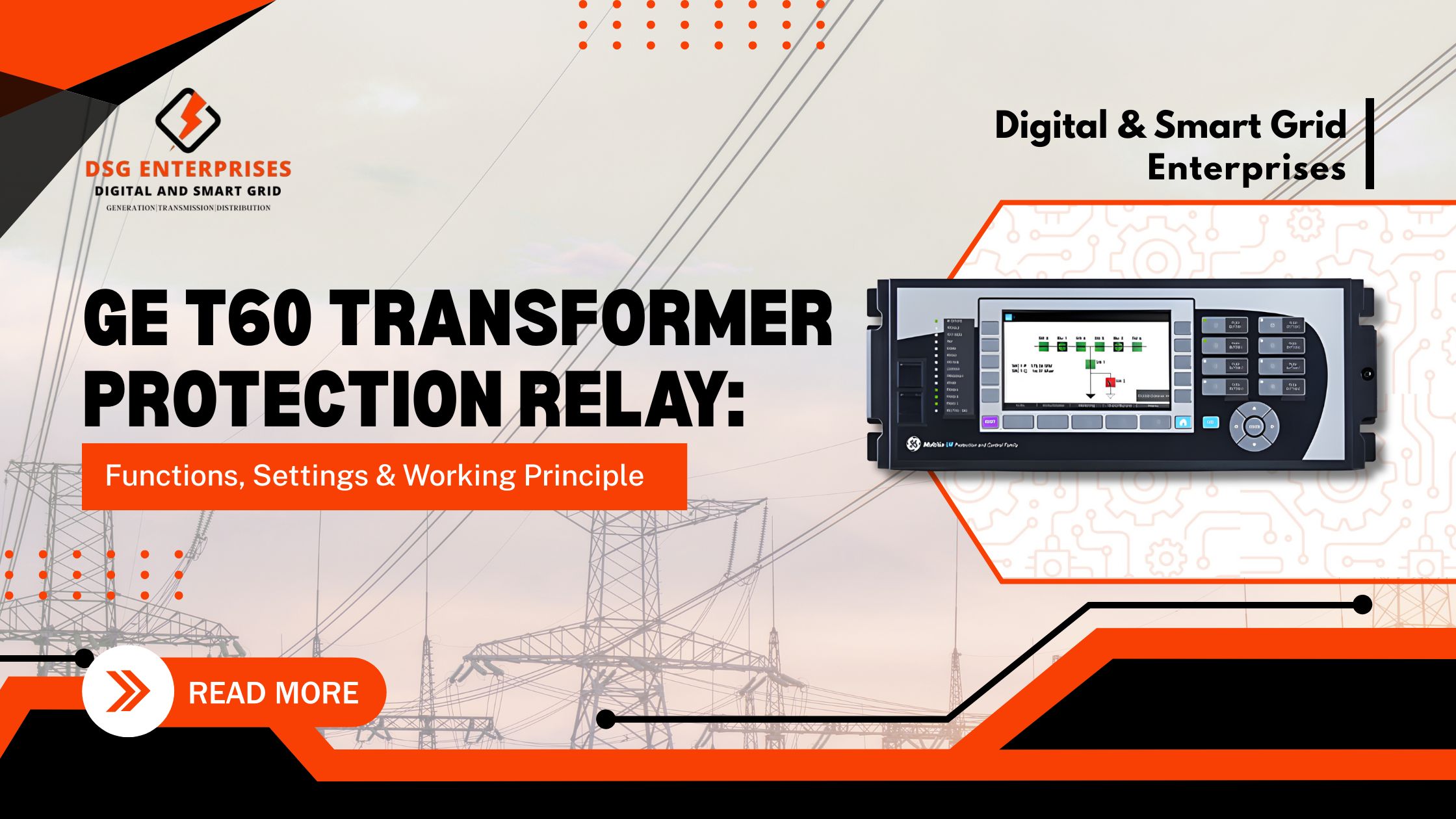
In the realm of power system protection, ensuring the safety and reliability of transformers is paramount. The GE T60 Transformer Protection Relay stands as a cutting-edge solution designed to safeguard critical transformer assets from various electrical faults and operational anomalies. This comprehensive guide explores the functions, settings, and working principles of this advanced protection system, helping engineers and facility managers make informed decisions about transformer protection.
Understanding the GE T60 Transformer Protection System
The GE T60 Transformer Protection System is a microprocessor-based relay that provides complete protection for power and distribution transformers. As part of GE’s Multilin T-Series family, the T60 offers superior performance, reliability, and flexibility for modern electrical infrastructure. This intelligent relay combines multiple protection functions in a single device, reducing installation complexity while enhancing overall system protection.
What Makes the GE T60 Stand Out?
The T60 relay represents a significant advancement in transformer protection technology. Unlike traditional electromechanical relays, this digital protection system offers:
- Multi-function capability: Integrates numerous protection, control, and monitoring functions
- Advanced communication protocols: Supports IEC 61850, Modbus, DNP3, and other industry-standard protocols
- Flexible I/O configuration: Adaptable to various transformer configurations and protection schemes
- Comprehensive event recording: Detailed fault analysis and system diagnostics
- User-friendly interface: Intuitive programming and monitoring capabilities
Key Functions of the GE T60 Transformer Protection Relay
The GE T60 Transformer Protection Relay incorporates a wide array of protection functions designed to detect and isolate transformer faults quickly and reliably:
Primary Protection Functions:
- Differential Protection (87T): The cornerstone of transformer protection, this function detects internal faults by comparing current entering and leaving the transformer, providing fast fault clearance for winding and core faults
- Restricted Earth Fault Protection (REF): Offers sensitive ground fault detection for transformer windings, particularly effective for detecting low-level ground faults that might escape differential protection
- Overcurrent Protection (50/51): Provides backup protection against phase and ground faults with instantaneous and time-delayed characteristics
- Thermal Overload Protection (49): Monitors transformer loading and prevents damage due to sustained overload conditions by tracking thermal capacity
Secondary Protection Functions:
- Buchholz Relay Input (63): Interfaces with gas-accumulation devices to detect internal faults involving oil decomposition
- Overvoltage and Undervoltage Protection (27/59): Protects against abnormal voltage conditions that could stress transformer insulation
- Frequency Protection (81O/U): Detects over-frequency and under-frequency conditions that indicate system instability
- Breaker Failure Protection: Initiates backup tripping when primary circuit breakers fail to operate
Advanced Monitoring Functions:
- Winding Temperature Monitoring: Continuously tracks oil and winding temperatures to prevent thermal damage
- On-Load Tap Changer (OLTC) Monitoring: Supervises tap changer operation and detects mechanical failures
- Dissolved Gas Analysis (DGA) Integration: Works with external DGA monitors to detect incipient faults through oil analysis
- Power Quality Monitoring: Records voltage, current, power factor, and harmonics for system analysis
Working Principle of the GE T60 Transformer Protection System
Understanding how the GE T60 Transformer Protection Relay operates is essential for proper implementation and maintenance:
Signal Acquisition and Processing:
The T60 continuously monitors voltage and current signals from instrument transformers (CTs and VTs) connected to the power transformer. These analog signals undergo several processing stages:
- Analog-to-Digital Conversion: High-speed ADCs sample incoming signals at precise intervals, converting analog waveforms to digital data
- Digital Filtering: Advanced algorithms remove noise and extract fundamental frequency components
- Phasor Calculation: The relay calculates magnitude and phase angle information for all monitored quantities
- Harmonic Analysis: FFT algorithms identify harmonic content for power quality assessment
Differential Protection Operation:
The differential protection algorithm, the heart of transformer protection, operates on the following principle:
- Current Comparison: The relay compares currents on the primary and secondary sides of the transformer after compensating for the transformer ratio and vector group
- Restraint Characteristics: Sophisticated restraint algorithms prevent false tripping during magnetizing inrush, CT saturation, and external faults
- Harmonic Blocking/Restraint: Second and fifth harmonic content analysis distinguishes between inrush conditions and internal faults
- Slope Characteristics: Dual or triple slope percentage differential characteristics provide security and sensitivity across wide current ranges
Decision Making and Tripping:
When fault conditions exceed preset thresholds:
- Logic Processing: Boolean logic evaluates all protection elements and their interdependencies
- Trip Signal Generation: Output contacts energize to trip the associated circuit breakers
- Event Recording: Detailed fault records capture pre-fault, fault, and post-fault data
- Communication: Alarm signals are transmitted to SCADA systems for operator awareness
Critical Settings and Configuration
Proper configuration of the GE T60 Transformer Protection System is crucial for reliable operation:
Differential Protection Settings:
- Pickup Current: Typically set between 0.15 to 0.3 pu of transformer rated current
- Slope Settings: Slope 1 usually 25-40%, Slope 2 around 50-80% for security against CT errors
- Harmonic Blocking Thresholds: Second harmonic blocking set at 15-20% for inrush discrimination
- CT Ratio and Compensation: Must match actual CT ratios and transformer vector group
Overcurrent Settings:
- Phase Overcurrent Pickup: Coordinated with downstream devices, typically 1.2-1.5x transformer rated current
- Ground Overcurrent Pickup: Set based on system grounding and fault current levels
- Time Delay Characteristics: Selected to coordinate with upstream and downstream protection
Voltage and Frequency Settings:
- Overvoltage Pickup: Usually 110-120% of nominal voltage with appropriate time delays
- Undervoltage Pickup: Typically 70-90% of nominal voltage
- Frequency Limits: Matched to system operating requirements and generator protection
GE T60 Transformer Protection Price Considerations
When evaluating the GE T60 Transformer Protection Price, several factors influence the overall investment:
Cost Components:
- Relay Hardware: Base relay price varies depending on model variant and I/O configuration
- Communication Modules: Additional cost for specific protocol cards and fiber optic interfaces
- Software Licenses: Some advanced features may require separate licensing
- Installation and Commissioning: Professional services for setup and testing
- Training: Operator and maintenance personnel training programs
Value Proposition:
While the initial GE T60 Transformer Protection Price may be higher than basic relays, the long-term value includes:
- Asset Protection: Prevents costly transformer failures and reduces downtime
- Reduced Maintenance: Self-diagnostic capabilities minimize periodic testing requirements
- System Integration: Native protocol support eliminates gateway costs
- Future-Proofing: Firmware updates extend the relay functionality over its lifetime
Selecting the Right GE T60 Transformer Protection Supplier
Choosing a qualified GE T60 Transformer Protection Supplier is as important as selecting the relay itself:
Supplier Evaluation Criteria:
- Authorized Distribution: Verify the supplier is an authorized GE Grid Solutions partner to ensure genuine products and factory support
- Technical Expertise: Assess the supplier’s engineering capabilities for application support and system integration
- After-Sales Support: Evaluate warranty terms, spare parts availability, and repair services
- Project Experience: Review the supplier’s track record with similar installations and industries
- Training Capabilities: Confirm availability of comprehensive training programs for operations and maintenance staff
Questions to Ask Your Supplier:
- Product Availability: Lead times and stock availability for standard configurations
- Customization Options: Ability to configure relays to specific application requirements
- Commissioning Support: On-site technical assistance for installation and startup
- Documentation: Completeness of manuals, setting guides, and application notes
- Software Tools: Access to relay programming and analysis software
Installation and Commissioning Best Practices
Successful implementation of the GE T60 Transformer Protection Relay requires careful attention to installation details:
Pre-Installation Verification:
- Relay Inspection: Check for shipping damage and verify model number matches specifications
- CT and VT Verification: Confirm instrument transformer ratios, polarity, and burden compatibility
- Panel Integration: Ensure proper mounting, wiring, and environmental protection
- Power Supply: Verify auxiliary power meets relay requirements for voltage and capacity
Commissioning Steps:
- Primary Injection Testing: Verify CT circuits, polarity, and current transformer ratio corrections
- Secondary Injection Testing: Validate all protection functions using relay test sets
- Communication Testing: Confirm protocol configuration and SCADA integration
- Settings Verification: Document all settings and verify against protection studies
- Functional Testing: Perform end-to-end testing of trip circuits and alarm outputs
Maintenance and Troubleshooting
Regular maintenance ensures the GE T60 Transformer Protection System continues to perform reliably:
Routine Maintenance Activities:
- Visual Inspection: Check for loose connections, display functionality, and alarm indicators
- Self-Test Monitoring: Review relay diagnostics for any internal alarms or warnings
- Event Log Analysis: Periodically download and analyze event records for system disturbances
- Firmware Updates: Apply manufacturer-recommended firmware upgrades for enhanced functionality
- Battery Replacement: Replace internal battery per manufacturer recommendations (typically 5-10 years)
Common Issues and Solutions:
- False Differential Trips: Review CT matching, compensation settings, and harmonic blocking thresholds
- Communication Failures: Verify network configuration, cable integrity, and protocol settings
- Incorrect Measurements: Check CT/VT connections, polarity, and ratio settings
- Display or Interface Problems: Restart relay, check connections, or contact technical support
Conclusion
The GE T60 Transformer Protection Relay represents a sophisticated, reliable solution for safeguarding critical transformer assets in modern power systems. Its comprehensive protection functions, advanced communication capabilities, and flexible configuration options make it an excellent choice for utilities, industrial facilities, and commercial installations.
Understanding the relay’s functions, working principles, and proper settings enables protection engineers to maximize its effectiveness while minimizing false operations. When sourcing the device, working with a qualified GE T60 Transformer Protection Supplier ensures proper application support, competitive GE T60 Transformer Protection Price, and long-term technical assistance.
We, Digital and Smart Grid Enterprises, are the leading GE Transformer Protection Systems Suppliers, traders, and exporters in India. The Transformer Protection System from GE offers cutting-edge solutions for transformer asset protection, control, and monitoring. Transformers have become a necessary component for high-voltage power transmission, guaranteeing that long-distance power transmission is cost-effective. GE’s transformer protection solutions improve transformer dependability by using advanced techniques and approaches to extend transformer life. For GE T60 Transformer Protection prices or product inquiries, you can reach us at +91 7021624024 or email info@dsgenterprises.in. With strong technical expertise, our team supports you at every step from selecting the right product to providing complete after-sales assistance. Explore our full range of products by clicking here for more details