
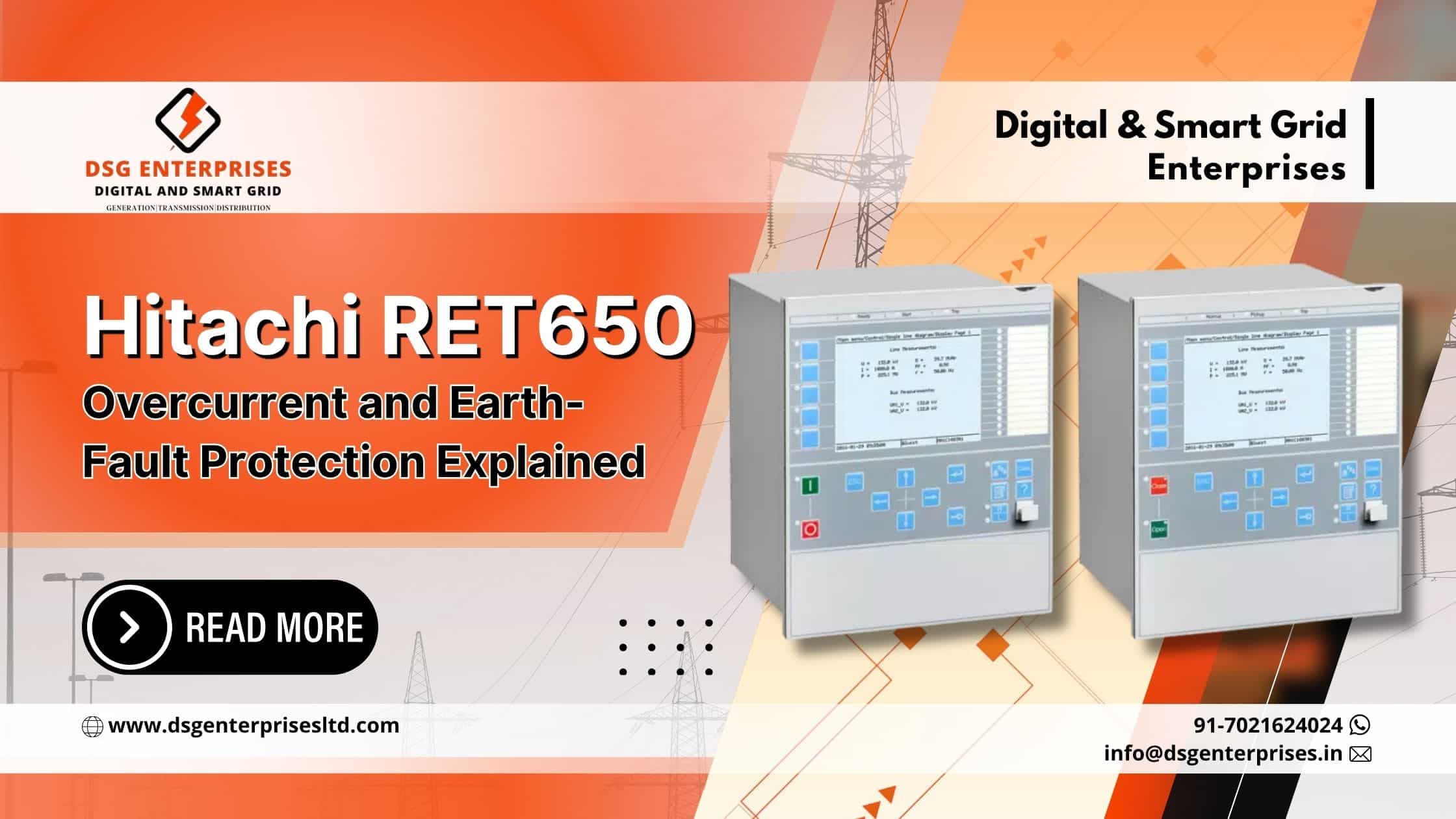
A transformer is one of the costliest assets in any substation. When a fault hits it, the damage spreads fast, so you need a relay that reacts in the right way at the right time. The Hitachi RET650 Protection Relay is built for that job.
This guide explains how the RET650 handles overcurrent and earth-fault protection. We use simple words and short sentences, so both new and experienced engineers can follow along.
What Is the Hitachi RET650 Protection Relay?
The Hitachi RET650 Protection Relay is a transformer protection and control device from Hitachi Energy’s Relion 650 series. It protects two-winding power transformers and also supports reactors and other similar equipment.
Engineers often call it the RET650 Numerical Relay. A numerical relay reads current and voltage signals, converts them to digital data, and runs protection logic in software. This design is more accurate and more flexible than older electromechanical relays.
In short, the Hitachi RET650 Relay does three jobs in one box:
- Protects: It detects faults and trips the circuit breaker.
- Monitors: It records events, disturbances, and measured values.
- Controls: It supports breaker control and communicates with the substation system.
Why Overcurrent and Earth-Fault Protection Matter
Transformers face many kinds of faults. Two of the most common are overcurrent and earth faults.
- Overcurrent: Current rises above the safe level because of a short circuit or an overload.
- Earth fault: A phase conductor touches the ground or the transformer body, so current flows through an unwanted path.
Both faults create heat and mechanical stress. If you ignore them, insulation breaks down, windings burn, and the outage grows. Therefore, fast and selective protection is not optional. It is essential.
How the RET650 Handles Overcurrent Protection
The RET650 offers phase overcurrent protection that acts as a backup to the main transformer protection. Here is how it works in simple terms.
The relay measures the current in each phase all the time. If the current crosses a set limit and stays there for a set time, the relay sends a trip command to the breaker.
Key Features of Overcurrent Protection
- Multiple steps: You can set several stages, each with its own current level and time delay. This lets you trip fast for severe faults and slowly for mild ones.
- Definite time and inverse time curves: You pick a fixed delay or a curve where higher current gives a faster trip. Standard IEC and ANSI curves are available.
- Directional control: Where fault current can flow in both directions, the relay checks direction so it trips only for faults on the protected side.
- Harmonic restraint: The relay can tell inrush current from a real fault, so it avoids false trips when you energize the transformer.
- Instantaneous stage: A high-set stage clears very large faults with almost no delay.
A Simple Example
Imagine a transformer feeding a busy industrial plant. A short circuit happens on a downstream feeder, but the feeder relay fails to clear it. The overcurrent stage in the RET650 sees the high current, waits through its time delay, and then trips the transformer breaker. The plant loses power, but the transformer survives.
How the RET650 Handles Earth-Fault Protection
Earth faults often produce smaller currents than phase-to-phase faults. Consequently, they can slip past normal overcurrent settings. The RET650 solves this with dedicated earth-fault functions.
Main Earth-Fault Functions
- Residual overcurrent protection: The relay measures the residual (neutral) current and trips when it passes a set limit. It supports multiple steps and time curves, just like phase overcurrent.
- Directional earth-fault protection: The relay compares the direction of earth-fault current to decide whether the fault sits inside or outside the protected zone.
- Restricted earth-fault protection (REF): This function guards the transformer winding against ground faults close to the neutral point. It is fast, sensitive, and very selective.
- Sensitive earth-fault protection: In systems with high-impedance grounding, fault current stays tiny. The relay can pick up even these low currents.
Why Restricted Earth Fault Is a Big Deal
A standard differential function may miss faults near the winding’s neutral end because the current change is so small. Restricted earth-fault protection fills that gap. As a result, you catch ground faults that would otherwise stay hidden and cause more serious damage.
Settings Tips for Better Performance
Good hardware needs good settings. Follow these simple tips when you configure your Hitachi RET650 Protection Relay.
- Start with a short-circuit study: Know the fault levels at your site before you pick any pickup value.
- Coordinate with upstream and downstream relays: Keep time gaps between devices so only the closest relay to the fault trips.
- Set inrush restraint carefully: Test your values against real energization conditions.
- Match the grounding system: Solidly grounded and resistance-grounded networks need different earth-fault settings.
- Test after every change: Run secondary injection tests and review the disturbance records.
Moreover, document every setting. Clear records save hours when you review or troubleshoot later.
Communication and Integration Benefits
The RET650 Numerical Relay supports the IEC 61850 standard, which makes it easy to connect with modern substation automation systems. You can send trip signals through GOOSE messages, share data with SCADA, and use one engineering tool to configure the whole relay.
Additionally, built-in disturbance recording helps you study each fault. You see exactly what current flowed, when the relay picked up, and when it tripped. This evidence improves future settings and speeds up root-cause analysis.
Benefits of Using the Hitachi RET650 Relay
- High reliability: Strong self-supervision checks the relay’s own health.
- Flexible protection: One device covers overcurrent, earth-fault, differential, and other functions.
- Simple engineering: A graphical tool helps you build and test logic with less effort.
- Future-ready design: Digital communication fits both new and upgraded substations.
- Lower maintenance: Fewer separate devices means fewer parts to test and replace.
Conclusion
Overcurrent and earth-fault protection form the backbone of transformer safety. The Hitachi RET650 Protection Relay brings both together in one smart, flexible device. It detects faults fast, avoids false trips, and gives you clear data after every event.
If you plan a new substation or upgrade an old one, review the RET650 closely. Match its settings to your network, test it well, and it will protect your transformer for years. For pricing or inquiries, feel free to contact us at +91 7021624024 or email info@dsgenterprises.in. Our experienced technical team is here to guide you at every stage, from choosing the right product to ensuring reliable after-sales support. Click here to explore our complete range of products and learn more.