
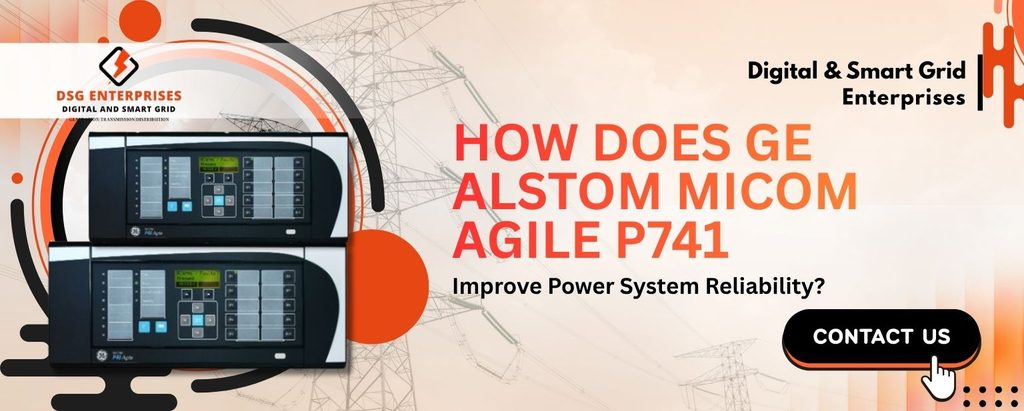
A single busbar fault can black out an entire substation in milliseconds. That is why protection engineers trust the GE MiCOM P741 Relay to isolate faults fast.
The GE MiCOM P741 Relay protects busbars at every voltage level. It combines centralized and distributed protection logic in one platform. The relay clears faults in less than one cycle, regardless of fault current or topology. This speed limits equipment damage and keeps the rest of the grid stable.
Busbar protection sits at the heart of every substation. When a bus fault goes undetected, the outage can spread across many feeders. As a result, utilities and EPC contractors across India increasingly specify this relay for new substations and aging retrofits. This guide covers how the relay works, what it costs, and how to choose a dependable supplier.
What Makes the GE MiCOM P741 Relay Essential for Busbar Protection?
Busbar protection relays must be fast, secure, and adaptable. The GE MiCOM P741 Relay meets all three needs through its distributed architecture.
A busbar relay is a device that monitors current flowing into and out of a substation bus. It is essential because it stops internal faults from spreading. Without it, one internal fault could trip an entire substation instead of a single feeder circuit.
The P741 platform is part of the wider Agile P74x series. It works alongside the P742 and P743 peripheral units. Together, they cover both greenfield projects and brownfield retrofits across India’s growing power network. This flexible scheme can:
- Protect up to 28 terminals across eight differential zones (three-phase);
- Support solidly grounded, impedance grounded, Petersen coil grounded, and isolated systems;
- Operate as either a centralized or fully distributed scheme, based on site needs.
How Does the GE Alstom P741 Busbar Relay Detect and Clear Faults?
Speed and security often work against each other in protection design. However, the GE Alstom P741 Busbar relay balances both through dynamic topology processing.
High fault currents demand fast clearing to limit equipment damage. Tripping incorrectly for an external fault, though, can cause large, unnecessary outages. Therefore, the relay reads substation topology continuously before it commands a trip.
Key detection capabilities include:
- CT saturation detection, which prevents misoperation during heavy fault currents;
- A fast-reset circuit breaker failure element, resetting in under one cycle;
- Constant tripping time, independent of fault current or feeder count;
- Dynamic topology processing, which updates zones as switches open and close.
Why does this matter for reliability? Consistent, sub-cycle tripping keeps fault damage contained. It also protects nearby transformers and switchgear from added mechanical and thermal stress. This blend of speed and security is what makes the GE Alstom P741 Busbar relay dependable in the field.
Field engineers also value the relay’s self-monitoring functions. Continuous supervision of CT circuits, binary inputs, and fiber links flags wiring problems before they cause a missed trip. This proactive monitoring reduces unplanned downtime. It also helps maintenance teams plan inspections around real equipment condition, not just a fixed calendar schedule.
Key Features and Benefits of the GE MiCOM P741 Relay
Beyond raw speed, the GE MiCOM P741 Relay offers benefits that simplify installation and long-term maintenance.
Fiber-optic links connect the central and peripheral units, not copper cable. Consequently, engineers avoid electromagnetic interference, touch potential, and step potential risks. Many GE-branded models also skip internal batteries; this removes a maintenance item and eases shipping logistics.
Notable benefits include:
- Free scheme configuration and monitoring software, at no extra licensing cost;
- Advanced binary inputs that meet strict surge-withstand and ESI 48-4 EB2 standards;
- Immunity to spurious wiring pickup, switching noise, and induction from parallel circuits;
- Reduced cabling between the switchyard and control room, cutting civil costs.
What does this mean for procurement teams and plant managers? Fewer site visits and simpler commissioning lower lifecycle costs over time. These design choices make the relay a sound long-term investment for growing substations.
The free configuration software also shortens engineering time during panel testing. Engineers can build, simulate, and verify a scheme offline before energizing the busbar on site. That practice catches wiring or logic errors early, well before commissioning day. As a result, outage windows stay short and predictable for the grid operator.
GE P741 Relay Price and Total Cost of Ownership
Budget planning is often the first question procurement managers ask. GE P741 Relay Price depends heavily on configuration; a standalone central unit costs less than a full distributed scheme.
When evaluating GE P741 Relay Price, look past the sticker figure alone. Furthermore, factor in installation, commissioning support, and spare-parts availability over the relay’s service life.
As a supplier of GE and Alstom protection relays in India, we help customers match quotes to real project needs. This avoids paying for zones or terminals a substation will never use. A distributed scheme costs more upfront. On the other hand, it can cut cabling and civil work sharply, lowering total installed cost.
Voltage class and terminal count both shape the final number too. A 33 kV distribution bus with six feeders needs a smaller scheme. A 220 kV transmission bus with 28 terminals needs a much larger one. Tender specifications often bundle commissioning and training into the contract value. That bundling can make one quote look higher than another. Even so, both quotes may cover the same scope of work and equipment quality.
An early, accurate quote helps utilities and EPC contractors budget substation upgrades with real confidence. It also helps avoid last-minute change orders once a tender is already underway.
Finding Reliable GE P741 Relay Suppliers in India
Why does supplier choice matter so much here? Choosing among GE P741 Relay Suppliers affects delivery timelines and after-sales service quality directly.
Not every supplier stocks genuine GE and Alstom parts. Some only source relays on request after an order lands. As a result, project timelines can slip when stock or expertise is missing. When shortlisting GE P741 Relay Suppliers, ask these practical questions:
- Does the supplier hold genuine GE/Alstom stock, or source on request only?
- Can they provide commissioning support and relay configuration training?
- What is their typical lead time for spare peripheral units?
- Do they offer type-test certificates and warranty support for audits?
Reliable suppliers also help with panel integration and protocol setup during commissioning. Working with an experienced supplier reduces project delays and eases long-term maintenance for operations teams.
Ask about training programs too. A supplier that trains site engineers on the free configuration software builds internal capability within the utility. This reduces reliance on the supplier for routine scheme changes later. Their deeper expertise stays available for larger upgrades or fault investigations when the utility needs it.
A good supplier relationship outlasts the initial purchase order. Relays stay in service for decades. Ongoing access to firmware updates, calibration support, and replacement modules matters as much as the first delivery. Utilities that build a lasting relationship with one trusted supplier often see faster response during emergency outages. The supplier already understands their specific substation configuration, which speeds up troubleshooting considerably.
Conclusion
The GE MiCOM P741 Relay combines sub-cycle tripping, flexible architecture, and fiber-based communication. Together, these features keep busbars protected under demanding fault conditions. A project may need a centralized scheme or a fully distributed setup across 28 terminals. Either way, it adapts to real substation requirements. The result is measurably better power system reliability for utilities, EPC contractors, and plant operators alike.
If you are comparing GE P741 Relay Price options or evaluating GE P741 Relay Suppliers, request a project-specific quote first. A properly configured GE Alstom P741 Busbar relay setup will protect your substation for years to come. Genuine parts and strong commissioning support make that long-term reliability possible from day one.
Looking to buy GE Alstom MiCOM Agile P741 for reliable power system protection? Digital and Smart Grid Enterprises offers GE Alstom MiCOM Agile P741 protection solutions for applications requiring dependable feeder and power system protection. For GE Alstom MiCOM Agile P741 pricing, availability, and technical assistance, contact us at +91 7021624024 or email info@dsgenterprises.in. Our expert team can help you select the right relay for your application and provide support from product selection to after-sales service. Click here to know more about the GE Busbar Protection System and meet your protection requirements.