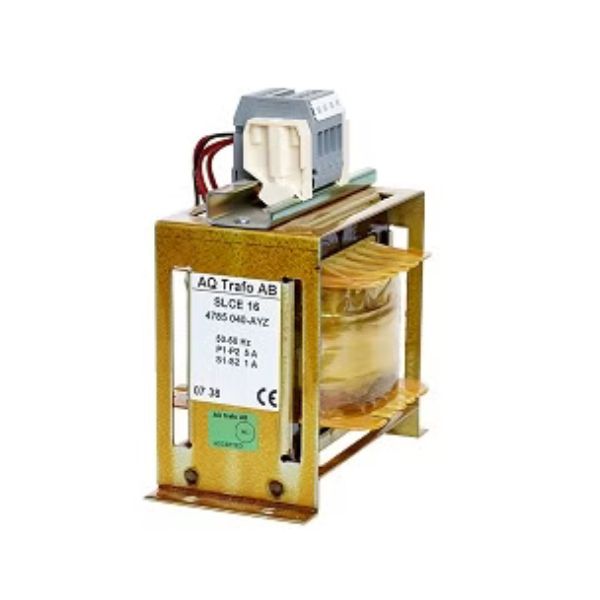
Auxiliary Current Transformers
Description
Transformers – Auxiliary Current Transformers
Auxiliary current transformers (CTs) play an important role in protective relaying circuits across various applications. They adjust secondary current levels to match the requirements of protective relays. Typically, an auxiliary CT uses one primary input winding and one secondary winding to supply the required current to the relay.
Additionally, auxiliary CTs can supply a single-phase relay with the vector sum of three-phase-to-neutral currents from the main CTs. This arrangement allows engineers to combine two or more AC currents and transform their sum into a single secondary current. Therefore, auxiliary CTs support various protection, relaying, and measuring applications.
Another important advantage of auxiliary CTs is electrical isolation between primary and secondary current circuits. This isolation also helps increase the insulation level between current circuits. For example, the standard insulation level of SLCE and SLXE auxiliary CTs undergoes factory testing at 2.5 kV for one minute. Manufacturers test the insulation both between windings and between windings and ground.
For applications involving the RADHL pilot-wire differential relay, engineers can choose a special SLCE 8 auxiliary CT version with 15 kV insulation for pilot wires. Furthermore, another SLCE 8 version serves as a three-phase summation CT with RADHL. Engineers can refer to the RADHL data sheet for the SLCE 8 dimensions.
Moreover, multi-tapped SLCE 12 auxiliary CTs help match different CT ratios. For instance, engineers can use them with RADSB and other transformer differential relays. Meanwhile, the larger SLCE 16 and SLXE 4 models provide additional iron capacity. Consequently, they can handle applications with higher relay circuit loads.
Manufacturers have also tested the standardized winding versions for compatibility with specific protection products. These include the RADSB, RADSC, RADS, and REB 100 series of transformer and busbar differential relays.
Finally, users can request auxiliary CTs with alternative ratios or specific electrical characteristics to meet their application requirements. This flexibility makes them suitable for a wider range of protection and measurement systems.